

This physics problem tests your understanding of fundamental physical laws and their applications. The step-by-step solution below breaks down the problem using relevant equations and physical reasoning.
ScanSolve AI Answer
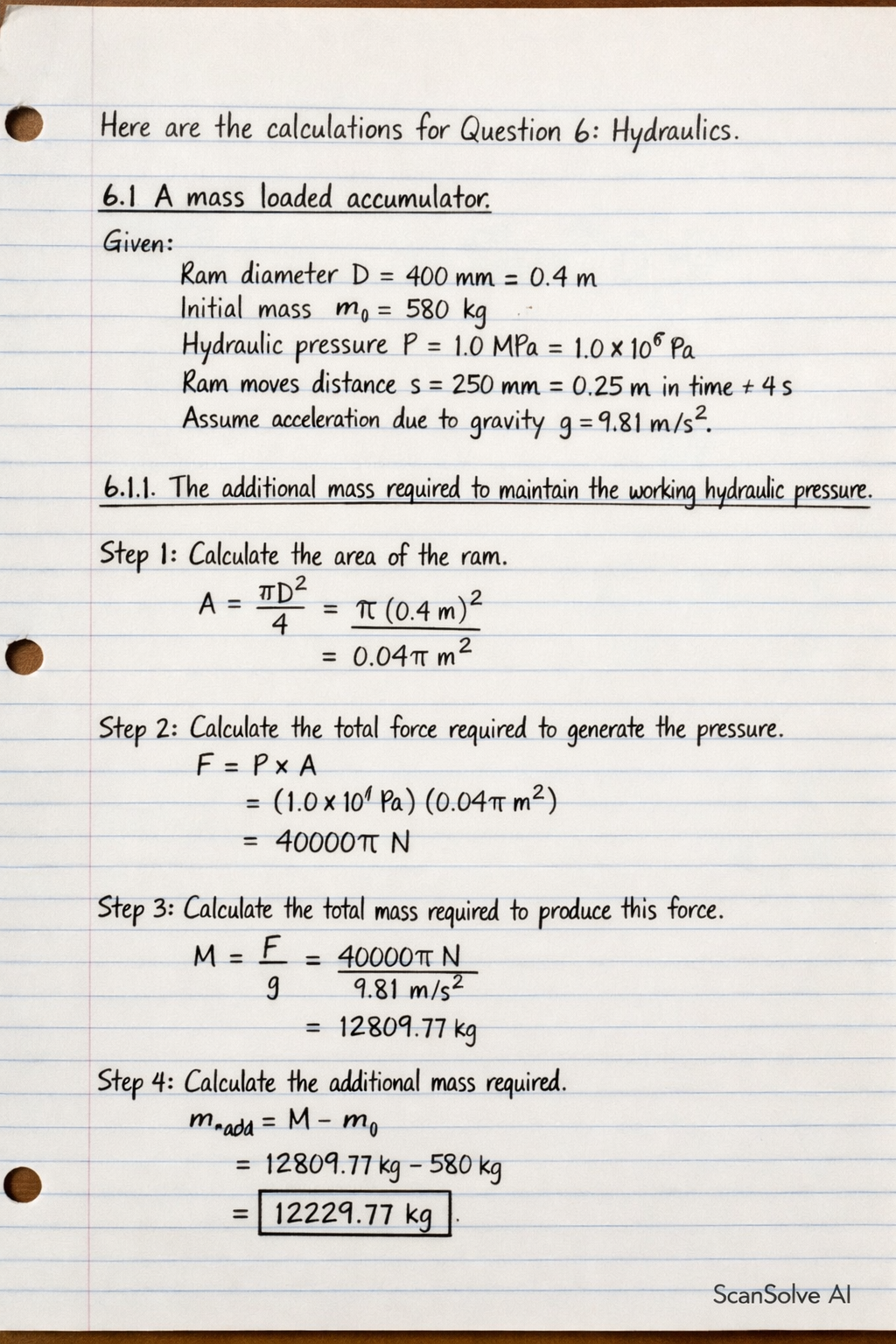
Here are the calculations for Question 6: Hydraulics. 6.1 A mass loaded accumulator Given: Ram diameter D = 400 mm = 0.4 m Initial mass m_0 = 580 kg Hydraulic pressure P = 1.0 MPa = 1.0 × 10^6 Pa Ram moves distance s = 250 mm = 0.25 m in time t = 4 s Assume acceleration due to gravity g = 9.81 m/s^2. 6.1.1 The additional mass required to maintain the working hydraulic pressure. Step 1: Calculate the area of the ram. A = ( D^2)/(4) = (0.4 m)^24 = 0.04 m^2 Step 2: Calculate the total force required to generate the pressure. F = P × A = (1.0 × 10^6 Pa) × (0.04 m^2) = 40000 N Step 3: Calculate the total mass required to produce this force. M = (F)/(g) = 40000 N9.81 m/s^2 ≈ 12809.77 kg Step 4: Calculate the additional mass required. m_add = M - m_0 = 12809.77 kg - 580 kg = 12229.77 kg 6.1.2 The work done by the ram in the working stroke. Step 1: Use the force calculated in 6.1.1. F = 40000 N Step 2: Calculate the work done. W = F × s = (40000 N) × (0.25 m) = 10000 J = 31415.93 J 6.1.3 The power transmitted by the ram during the working stroke. Step 1: Use the work done calculated in 6.1.2. W = 10000 J Step 2: Calculate the power transmitted. P_transmitted = (W)/(t) = 10000 J4 s = 2500 W = 7853.98 W 6.2 The plunger of a three-cylinder water pump Given: Number of cylinders N = 3 Plunger diameter d = 80 mm = 0.08 m Stroke length L = 200 mm = 0.2 m Delivery pressure P = 820 kPa = 820 × 10^3 Pa 6.2.1 The power required to drive the pump at 180 r/min if the overall efficiency is 88\%. Step 1: Calculate the area of one plunger. A_plunger = ( d^2)/(4) = (0.08 m)^24 = 0.0016 m^2 Step 2: Calculate the theoretical flow rate of the pump. Assuming a single-acting pump, the number of strokes per second for each cylinder is 180 r/min / 60 s/min = 3 s^-1. Q_theoretical = N × A_plunger × L × N_rpm60 Q_theoretical = 3 × (0.0016 m^2) × (0.2 m) × (3 s^-1) = 0.00288 m^3/s Step 3: Calculate the output power of the pump. P_out = P × Q_theoretical = (820 × 10^3 Pa) × (0.00288 m^3/s) = 2361.6 W Step 4: Calculate the input power required, considering the efficiency. P_in = P_out = 2361.6 W0.88 = 8430.68 W 6.2.2 The volume of water delivered per minute in litres, if the pump has a slip of 5\%. Step 1: Calculate the theoretical flow rate in m^3/min. Q_theoretical, min = Q_theoretical × 60 s/min = (0.00288 m^3/s) × 60 = 0.1728 m^3/min Step 2: Calculate the actual flow rate considering a slip of 5\%. Q_actual, min = Q_theoretical, min × (1 - slip) Q_actual, min = (0.1728 m^3/min) × (1 - 0.05) = 0.16416 m^3/min Step 3: Convert the actual flow rate to litres per minute. Q_actual, litres/min = Q_actual, min × 1000 litres/m^3 Q_actual, litres/min = (0.16416 m^3/min) × 1000 = 515.69 litres/min 6.3 A hydraulic press Given: Ram diameter D_ram = 90 mm = 0.09 m Plunger diameter d_plunger = 18 mm = 0.018 m Plunger stroke L_plunger = 35 mm = 0.035 m Mechanical advantage of lever MA_lever = 10 6.3.1 The force required to lift a 4-ton load if the efficiency of the press is 80\%. Step 1: Calculate the force exerted by the 4-ton load. F_load = 4 tons × 1000 kg/ton × 9.81 m/s^2 = 4000 kg × 9.81 m/s^2 = 39240 N Step 2: Calculate the area of the ram and the plunger. A_ram = D_ram^24 = (0.09 m)^24 = 0.002025 m^2 A_plunger = d_plunger^24 = (0.018 m)^24 = 0.000081 m^2 Step 3: Calculate the theoretical force on the plunger. The pressure in the system is P = F_loadA_ram. The theoretical force on the plunger is F_plunger, theoretical = P × A_plunger. F_plunger, theoretical = F_load × A_plungerA_ram = 39240 N × 0.000081 m^20.002025 m^2 F_plunger, theoretical = 39240 N × (0.000081)/(0.002025) = 39240 N × (1)/(25) = 1569.6 N Step 4: Calculate the actual force on the plunger, considering the efficiency of 80\%. F_plunger, actual = F_plunger, theoretical = 1569.6 N0.80 = 1962 N Step 5: Calculate the input force required on the lever, considering its mechanical advantage of 10. F_input = F_plunger, actualMA_lever = 1962 N10 = 196.2 N 6.3.2 The number of strokes required to raise the load 180 mm if the hydraulic system has a slip of 4\%. Step 1: Calculate the volume displaced by one theoretical plunger stroke. V_plunger, theoretical = A_plunger × L_plunger = (0.000081 m^2) × (0.035 m) = 0.000002835 m^3 Step 2: Calculate the volume required to lift the ram by 180 mm. H_ram = 180 mm = 0.18 m V_ram = A_ram × H_ram = (0.002025 m^2) × (0.18 m) = 0.0003645 m^3 Step 3: Calculate the actual volume delivered per plunger stroke, considering a slip of 4\%. V_plunger, actual = V_plunger, theoretical × (1 - slip) V_plunger, actual = (0.000002835 m^3) × (1 - 0.04) = 0.0000027216 m^3 Step 4: Calculate the number of strokes required. n_actual = V_ramV_plunger, actual = 0.0003645 m^30.0000027216 m^3 = 133.928... Since the number of strokes must be a whole number to achieve the desired lift, we round up. n_actual = 134 strokes Drop the next question.