

This physics problem tests your understanding of fundamental physical laws and their applications. The step-by-step solution below breaks down the problem using relevant equations and physical reasoning.
ScanSolve AI Answer
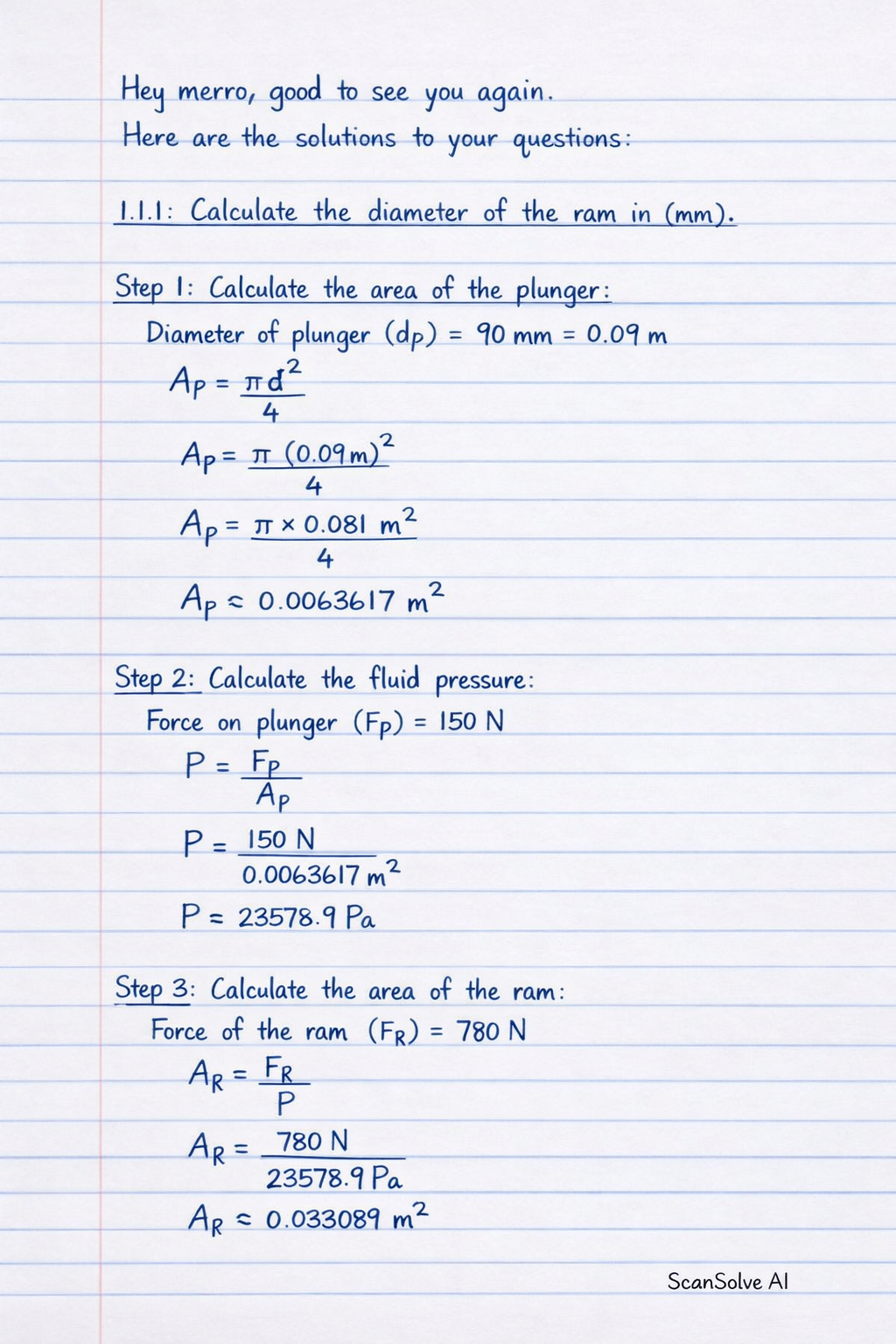
Here are the solutions to your questions: 1.1.1 Calculate the diameter of the ram in (mm). Step 1: Calculate the area of the plunger. The diameter of the plunger (d_P) is 90 mm, which is 0.09 m. The area of the plunger (A_P) is given by the formula A = ( d^2)/(4). A_P = (0.09 m)^24 = × 0.0081 m^24 ≈ 0.0063617 m^2 Step 2: Calculate the fluid pressure. The force on the plunger (F_P) is 150 N. The fluid pressure (P) is given by P = (F_P)/(A_P). P = 150 N0.0063617 m^2 ≈ 23578.9 Pa Step 3: Calculate the area of the ram. The force developed by the ram (F_R) is 780 N. According to Pascal's principle, the pressure is uniform throughout the fluid, so the pressure on the ram is also P. The area of the ram (A_R) is given by A_R = (F_R)/(P). A_R = 780 N23578.9 Pa ≈ 0.033089 m^2 Step 4: Calculate the diameter of the ram and convert to millimeters. The diameter of the ram (d_R) is given by d_R = sqrt((4 A_R)/()). d_R = sqrt(4 × 0.033089 m)^2 = sqrt(0.04218 m)^2 ≈ 0.20538 m Converting to millimeters: d_R = 0.20538 m × 1000 mm/m ≈ 205.38 mm The diameter of the ram is 205.38 mm. 1.1.2 Calculate the fluid pressure. The fluid pressure was calculated in Step 2 of 1.1.1. P ≈ 23578.9 Pa The fluid pressure is 23578.9 Pa. 1.2 Calculate the number of teeth of gear Y. Step 1: Identify the gear ratios for each meshing pair. For gears W and X: (N_X)/(N_W) = (T_W)/(T_X) For gears Y and Z: (N_Z)/(N_Y) = (T_Y)/(T_Z) Step 2: Relate the speeds of the compound shaft. Gears X and Y are on the same shaft, so their rotational speeds are equal: N_X = N_Y. Step 3: Combine the equations to solve for T_Y. We know N_W = 1800 r/min (input speed) and N_Z = 25 r/min (output speed). From the gear ratio equations: N_X = N_W (T_W)/(T_X) N_Y = N_Z (T_Z)/(T_Y) Since N_X = N_Y: N_W (T_W)/(T_X) = N_Z (T_Z)/(T_Y) Rearrange to solve for T_Y: T_Y = (N_Z × T_Z × T_X)/(N_W × T_W) Step 4: Substitute the given values and calculate T_Y. N_W = 1800 r/min N_Z = 25 r/min T_W = 20 teeth T_X = 120 teeth T_Z = 160 teeth T_Y = 25 r/min × 160 teeth × 120 teeth1800 r/min × 20 teeth T_Y = (480000)/(36000) = 13.333... Since the number of teeth must be a whole number, there might be a slight rounding in the problem's given speeds or teeth counts, or it implies a non-integer ratio. However, in practical gear design, teeth are integers. If we assume the values are exact, the result is not an integer. Let's recheck the calculation. 25 × 160 × 120 = 480000 1800 × 20 = 36000 480000 / 36000 = 480 / 36 = 40 / 3 = 13.333... It's possible the problem expects a rounded answer or there's an error in the problem statement's numbers. Given that teeth must be integers, I will provide the exact fraction and note the non-integer result. However, if this is a multiple choice question, I would look for the closest integer. Assuming it expects an exact calculation: T_Y = (40)/(3) teeth The number of teeth of gear Y is 13.33. 1.3 Name the measuring equipment used to measure each of the following in electrical circuits: 1.3.1 Potential difference A voltmeter is used to measure potential difference. 1.3.2 Resistance An ohmmeter is used to measure resistance. Drop the next question. 📸