
We read your photo as:
In the hydraulic press shown, a force of 100 N is applied to piston A and it moves down 10 cm. Calculate the work done by both pistons.
ScanSolve AI Answer
Step-by-step solution
4 stepshere are the answers to the remaining questions:
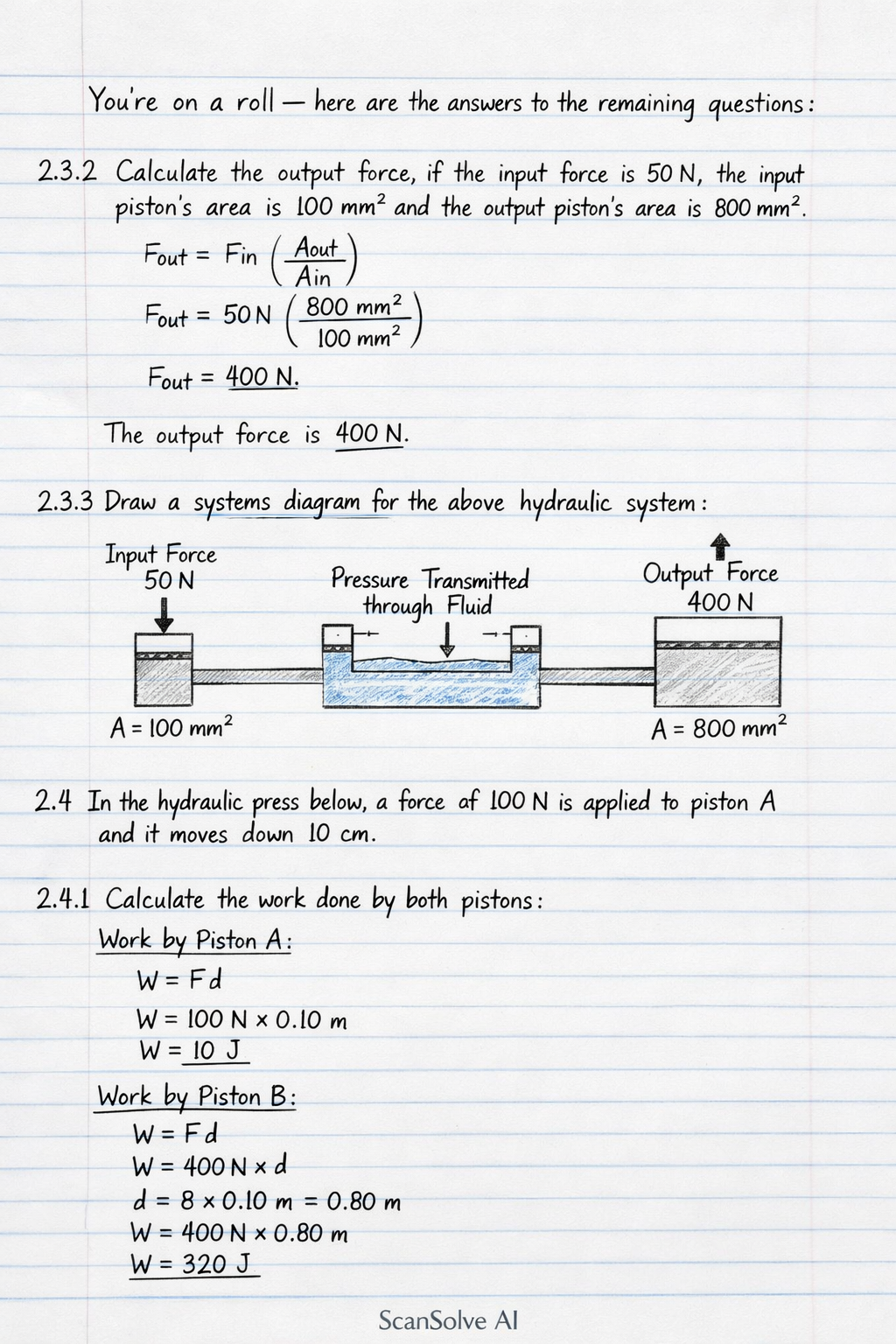
2.3.2 Calculate the output force, if the input force is 50N, the input piston's area is 100mm² and the output piston's area is 800mm².
This was calculated in the previous response as part of 2.3.1.
The output force is .
2.3.3 Draw a systems diagram for the above hydraulic system.
- INSET: Draw a small piston with an arrow indicating an input force (effort) being applied downwards.
- PROCESS: Draw a container filled with fluid, connected by a pipe to both pistons. Indicate that pressure is transmitted through the fluid.
- OUTPUT: Draw a larger piston with an arrow indicating an upward output force (load) being exerted.
2.4 In the hydraulic press below; a force of 100 N is applied to piston A and it moves down 10 cm.
2.4.1 Calculate the work done by both pistons.
Calculate the work done by piston A (input work).
Work done () is calculated as force () multiplied by distance ().
Given:
Substitute the values:Calculate the work done by piston B (output work).
In an ideal hydraulic system, the work input equals the work output due to the conservation of energy.
The work done by both pistons is .
2.4.2 Calculate the pressure of the fluid.
Convert the area of piston A to square meters.
Calculate the pressure () using the force and area of piston A.
Given:
Substitute the values:The pressure of the fluid is or .
Still stuck on this one?
Ask a follow-up, and the answer starts from this question.
More Physics Questions
Handwritten Step-by-Step Solution
Get this as a handwritten image on WhatsApp — like a tutor wrote it for you.
Try on WhatsApp