

This physics problem tests your understanding of fundamental physical laws and their applications. The step-by-step solution below breaks down the problem using relevant equations and physical reasoning.
ScanSolve AI Answer
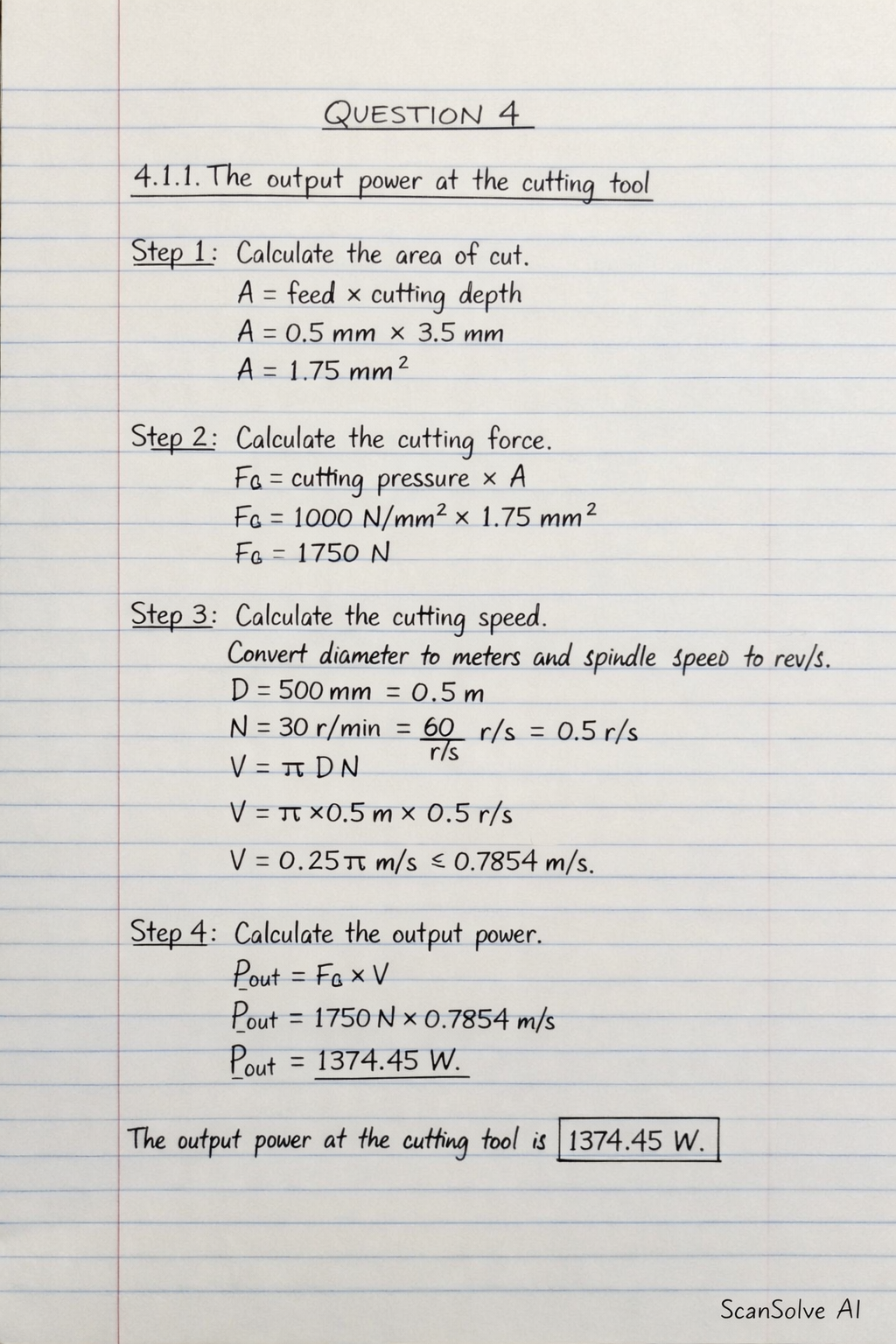
Here are the solutions to the questions: QUESTION 4 4.1.1 The output power at the cutting tool Step 1: Calculate the area of cut. A = feed × cutting depth A = 0.5 mm × 3.5 mm = 1.75 mm^2 Step 2: Calculate the cutting force. F_c = cutting pressure × A F_c = 1000 N/mm^2 × 1.75 mm^2 = 1750 N Step 3: Calculate the cutting speed. Convert diameter to meters and spindle speed to revolutions per second. D = 500 mm = 0.5 m N = 30 r/min = (30)/(60) r/s = 0.5 r/s V = D N V = × 0.5 m × 0.5 r/s = 0.25 m/s ≈ 0.7854 m/s Step 4: Calculate the output power. P_out = F_c × V P_out = 1750 N × 0.7854 m/s = 1374.45 W The output power at the cutting tool is 1374.45 W. 4.1.2 The input power from the motor Step 1: Use the drive efficiency formula. = P_outP_in P_in = P_out P_in = 1374.45 W0.85 = 1617.00 W The input power from the motor is 1617.00 W. 4.2.1 The horizontal force required to move the ram Step 1: Calculate the normal force (weight of the ram). Assume gravitational acceleration g = 9.81 m/s^2. N = m × g N = 200 kg × 9.81 m/s^2 = 1962 N Step 2: Calculate the horizontal force (friction force). F_f = × N F_f = 0.07 × 1962 N = 137.34 N The horizontal force required to move the ram is 137.34 N. 4.2.2 The coefficient of friction if the force to move the ram is increased by 30% Step 1: Calculate the new force required. F_new = F_f × (1 + 0.30) F_new = 137.34 N × 1.30 = 178.542 N Step 2: Calculate the new coefficient of friction. The normal force remains the same. _new = F_newN _new = 178.542 N1962 N = 0.091 The new coefficient of friction is 0.091. QUESTION 5 5.1.1 The cutting power Step 1: Convert spindle speed to revolutions per second and then to angular velocity. N = 240 r/min = (240)/(60) r/s = 4 r/s = 2 N = 2 × 4 rad/s = 8 rad/s ≈ 25.13 rad/s Step 2: Calculate the cutting power using torque and angular velocity. P_c = T × P_c = 28 N·m × 8 rad/s = 224 W ≈ 703.72 W The cutting power is 703.72 W. 5.1.2 The feed force if the feed is 0,20 mm/rev The thrust on the drill is given as 1200 N. This thrust force is the feed force. The feed rate of 0.20 mm/rev is the specific condition under which this force is applied. The feed force is 1200 N. 5.2.1 The feed per tooth Step 1: Use the formula for feed per tooth. f_z = Table feedN × Z f_z = 250 mm/min200 r/min × 8 teeth = (250)/(1600) mm/tooth f_z = 0.15625 mm/tooth The feed per tooth is 0.15625 mm/tooth. 5.2.2 The material removal rate if the width of cut is 40 mm and the depth of cut is 2 mm Step 1: Use the formula for material removal rate (MRR). MRR = width of cut × depth of cut × table feed MRR = 40 mm × 2 mm × 250 mm/min MRR = 20000 mm^3/min The material removal rate is 20000 mm^3/min. 5.3 State FOUR safety precautions to be observed when operating a lathe. • Always wear appropriate Personal Protective Equipment (PPE), including safety glasses. • Ensure the workpiece is securely clamped in the chuck or between centers before starting the machine. • Keep hands and loose clothing clear of all rotating parts and cutting tools. • Never leave the lathe running unattended. 5.4 There is an inconsistency in the problem statement for Question 5.4. Given: Power transmitted (P) = 5.5 kW = 5500 W Belt speed (V) = 18 m/s Difference between tight-side and slack-side tensions (T_1 - T_2) = 1000 N The formula for power transmitted by a belt is P = (T_1 - T_2) × V. If we use the given values: 5500 W = (1000 N) × (18 m/s) = 18000 W. This shows that 5500 W ≠ 18000 W, indicating a contradiction in the given information. To make the problem solvable for individual tensions, we will assume that the "1 000 N" refers to the sum of the tight-side and slack-side tensions (T_1 + T_2 = 1000 N), as this is a common way for such problems to be structured when there's an error in phrasing. Step 1: Calculate the actual difference in tensions from the given power and belt speed. T_1 - T_2 = (P)/(V) T_1 - T_2 = 5500 W18 m/s = 305.56 N Step 2: Use the assumed sum of tensions to form a system of equations. 1. T_1 - T_2 = 305.56 N 2. T_1 + T_2 = 1000 N (Assumption: "difference" was a typo for "sum") 5.4.1 The tight-side tension Step 3: Add the two equations to solve for T_1. (T_1 - T_2) + (T_1 + T_2) = 305.56 N + 1000 N 2T_1 = 1305.56 N T_1 = 1305.56 N2 = 652.78 N The tight-side tension is 652.78 N. 5.4.2 The slack-side tension Step 4: Substitute T_1 into the second equation to solve for T_2. 652.78 N + T_2 = 1000 N T_2 = 1000 N - 652.78 N = 347.22 N The slack-side tension is 347.22 N. Send me the next one 📸