
We read your photo as:
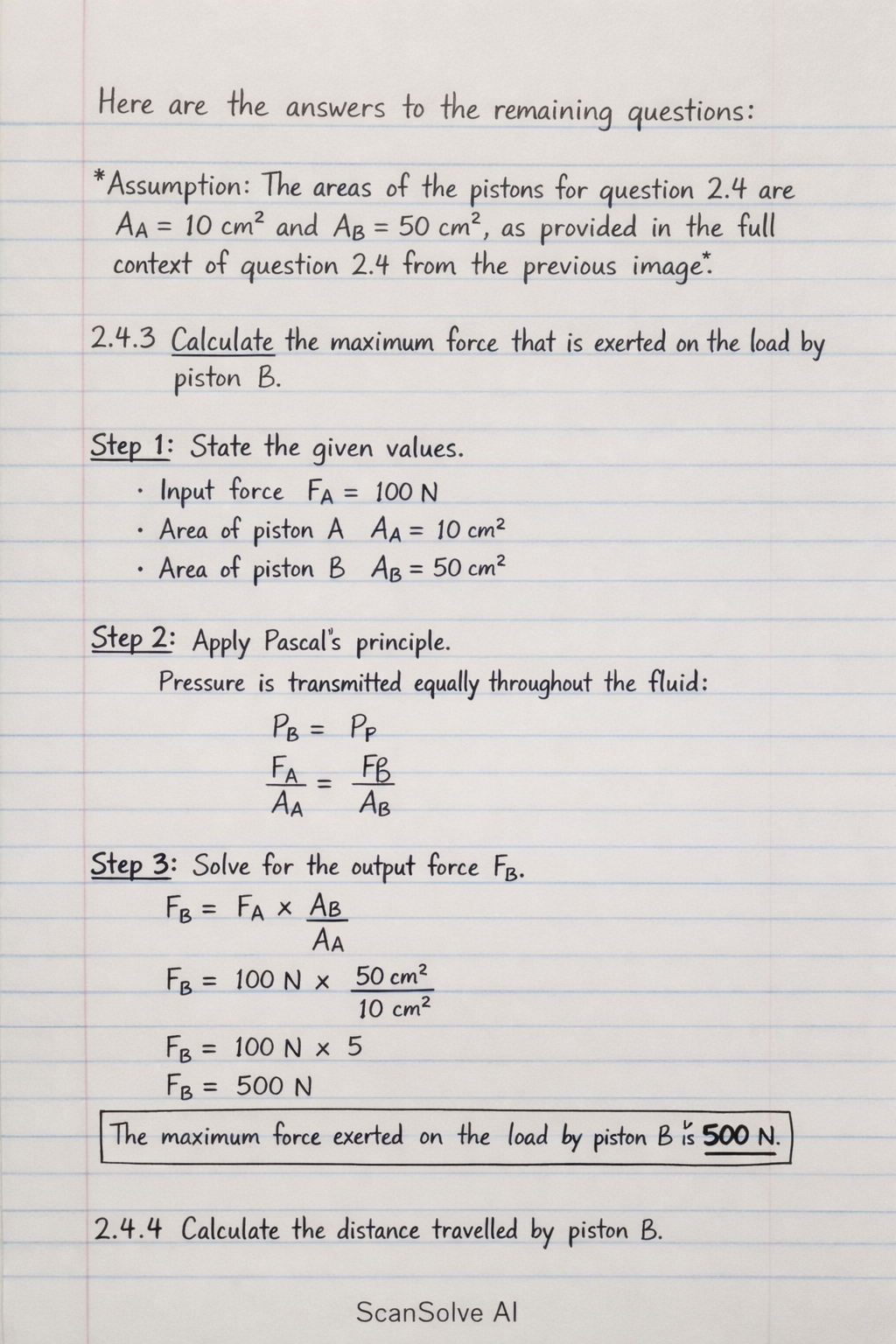
The provided solution addresses two questions: 2.4.3 Calculate the maximum force that is exerted on the load by piston B. 2.4.4 Calculate the distance travelled by piston B.
ScanSolve AI Answer
Answer
Step-by-step solution
8 stepsHere are the answers to the remaining questions:
Assumption: The areas of the pistons for question 2.4 are and , as provided in the full context of question 2.4 from the previous image.
2.4.3 Calculate the maximum force that is exerted on the load by piston B.
State the given values.
Input force
Area of piston A
Area of piston BApply Pascal's principle.
Pressure is transmitted equally throughout the fluid:
Solve for the output force .
The maximum force exerted on the load by piston B is .
2.4.4 Calculate the distance travelled by piston B.
State the known values.
Input force
Input distance
Output force (from 2.4.3)Apply the principle of work done (Work input = Work output).
Solve for the output distance .
The distance travelled by piston B is .
2.4.5 Calculate the mechanical advantage of the system.
State the known values.
Input force
Output force (from 2.4.3)
Area of piston A
Area of piston BCalculate mechanical advantage (MA) using forces or areas.
Alternatively, using areas:
The mechanical advantage of the system is .
2.5 Name the type of mechanical advantage that is achieved when a small syringe drives a larger syringe.
The type of mechanical advantage achieved is force multiplication.
Try one yourself
A new problem that tests the same skill.
Still stuck on this one?
Ask a follow-up, and the answer starts from this question.
More Physics Questions
Handwritten Step-by-Step Solution
Get this as a handwritten image on WhatsApp — like a tutor wrote it for you.
Try on WhatsApp