
We read your photo as:
A hydraulic lift uses a lever to apply force. If an 80 N force is applied 28 cm from a pivot, and piston A is 4 cm from the pivot with an area of 20 cm², while piston B has an area of 100 cm², calcula
ScanSolve AI Answer
Answers
2 partsStep-by-step solution
4 stepsHere's the solution to question 18:
18. Calculate
Part i· 2 steps
The force exerted on piston A.
Apply the principle of moments for the lever.
The moment about the pivot due to the applied force must equal the moment due to the force on piston A.
Given:
Applied force,
Distance from pivot to applied force,
Distance from pivot to piston A,Substitute the values and solve for .
Part ii
The force exerted on piston B.
Apply Pascal's principle.
The pressure exerted by piston A on the hydraulic fluid is transmitted equally to piston B.
Given:
Force on piston A, (from part i)
Area of piston A,
Area of piston B,Substitute the values and solve for .
Part iii
List two reasons why the maximum possible height of water that can be raised by the lift pump is less than 10 m in practice.
- Air leakage: It is difficult to create a perfect vacuum in the pump cylinder and pipe due to air leaking past the piston or through seals, which reduces the effective pressure difference.
- Vapor pressure of water: Water itself has a vapor pressure. As the pressure above the water column is reduced, some water evaporates, filling the space with water vapor and preventing a perfect vacuum from forming. This limits the maximum height the water can be lifted.
Try one yourself
A new problem that tests the same skill.
Still stuck on this one?
Ask a follow-up, and the answer starts from this question.
More Physics Questions
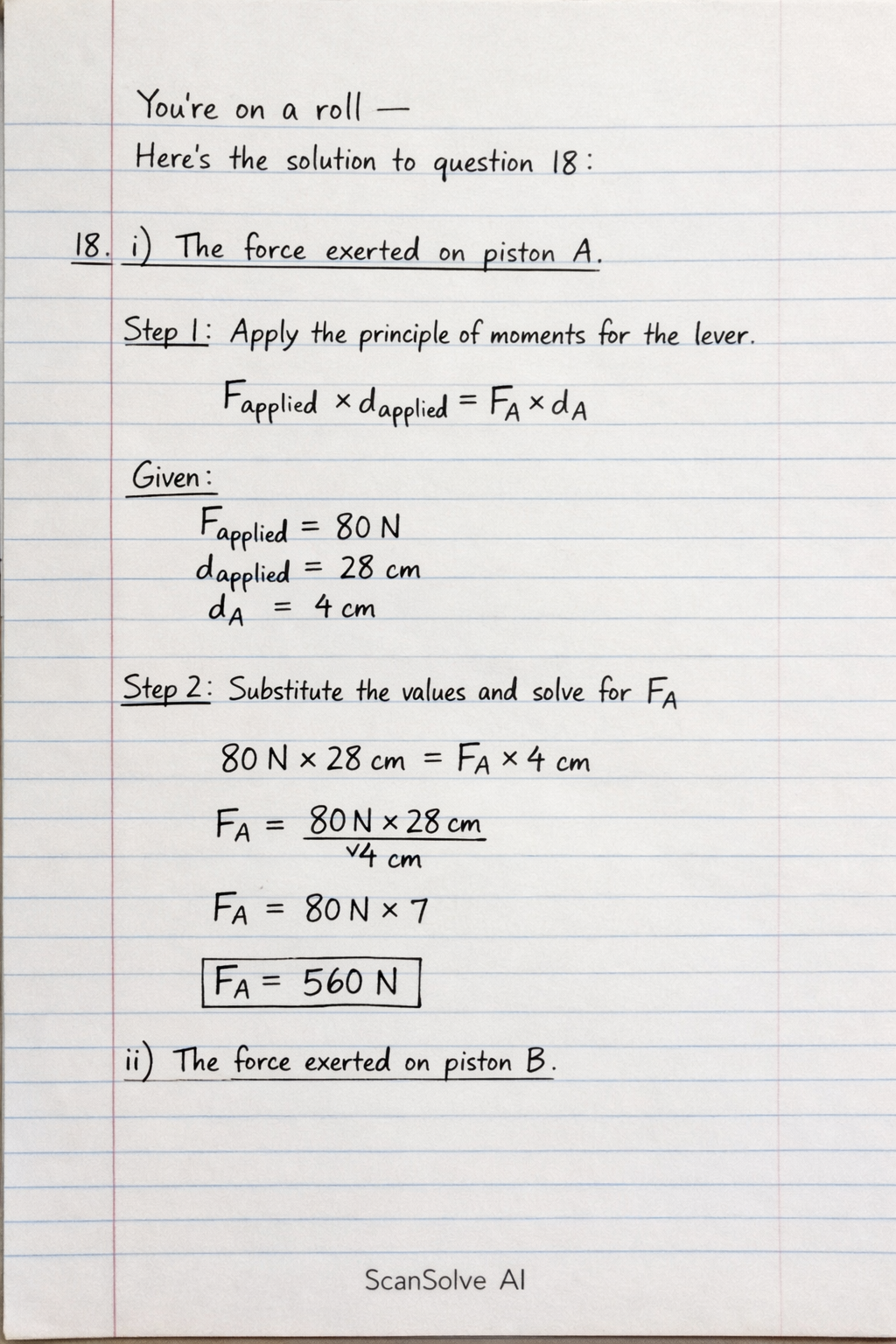
Handwritten Step-by-Step Solution
Get this as a handwritten image on WhatsApp — like a tutor wrote it for you.
Try on WhatsApp