
We read your photo as:
What is the force needed to apply a piston of 2 cm radius in order to result a force of 6000N at working piston of radius 6 cm?
ScanSolve AI Answer
Answer
Pascal's law
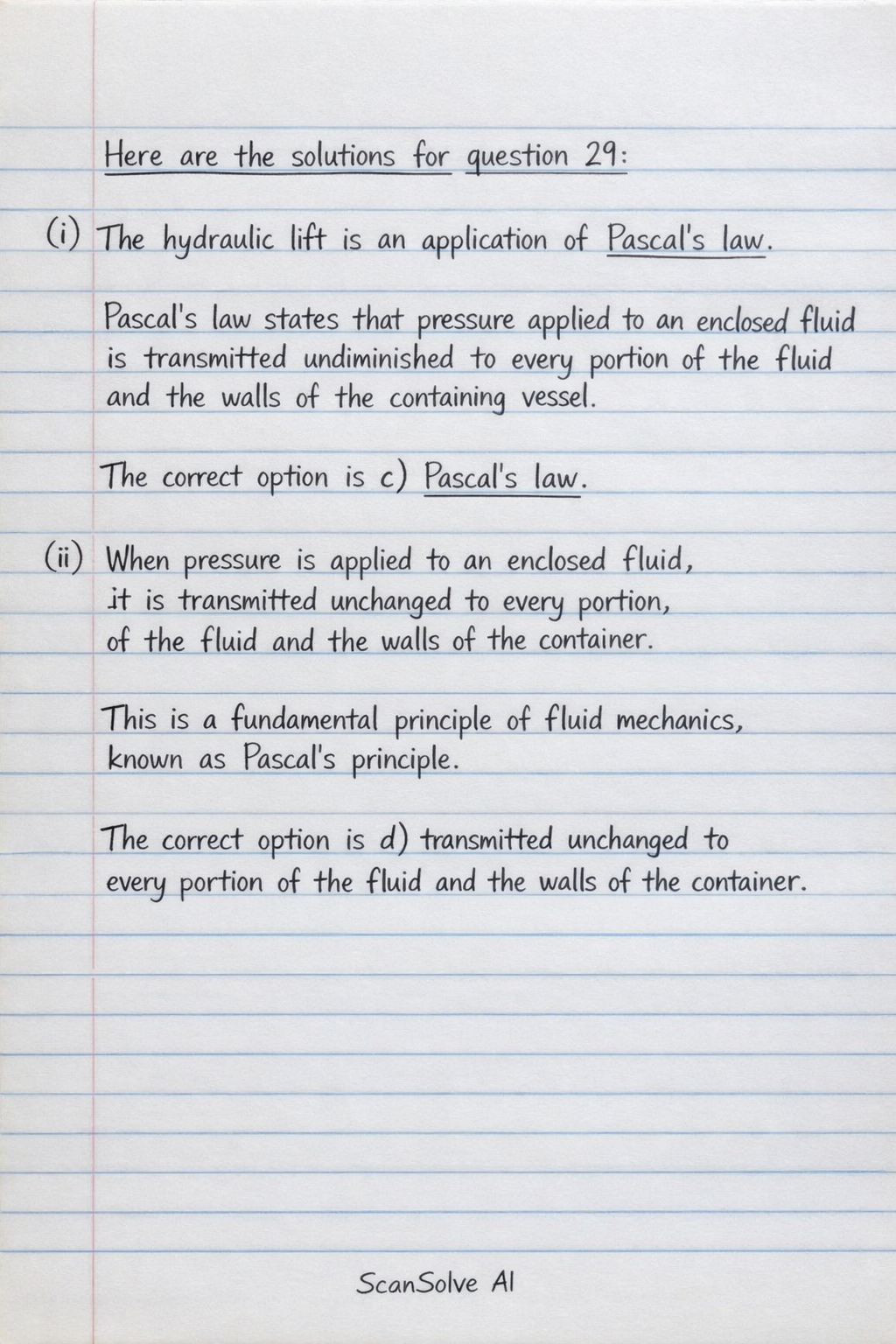
i) The hydraulic lift is an application of Pascal's law. Pascal's law states that pressure applied to an enclosed fluid is transmitted undiminished to every portion of the fluid and the walls of the containing vessel.
The correct option is c) Pascal's law.
ii) When pressure is applied to an enclosed fluid, it is transmitted unchanged to every portion of the fluid and the walls of the container. This is a fundamental principle of fluid mechanics, known as Pascal's principle.
The correct option is d) transmitted unchanged to every portion of the fluid and the walls of the container.
iii) For a hydraulic lift, the work done by the input piston is equal to the work done on the output piston (assuming an ideal system).
Let and be the area and distance moved by piston P1, and and be the area and distance moved by piston P2.
Given: , , .
The volume of fluid displaced by piston P1 must be equal to the volume of fluid displaced by piston P2.
Substitute the given values:
Divide both sides by :
Solve for :
The distance moved by piston P2 is .
iv) We use Pascal's principle, which states that the pressure exerted on the fluid by the smaller piston is equal to the pressure exerted by the fluid on the larger piston.
Let be the force applied on the input piston and be the force on the working piston.
Let be the radius of the input piston and be the radius of the working piston.
Given:
The area of a circular piston is .
So, and .
According to Pascal's principle:
Substitute the area formulas:
Cancel from both sides:
Solve for :
Substitute the given values:
Rounding to the nearest whole number, .
The force needed is .
Try one yourself
A new problem that tests the same skill.
Still stuck on this one?
Ask a follow-up, and the answer starts from this question.
More Physics Questions
Handwritten Step-by-Step Solution
Get this as a handwritten image on WhatsApp — like a tutor wrote it for you.
Try on WhatsApp