
We read your photo as:
Calculate each of the following: 4.1.1 The output power at the cutting tool 4.1.2 The input power from the motor
ScanSolve AI Answer
Step-by-step solution
13 stepsHere are the solutions to the questions:
Question 4.1
a) A lathe has a drive efficiency of . It is used to machine a workpiece of diameter at a spindle speed of . The cutting depth of the tool is and the feed of the tool is per revolution of the workpiece. The cutting pressure on the cutting tool is .
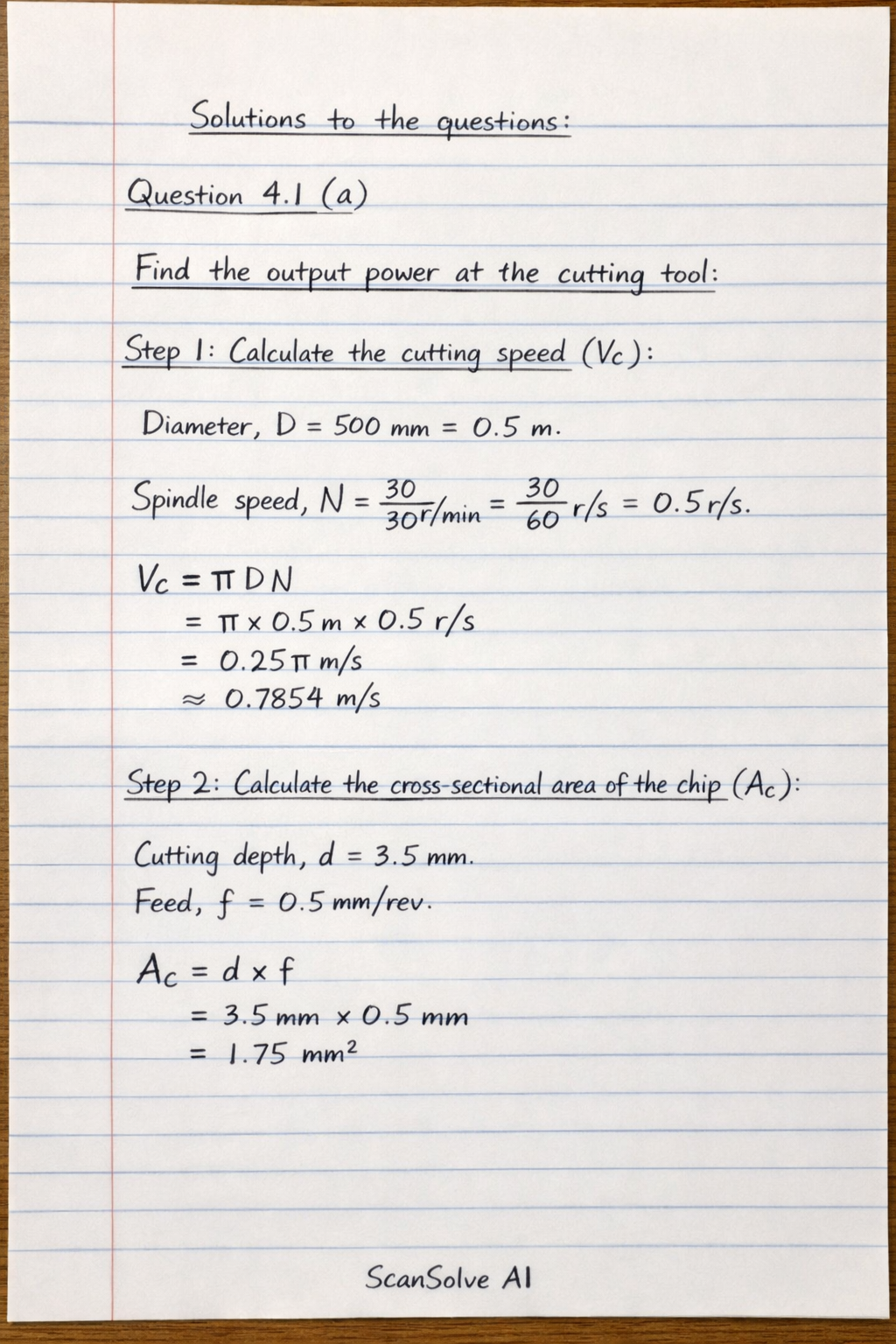
4.1.1 The output power at the cutting tool
Calculate the cutting speed ().
The diameter .
The spindle speed .Calculate the cross-sectional area of the chip ().
The cutting depth .
The feed .Calculate the cutting force ().
The cutting pressure (specific cutting energy) .
Calculate the output power ().
The output power at the cutting tool is .
4.1.2 The input power from the motor
Use the drive efficiency () to find the input power ().
The drive efficiency .
The input power from the motor is .
Question 4.2
b) A shaping machine has a ram of mass . The ram moves in slides with a coefficient of friction of 0.07 between the ram and the slides.
4.2.1 The horizontal force required to move the ram
Calculate the normal force ().
The mass of the ram . Assume acceleration due to gravity .
Calculate the horizontal force () required to overcome friction.
The coefficient of friction .
The horizontal force required to move the ram is .
4.2.2 The coefficient of friction if the force to move the ram is increased by 30%
Calculate the new horizontal force ().
The force is increased by , so .
Calculate the new coefficient of friction ().
The normal force remains the same ().
The new coefficient of friction is .
Question 5.1
a) A drilling machine has a spindle speed of and a drill of diameter. The thrust on the drill is and the cutting torque is .
5.1.1 The cutting power
Convert the spindle speed to revolutions per second.
The spindle speed .
Calculate the cutting power () using the cutting torque.
The cutting torque .
The cutting power is .
5.1.2 The feed force if the feed is 0.20 mm/rev
The feed force is the thrust force acting on the drill. The problem states that "The thrust on the drill is ". The value of the feed () is a characteristic of the operation but does not change the given thrust force.
The feed force is .Question 5.2
b) A horizontal milling machine uses a cutter of diameter. The cutter has 8 teeth and is running at . The table feed is .
5.2.1 The feed per tooth
Calculate the feed per tooth ().
The table feed .
The number of teeth .
The running speed .The feed per tooth is .
5.2.2 The material removal rate if the width of cut is 40 mm and the depth of cut is 2 mm
Calculate the material removal rate ().
The width of cut .
The depth of cut .
The table feed .The material removal rate is .
Question 5.3
State FOUR safety precautions to be observed when operating a lathe.- Always wear appropriate Personal Protective Equipment (PPE), including safety glasses or a face shield, and avoid loose clothing, jewelry, or long hair that could get caught in rotating parts.
- Ensure the workpiece is securely clamped in the chuck or between centers before starting the machine to prevent it from being thrown out.
- Never leave the chuck key in the chuck after tightening, as it can become a dangerous projectile when the machine is started.
- Keep hands and fingers clear of all rotating parts and cutting tools during operation, and use a brush or hook to remove chips, never bare hands.
Question 5.4
d) A belt drive transmits at a belt speed of . The difference between tight-side and slack-side tensions is .
There is an inconsistency in the problem statement.
The power transmitted by a belt drive is given by the formula:Where is the power, is the tight-side tension, is the slack-side tension, and is the belt speed.
Given:
If we use the given power and belt speed to calculate the tension difference:
This calculated difference () contradicts the explicitly stated difference of .
Since the problem provides contradictory information, it is impossible to uniquely determine and individually. To find and , a second independent equation (e.g., the ratio of tensions ) would be required, which is not provided.Therefore, the tight-side tension and slack-side tension cannot be calculated from the given information.
Still stuck on this one?
Ask a follow-up, and the answer starts from this question.
More Physics Questions
Handwritten Step-by-Step Solution
Get this as a handwritten image on WhatsApp — like a tutor wrote it for you.
Try on WhatsApp