
We read your photo as:
A horizontal force is applied to a system of two blocks (m1 = 300g, m2 = 500g) resting on a horizontal surface. The coefficient of friction is 0.4. If the blocks accelerate at 200 cm/s2, what is the m
ScanSolve AI Answer
Answer
Step-by-step solution
6 stepsHere's how to solve the problem:
Convert all given values to SI units.
The coefficient of friction and gravitational acceleration are already in appropriate units.
Calculate the total mass of the system.
Since the two blocks are in contact and move together, we can treat them as a single system with a total mass .
Calculate the total normal force acting on the blocks.
On a horizontal table, the normal force is equal to the total weight of the system.
Calculate the total friction force.
The friction force is given by the product of the coefficient of friction and the normal force.
Apply Newton's Second Law to find the applied force.
The net force acting on the system is the applied force minus the friction force . This net force causes the acceleration .
Rearrange the equation to solve for :
Substitute the calculated values:
Round the result and compare with the given options.
Rounding to two decimal places gives .
This matches option C.The final answer is .
Try one yourself
A new problem that tests the same skill.
Still stuck on this one?
Ask a follow-up, and the answer starts from this question.
More Physics Questions
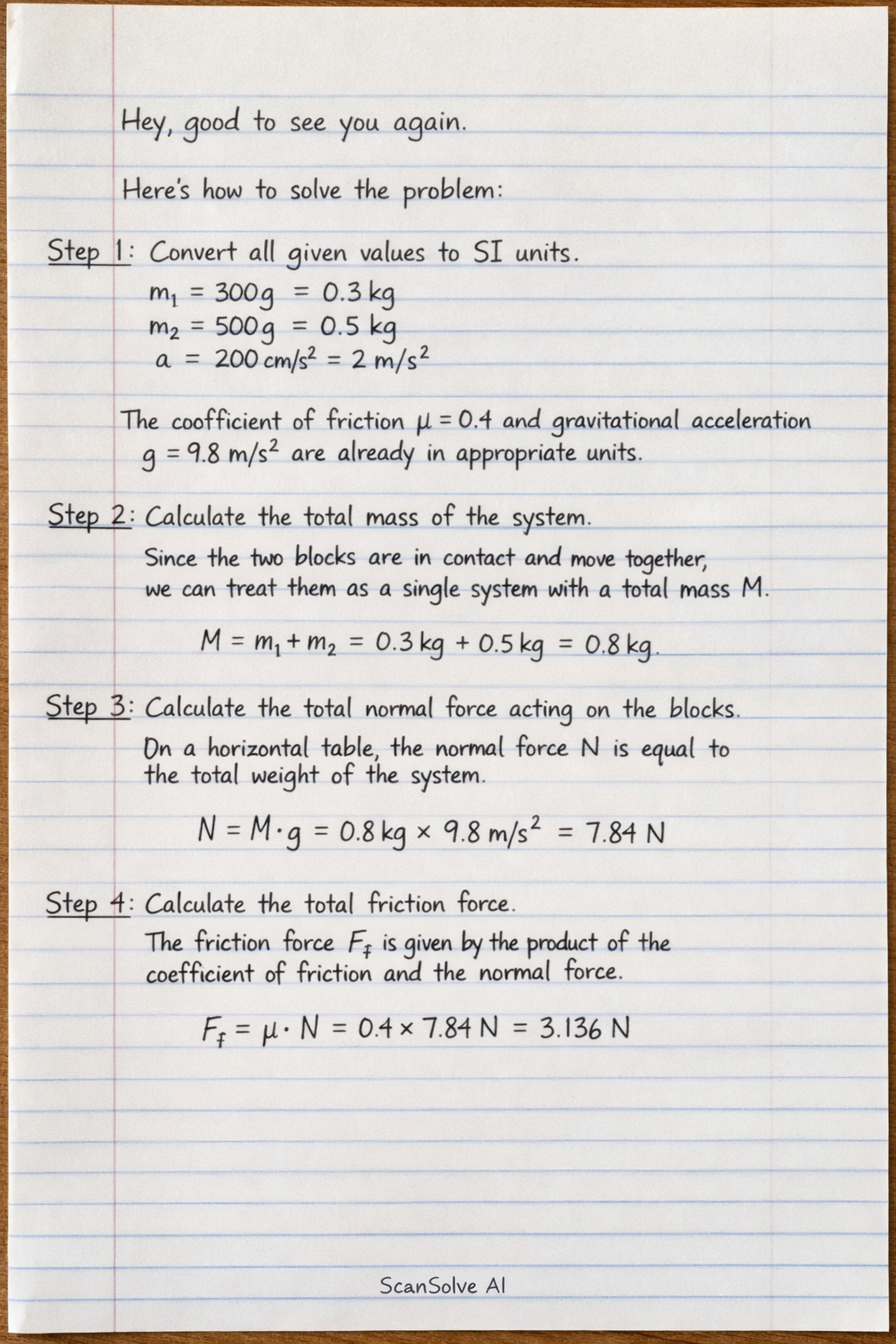
Handwritten Step-by-Step Solution
Get this as a handwritten image on WhatsApp — like a tutor wrote it for you.
Try on WhatsApp