
We read your photo as:
A glass bulb is filled with 0,6 m³ of mercury at a temperature of 20 °C. The bulb and mercury are heated to 70 °C. The linear coefficient of expansion of glass is 11 × 10⁻⁶/°C and the volume coefficient of expansion of mercury is 20 × 10⁻⁵/°C. Calculate the overflow of mercury.
ScanSolve AI Answer
Answer
Step-by-step solution
5 stepsHere's the solution for question 3:
Given:
Initial volume () =
Initial temperature () =
Final temperature () =
Linear coefficient of expansion of glass () =
Volume coefficient of expansion of mercury () =
Calculate the change in temperature ().
Calculate the volumetric expansion coefficient of glass ().
The volumetric expansion coefficient for a solid is approximately three times its linear expansion coefficient.
Calculate the change in volume of the glass bulb ().
Calculate the change in volume of the mercury ().
Calculate the overflow of mercury.
The overflow is the difference between the absolute expansion of mercury and the expansion of the glass bulb.
Try one yourself
A new problem that tests the same skill.
Still stuck on this one?
Ask a follow-up, and the answer starts from this question.
More Physics Questions
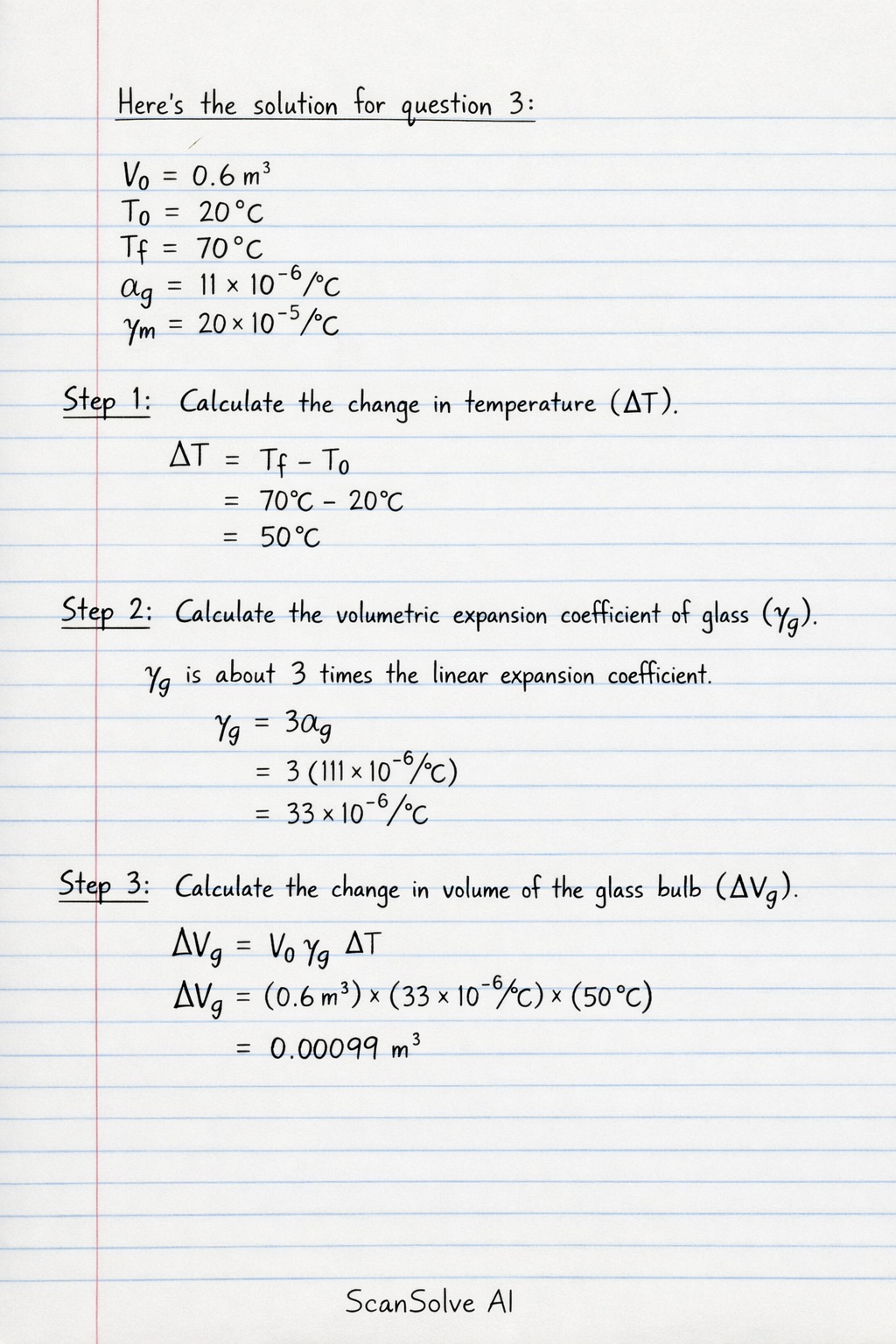
Handwritten Step-by-Step Solution
Get this as a handwritten image on WhatsApp — like a tutor wrote it for you.
Try on WhatsApp