
We read your photo as:
A U-shaped tube contains water and mercury. The water column is 15 cm high. Calculate the gauge pressure at the interface and the vertical distance h to the mercury's top.
ScanSolve AI Answer
Answers
2 partsStep-by-step solution
4 stepsHere's how to solve the problem:
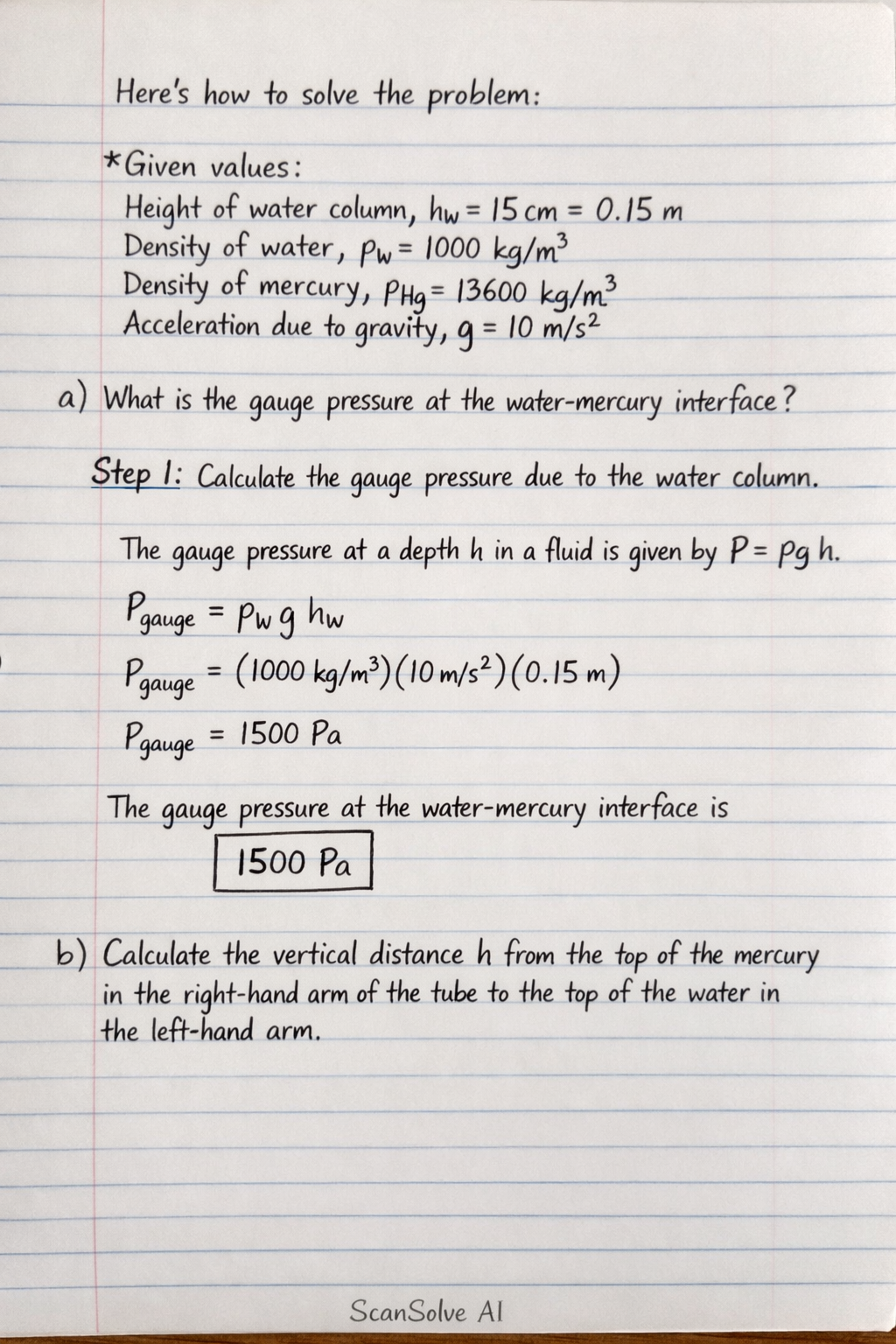
Given values:
Height of water column,
Density of water,
Density of mercury,
Acceleration due to gravity, (used to match the provided solution for part a)
Part a· 1 step
What is the gauge pressure at the water-mercury interface?
Calculate the gauge pressure due to the water column.
The gauge pressure at a depth in a fluid is given by .
The gauge pressure at the water-mercury interface is .
Part b
Calculate the vertical distance h from the top of the mercury in the right-hand arm of the tube to the top of the water in the left-hand arm.
Apply the principle of pressure balance.
At the same horizontal level (the water-mercury interface in the left arm), the pressure must be equal. Let be the height of the mercury column in the right arm above this interface.
The pressure exerted by the water column in the left arm is equal to the pressure exerted by the mercury column of height in the right arm.Solve for $2x$, the height of the mercury column above the interface.
Calculate the vertical distance .
The distance is the difference between the height of the water column () and the height of the mercury column () above the water-mercury interface.
Convert to centimeters and round to one decimal place:
The vertical distance is .
Try one yourself
A new problem that tests the same skill.
Still stuck on this one?
Ask a follow-up, and the answer starts from this question.
More Physics Questions
Handwritten Step-by-Step Solution
Get this as a handwritten image on WhatsApp — like a tutor wrote it for you.
Try on WhatsApp