
We read your photo as:
A uniform glass tube, closed at one end, contains a column of mercury 5 cm long. The length of the trapped air column is 26 cm when the tube is held vertically upright. When the tube is inverted, the
ScanSolve AI Answer
Step-by-step solution
8 stepsb) Calculate the value of the atmospheric pressure?
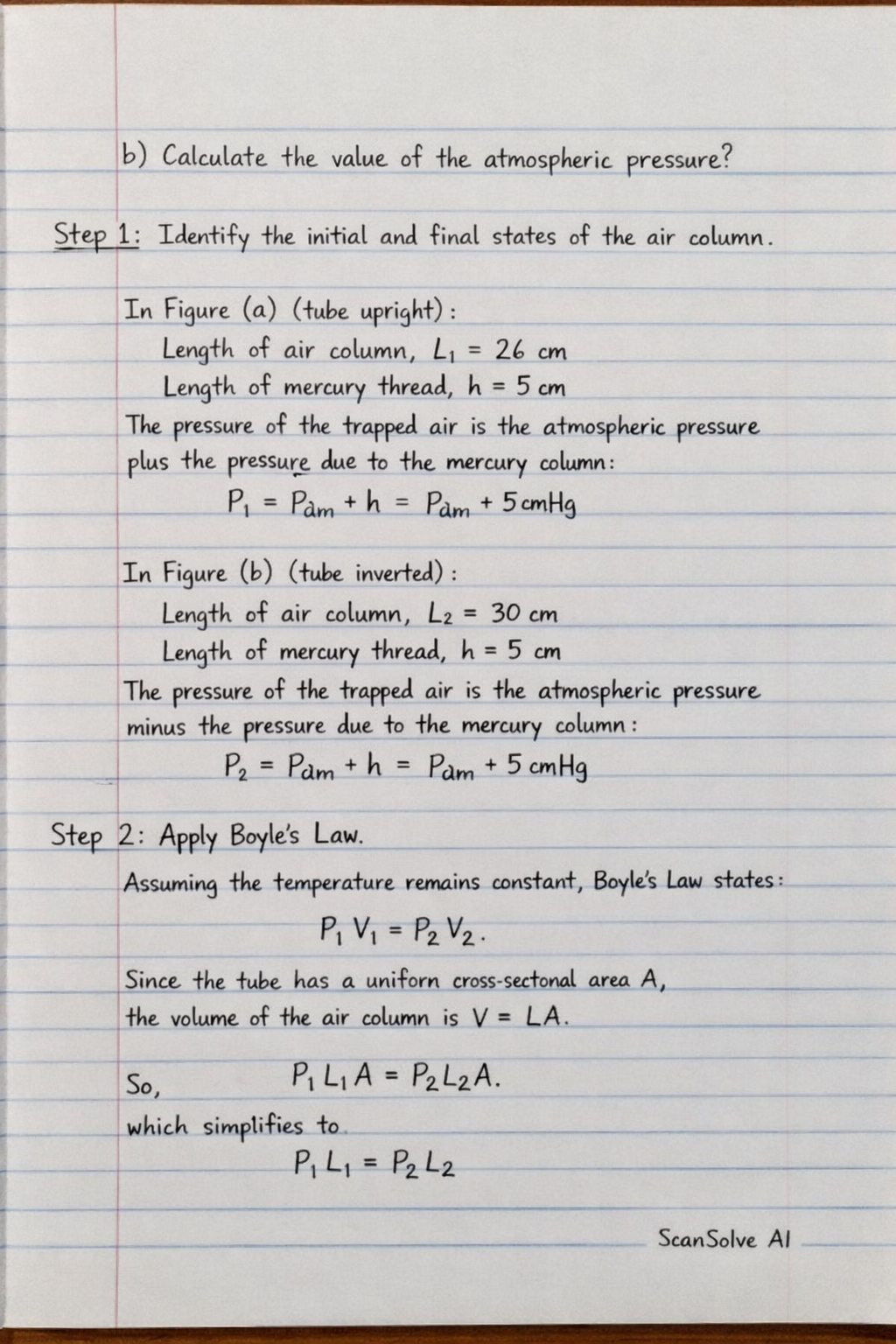
Identify the initial and final states of the air column.
In Figure (a) (tube upright):
Length of air column,
Length of mercury thread,
The pressure of the trapped air is the atmospheric pressure plus the pressure due to the mercury column:
In Figure (b) (tube inverted):
Length of air column,
Length of mercury thread,
The pressure of the trapped air is the atmospheric pressure minus the pressure due to the mercury column:
Apply Boyle's Law.
Assuming the temperature remains constant, Boyle's Law states .
Since the tube has a uniform cross-sectional area , the volume of the air column is .
So, , which simplifies to .Substitute the expressions for pressure and length into Boyle's Law.
Solve for .
The value of the atmospheric pressure is .
c) A steel cylinder of capacity contains nitrogen at a pressure of when the temperature is . What will be the pressure of nitrogen if it is allowed to flow into another cylinder of capacity with the temperature reduced to ?
Identify the initial conditions ().
Initial volume,
Initial pressure,
Initial temperature, . Convert to Kelvin:
Identify the final conditions () and the unknown ().
The gas flows into another cylinder of capacity . The total final volume is the sum of the capacities of both cylinders:
Final volume,
Final temperature, . Convert to Kelvin:
Final pressure,Apply the Combined Gas Law.
The Combined Gas Law is given by:
Substitute the values and solve for .
The pressure of nitrogen will be .
- a) State Archimedes principle. Archimedes' principle states that when an object is wholly or partially immersed in a fluid, it experiences an upward buoyant force equal to the weight of the fluid displaced by the object.
b) State one way of making a hydrometer more sensitive.
One way to make a hydrometer more sensitive is to increase the length of its stem or decrease the diameter of its stem.
Still stuck on this one?
Ask a follow-up, and the answer starts from this question.
More Physics Questions
Handwritten Step-by-Step Solution
Get this as a handwritten image on WhatsApp — like a tutor wrote it for you.
Try on WhatsApp