We read your photo as:

Num tubo em U, coloca-se mercúrio (p=13600 kg/m³) e água (p=1000 kg/m³). A altura da coluna do mercúrio acima da interface é 100 cm. Calcule a altura da coluna da água no verso da folha (1.0v).

Physics

ScanSolve AI Answer

Answers

2 parts
4

64000 Pa\text{64000 Pa}

165325 Pa\text{165325 Pa}

5

13.6 m\text{13.6 m}

Step-by-step solution

5 steps

Part 4· 2 steps

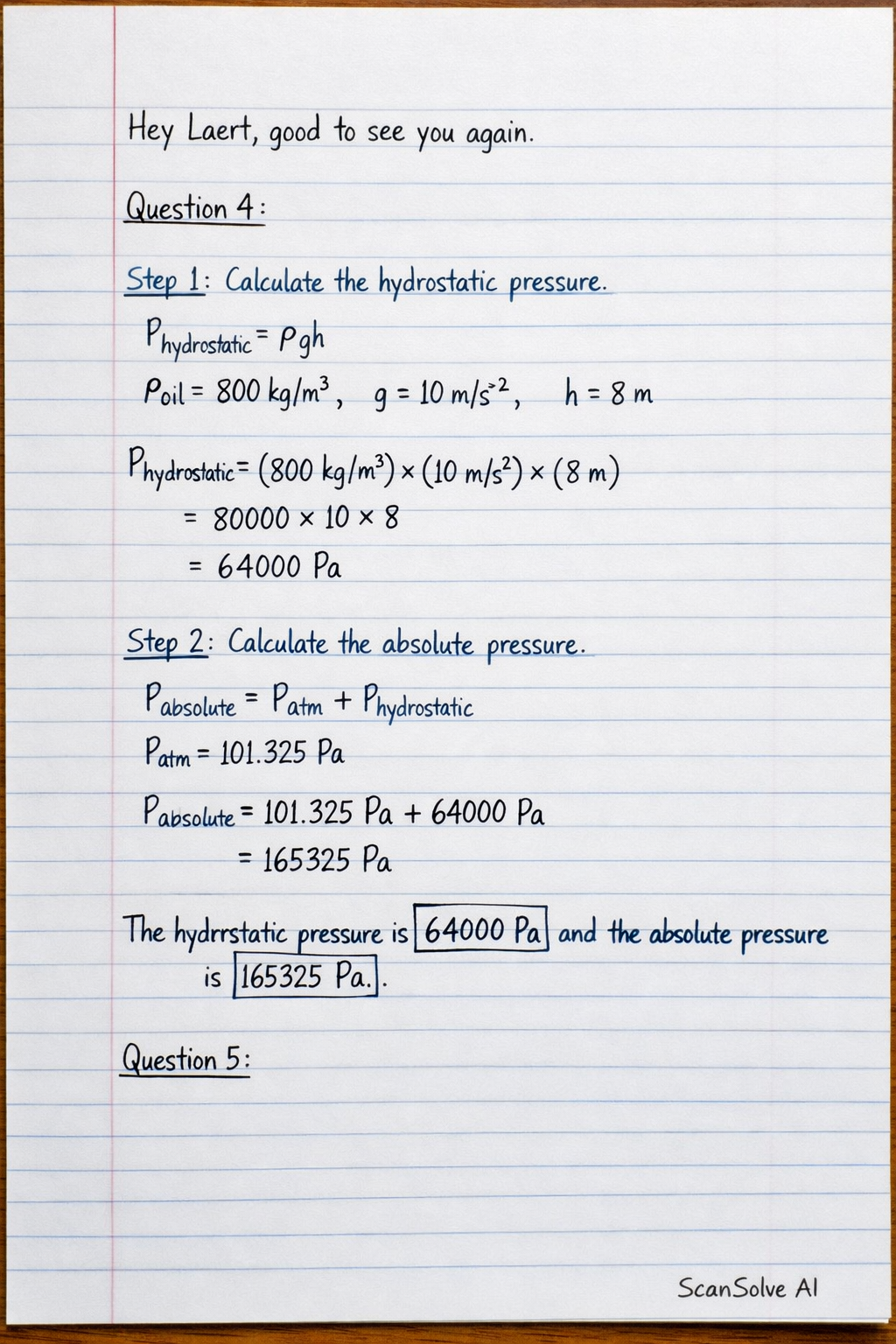
  1. Calculate the hydrostatic pressure.

    The hydrostatic pressure (PhydrostaticP_{hydrostatic}) is given by the formula Phydrostatic=ρghP_{hydrostatic} = \rho g h, where ρ\rho is the density of the fluid, gg is the acceleration due to gravity, and hh is the height of the fluid column.
    Given: ρoil=800 kg/m3\rho_{oil} = 800 \text{ kg/m}^3, g=10 m/s2g = 10 \text{ m/s}^2, h=8 mh = 8 \text{ m}.

    Phydrostatic=(800 kg/m3)×(10 m/s2)×(8 m)P_{hydrostatic} = (800 \text{ kg/m}^3) \times (10 \text{ m/s}^2) \times (8 \text{ m}) Phydrostatic=64000 PaP_{hydrostatic} = 64000 \text{ Pa}
  2. Calculate the absolute pressure.

    The absolute pressure (PabsoluteP_{absolute}) is the sum of the atmospheric pressure (PatmP_{atm}) and the hydrostatic pressure.
    Given: Patm=101.325 PaP_{atm} = 101.325 \text{ Pa}.

    Pabsolute=Patm+PhydrostaticP_{absolute} = P_{atm} + P_{hydrostatic} Pabsolute=101.325 Pa+64000 PaP_{absolute} = 101.325 \text{ Pa} + 64000 \text{ Pa} Pabsolute=165325 PaP_{absolute} = 165325 \text{ Pa}

    The hydrostatic pressure is 64000 Pa\boxed{\text{64000 Pa}} and the absolute pressure is 165325 Pa\boxed{\text{165325 Pa}}.

Part 5

13.6 m\text{13.6 m}

  1. Convert the height of the mercury column to meters.

    Given: hHg=100 cmh_{Hg} = 100 \text{ cm}.

    hHg=100 cm×1 m100 cm=1 mh_{Hg} = 100 \text{ cm} \times \frac{1 \text{ m}}{100 \text{ cm}} = 1 \text{ m}
  2. Apply the principle of equal pressure at the interface level.

    In a U-tube, at the same horizontal level within a continuous fluid, the pressure is equal. Therefore, the pressure exerted by the mercury column above the interface is equal to the pressure exerted by the water column above the interface.

    ρHgghHg=ρwaterghwater\rho_{Hg} g h_{Hg} = \rho_{water} g h_{water}

    We can cancel gg from both sides:

    ρHghHg=ρwaterhwater\rho_{Hg} h_{Hg} = \rho_{water} h_{water}
  3. Solve for the height of the water column, hwaterh_{water}.

    Given: ρHg=13600 kg/m3\rho_{Hg} = 13600 \text{ kg/m}^3, ρwater=1000 kg/m3\rho_{water} = 1000 \text{ kg/m}^3, hHg=1 mh_{Hg} = 1 \text{ m}.

    (13600 kg/m3)×(1 m)=(1000 kg/m3)×hwater(13600 \text{ kg/m}^3) \times (1 \text{ m}) = (1000 \text{ kg/m}^3) \times h_{water} 13600=1000×hwater13600 = 1000 \times h_{water} hwater=136001000 mh_{water} = \frac{13600}{1000} \text{ m} hwater=13.6 mh_{water} = 13.6 \text{ m}

    The height of the water column is 13.6 m\boxed{\text{13.6 m}}.

Was this helpful?

Try one yourself

A new problem that tests the same skill.

Still stuck on this one?

Ask a follow-up, and the answer starts from this question.

Got a different question?Ask your own question
Handwritten step-by-step solution preview

Handwritten Step-by-Step Solution

Get this as a handwritten image on WhatsApp — like a tutor wrote it for you.

Try on WhatsApp