
We read your photo as:
Calculate the pressure exerted by the mercury column.
Physics
ScanSolve AI Answer
Answer
Step-by-step solution
3 steps9.
Calculate the pressure exerted by the mercury column.
The pressure due to a column of fluid is given by the formula .
Given:
Density of mercury () =
Acceleration due to gravity () =
Difference in height () =Convert the pressure to kilopascals (kPa).
Determine the pressure of the gas supply.
From the diagram, the mercury level in the arm connected to the gas supply (left side) is lower than the mercury level in the arm open to the atmosphere (right side). This indicates that the pressure of the gas supply is greater than the atmospheric pressure.
Given atmospheric pressure () = .
The pressure of the gas supply is .
10.
- Effect on stability: His stability will increase.
- Explanation: Spreading his feet further apart increases the base area (or base of support) of the athlete. For an object to be stable, its center of gravity must fall within its base of support. A larger base area means the center of gravity can shift a greater distance horizontally before it falls outside the base, making the athlete more stable and less likely to topple over, especially when lifting heavy weights.
Was this helpful?
Try one yourself
A new problem that tests the same skill.
Still stuck on this one?
Ask a follow-up, and the answer starts from this question.
Got a different question?Ask your own question
More Physics Questions
QA U-tube manometer contains mercury. The open end is exposed to atmospheric pressure of 75 cmHg. A…QA U-shaped tube contains water and mercury. The water column is 15 cm high. Calculate the gauge…QCalculate the pressure due to the water.QCalculate the atmospheric pressure at sea level.QDetermine the pressure difference.
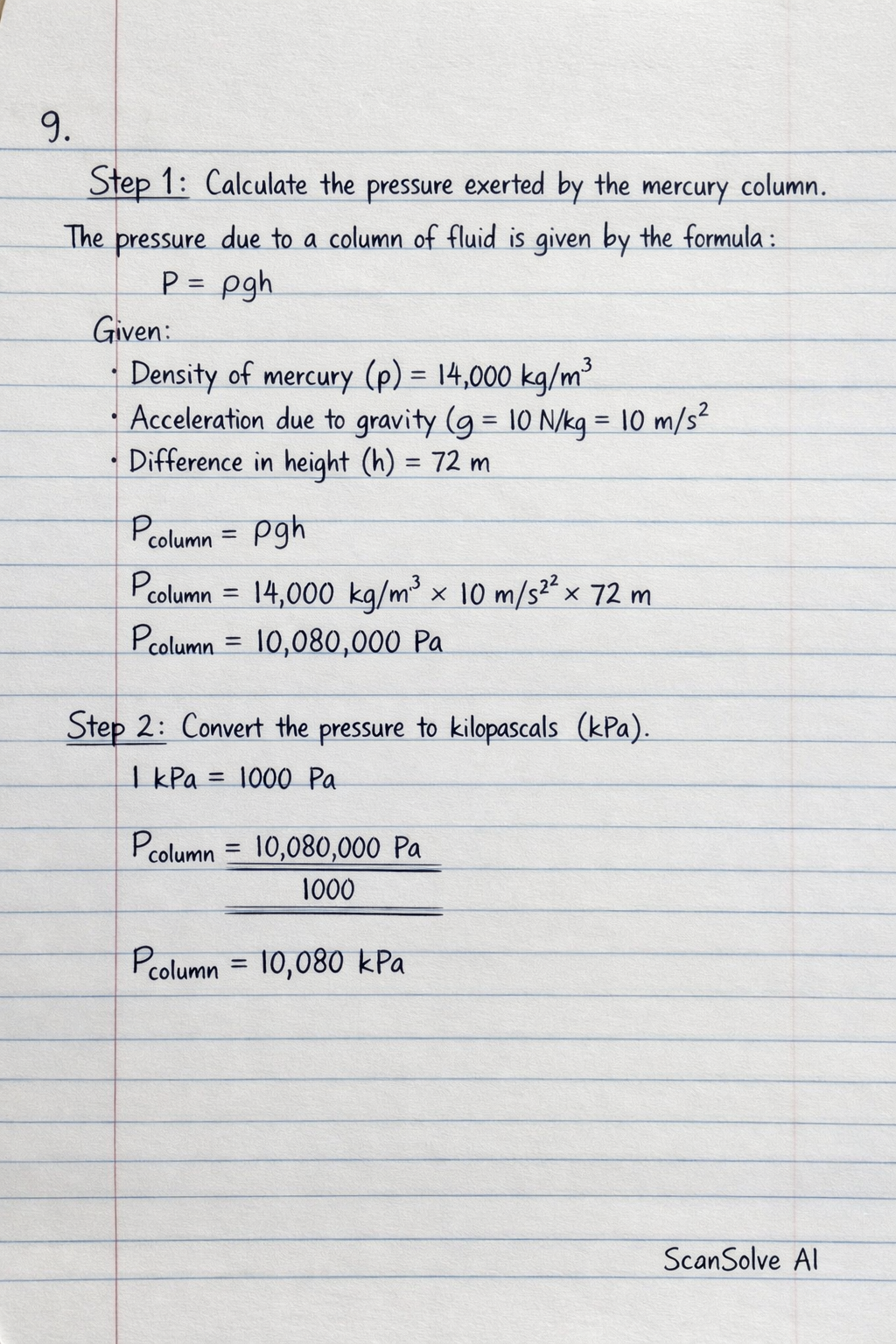
Handwritten Step-by-Step Solution
Get this as a handwritten image on WhatsApp — like a tutor wrote it for you.
Try on WhatsApp