

This physics problem tests your understanding of fundamental physical laws and their applications. The step-by-step solution below breaks down the problem using relevant equations and physical reasoning.
ScanSolve AI Answer
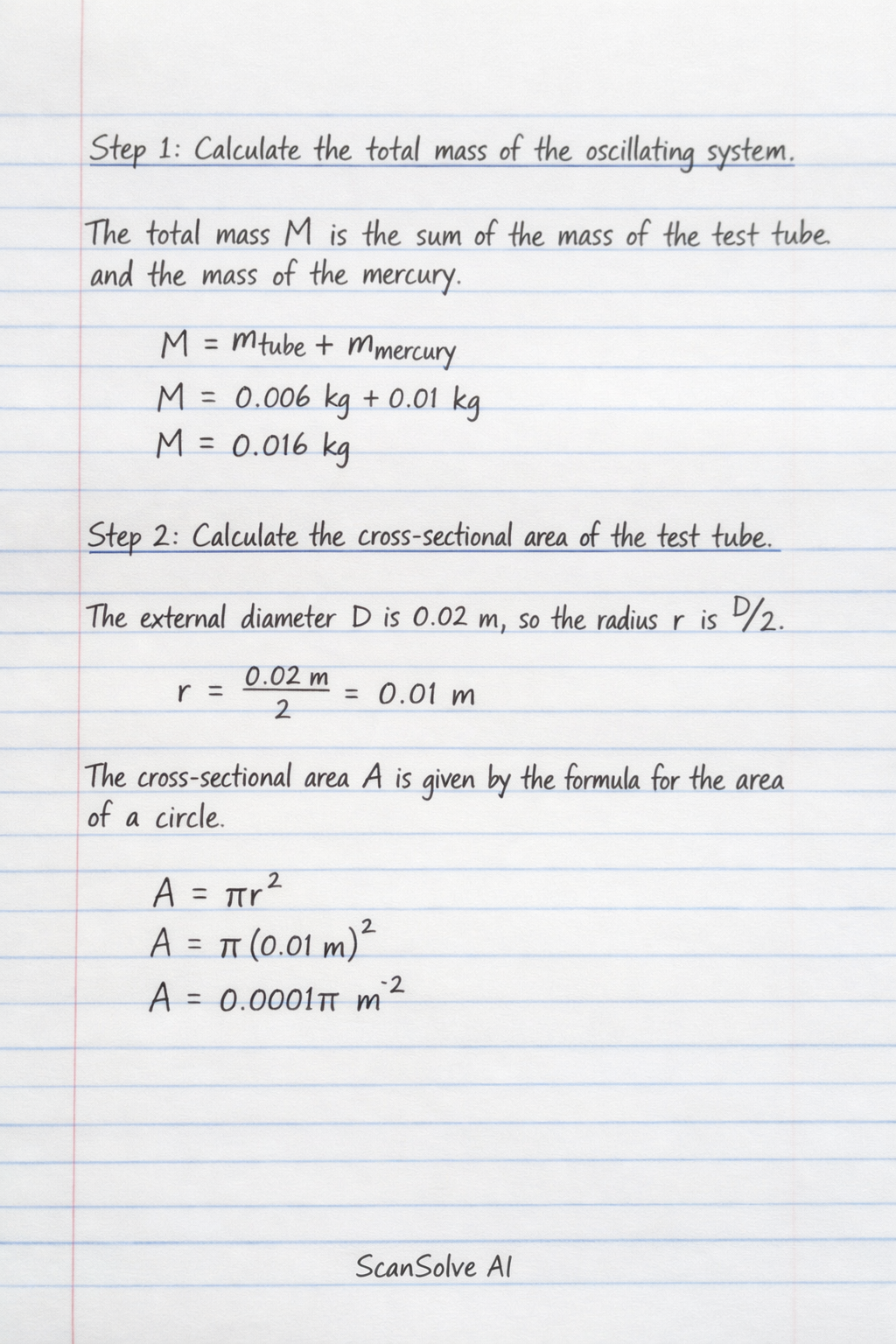
Step 1: Calculate the total mass of the oscillating system. The total mass M is the sum of the mass of the test tube and the mass of the mercury. M = m_tube + m_mercury M = 0.006 kg + 0.01 kg M = 0.016 kg Step 2: Calculate the cross-sectional area of the test tube. The external diameter D is 0.02 m, so the radius r is D/2. r = 0.02 m2 = 0.01 m The cross-sectional area A is given by the formula for the area of a circle. A = r^2 A = (0.01 m)^2 A = 0.0001 m^2 Step 3: Determine the effective spring constant for the oscillation. When the test tube is depressed by a small amount x, an additional volume V_additional = A x of water is displaced. The additional buoyant force F_buoyant, additional acts as a restoring force. F_buoyant, additional = _water V_additional g F_buoyant, additional = _water (A x) g This restoring force is proportional to the displacement x, which is characteristic of Simple Harmonic Motion (SHM). Comparing this to F = -kx, the effective spring constant k is: k = _water A g Using the density of water _water = 1000 kg/m^3 and acceleration due to gravity g = 9.81 m/s^2: k = (1000 kg/m^3) (0.0001 m^2) (9.81 m/s^2) k = 0.1 × 9.81 N/m k = 0.981 N/m Step 4: Calculate the period of oscillation. For a system undergoing SHM, the period T is given by: T = 2 sqrt((M)/(k)) Substitute the values of M and k: T = 2 sqrt(0.016 kg)0.981 N/m T = 2 sqrt((0.016)/(0.981)) T = 2 sqrt((0.016)/(3.0827)) T = 2 sqrt(0.005189) T = 2 × 0.07203 T = 0.4525 s The period of its oscillation is 0.453 s.