
We read your photo as:
A learner investigates the relationship between the pressure and volume of an enclosed DIATOMIC gas at 25 °C. He records the volume of the gas for different pressures in the table below. Write down the name of the gas law being investigated.
ScanSolve AI Answer
Step-by-step solution
5 steps1.1 Write down the name of the gas law being investigated.
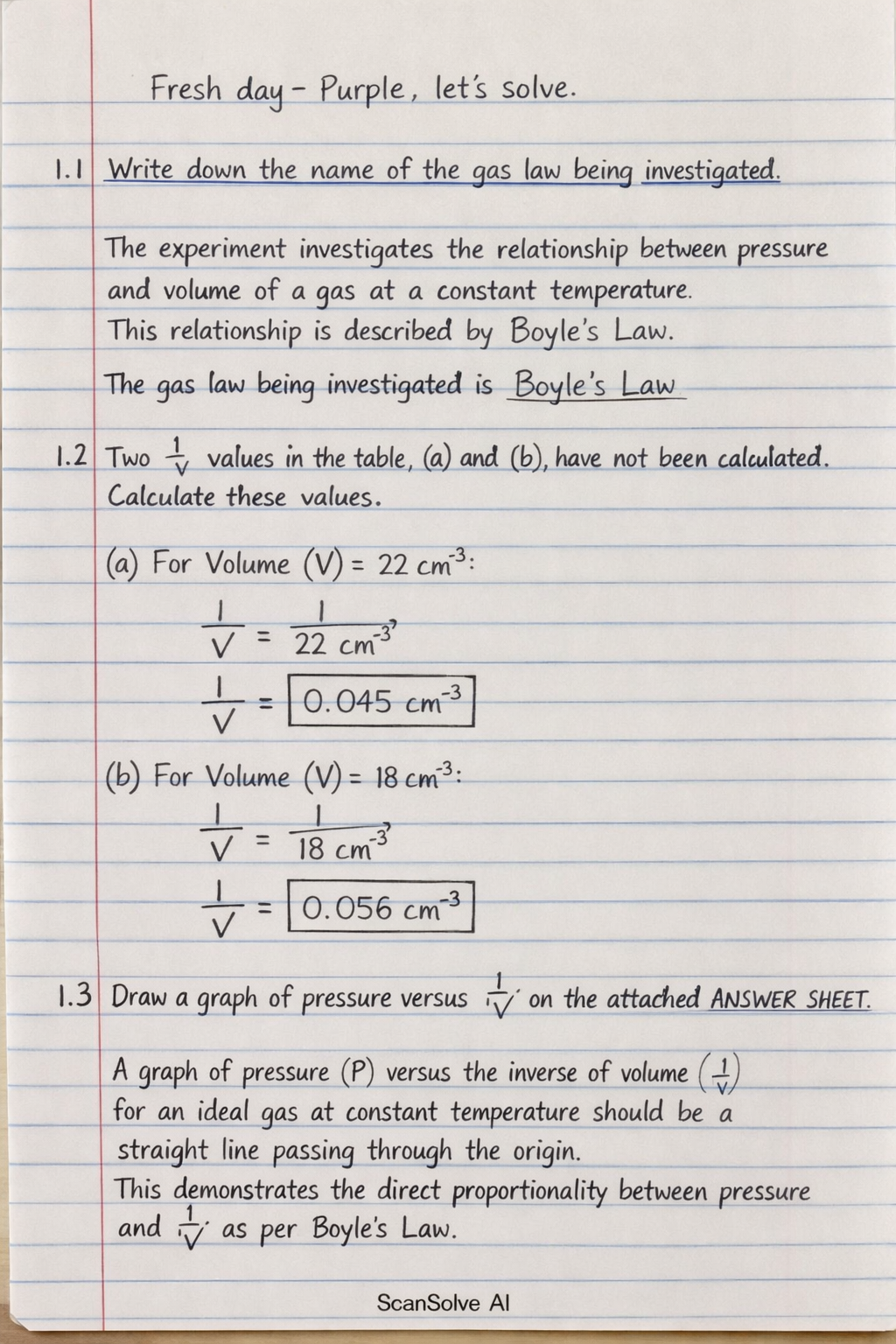
The experiment investigates the relationship between pressure and volume of a gas at a constant temperature. This relationship is described by Boyle's Law.
The gas law being investigated is Boyle's Law.
1.2 Two values in the table, (a) and (b), have not been calculated. Calculate these values.
a) For Volume () = 22 cm:
b) For Volume () = 18 cm:
1.3 Draw a graph of pressure versus on the attached ANSWER SHEET.
A graph of pressure () versus the inverse of volume () for an ideal gas at constant temperature should be a straight line passing through the origin. This demonstrates the direct proportionality between pressure and as per Boyle's Law.
1.4 Use the graph to determine the volume of the gas at 68 kPa.
Determine the constant of proportionality () from the given data.
According to Boyle's Law, , where is a constant. Using the first two data points from the table (40 kPa, 0.02 cm) and (80 kPa, 0.04 cm):
The constant is .
Calculate the volume () at a pressure of 68 kPa.
1.5.1 Use the conditions at a pressure of 100 kPa and calculate the molar mass of the enclosed gas.
Given:
Mass of gas () = g
Pressure () = 100 kPa
Volume () = 22 cm (from table at 100 kPa)
Temperature () = 25 °C
Ideal gas constant () =Convert given values to SI units.
Calculate the number of moles () using the Ideal Gas Law ().
Calculate the molar mass () of the gas.
1.5.2 Write down the molecular formula of the enclosed gas.
The calculated molar mass is approximately . The problem states the gas is diatomic.
Comparing this to common diatomic gases:- Nitrogen (N) has a molar mass of . The molecular formula of the enclosed gas is .
1.6 The sketch graph below shows the relationship between volume and temperature for an ideal gas.
This graph illustrates Charles's Law. It shows that for a fixed amount of gas at constant pressure, the volume is directly proportional to its absolute temperature (in Kelvin). The linear relationship passing through the origin is characteristic of this law.
Still stuck on this one?
Ask a follow-up, and the answer starts from this question.
More Physics Questions
Handwritten Step-by-Step Solution
Get this as a handwritten image on WhatsApp — like a tutor wrote it for you.
Try on WhatsApp