We read your photo as:

A U-tube manometer contains mercury. The open end is exposed to atmospheric pressure of 75 cmHg. A column of water 68 cm high exerts pressure. The difference in mercury levels is 30 cm. Calculate the

Physics

ScanSolve AI Answer

Answer

53312 Pa\textbf{53312 Pa}

Step-by-step solution

5 steps
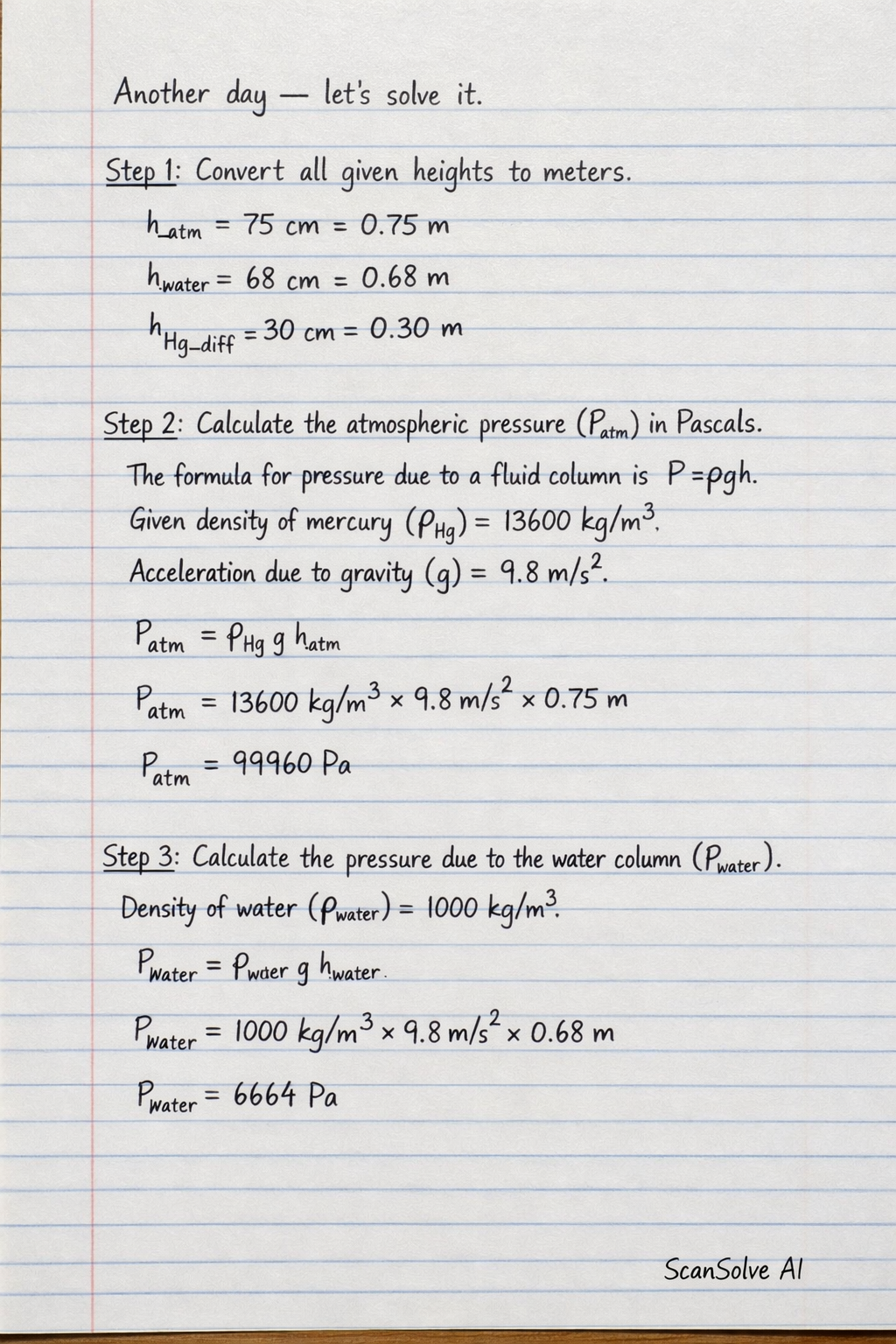
  1. Convert all given heights to meters.

    The atmospheric pressure is given as 75 cmHg75 \text{ cmHg}.

    hatm=75 cm=0.75 mh_{atm} = 75 \text{ cm} = 0.75 \text{ m}

    The height of the water column is 68 cm68 \text{ cm}.

    hwater=68 cm=0.68 mh_{water} = 68 \text{ cm} = 0.68 \text{ m}

    The difference in the mercury levels in the U-tube is 30 cm30 \text{ cm}.

    hHg_diff=30 cm=0.30 mh_{Hg\_diff} = 30 \text{ cm} = 0.30 \text{ m}
  2. Calculate the atmospheric pressure (PatmP_{atm}) in Pascals.

    The formula for pressure due to a fluid column is P=ρghP = \rho g h.
    Given density of mercury (ρHg\rho_{Hg}) = 13600 kg/m313600 \text{ kg/m}^3.
    Acceleration due to gravity (gg) = 9.8 m/s29.8 \text{ m/s}^2.

    Patm=ρHgghatmP_{atm} = \rho_{Hg} g h_{atm} Patm=13600 kg/m3×9.8 m/s2×0.75 mP_{atm} = 13600 \text{ kg/m}^3 \times 9.8 \text{ m/s}^2 \times 0.75 \text{ m} Patm=99960 PaP_{atm} = 99960 \text{ Pa}
  3. Calculate the pressure due to the water column (PwaterP_{water}).

    Density of water (ρwater\rho_{water}) = 1000 kg/m31000 \text{ kg/m}^3.

    Pwater=ρwaterghwaterP_{water} = \rho_{water} g h_{water} Pwater=1000 kg/m3×9.8 m/s2×0.68 mP_{water} = 1000 \text{ kg/m}^3 \times 9.8 \text{ m/s}^2 \times 0.68 \text{ m} Pwater=6664 PaP_{water} = 6664 \text{ Pa}
  4. Calculate the pressure due to the mercury column difference (PHg_diffP_{Hg\_diff}).

    PHg_diff=ρHgghHg_diffP_{Hg\_diff} = \rho_{Hg} g h_{Hg\_diff} PHg_diff=13600 kg/m3×9.8 m/s2×0.30 mP_{Hg\_diff} = 13600 \text{ kg/m}^3 \times 9.8 \text{ m/s}^2 \times 0.30 \text{ m} PHg_diff=39984 PaP_{Hg\_diff} = 39984 \text{ Pa}
  5. Determine the pressure of the trapped air (PairP_{air}).

    By balancing the pressure at the horizontal level of the lower mercury surface (indicated by the dashed line):
    The pressure on the left side (open to atmosphere) is PatmP_{atm}.
    The pressure on the right side (containing trapped air, water, and mercury above the dashed line) is the sum of the trapped air pressure, the pressure due to the water column, and the pressure due to the mercury column difference.

    Patm=Pair+Pwater+PHg_diffP_{atm} = P_{air} + P_{water} + P_{Hg\_diff}

    Rearrange to solve for PairP_{air}:

    Pair=Patm−Pwater−PHg_diffP_{air} = P_{atm} - P_{water} - P_{Hg\_diff} Pair=99960 Pa−6664 Pa−39984 PaP_{air} = 99960 \text{ Pa} - 6664 \text{ Pa} - 39984 \text{ Pa} Pair=53312 PaP_{air} = 53312 \text{ Pa}

    The pressure of the trapped air is:

    53312 Pa\textbf{53312 Pa}
Was this helpful?

Try one yourself

A new problem that tests the same skill.

Still stuck on this one?

Ask a follow-up, and the answer starts from this question.

Got a different question?Ask your own question
Handwritten step-by-step solution preview

Handwritten Step-by-Step Solution

Get this as a handwritten image on WhatsApp — like a tutor wrote it for you.

Try on WhatsApp