We read your photo as:

A glass flask has a capacity of 60 cm³ at 12 °C. Calculate the capacity of the flask at a temperature of 50 °C if the glass has a linear coefficient of expansion of 9 × 10⁻⁶/°C.

Physics

ScanSolve AI Answer

Answers

3 parts
a

60.06804 cm3\text{60.06804 cm}^3

b

0.4536 cm3\text{0.4536 cm}^3

c

0.38556 cm3\text{0.38556 cm}^3

Step-by-step solution

5 steps

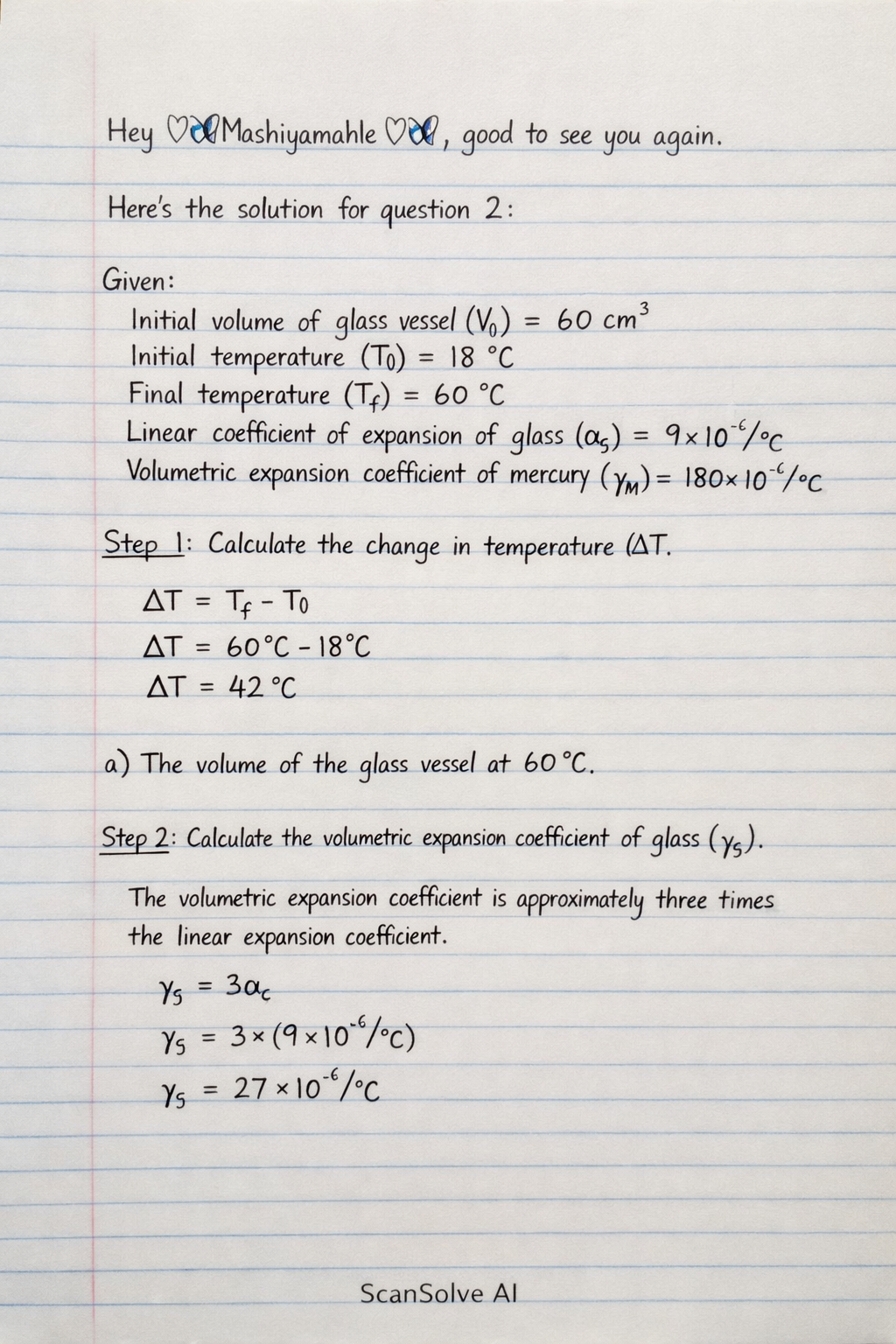
Here's the solution for question 2:

Given:
Initial volume of glass vessel (V0V_0) = 60 cm360 \text{ cm}^3
Initial temperature (T0T_0) = 18 °C18 \text{ °C}
Final temperature (TfT_f) = 60 °C60 \text{ °C}
Linear coefficient of expansion of glass (αg\alpha_g) = 9×10⁻⁶ /°C9 \times 10^{-6} \text{ /°C}
Volumetric expansion coefficient of mercury (γm\gamma_m) = 180×10−6 /°C180 \times 10^{-6} \text{ /°C}

Step 1: Calculate the change in temperature (ΔT\Delta T).

ΔT=Tf−T0=60 °C−18 °C=42 °C\Delta T = T_f - T_0 = 60 \text{ °C} - 18 \text{ °C} = 42 \text{ °C}

Part a· 3 steps

The volume of the glass vessel at 60 °C.

  1. Calculate the volumetric expansion coefficient of glass (γg\gamma_g).

    The volumetric expansion coefficient is approximately three times the linear expansion coefficient.

    γg=3αg=3×(9×10−6 /°C)=27×10−6 /°C\gamma_g = 3 \alpha_g = 3 \times (9 \times 10^{-6} \text{ /°C}) = 27 \times 10^{-6} \text{ /°C}
  2. Calculate the change in volume of the glass vessel (ΔVg\Delta V_g).

    ΔVg=V0γgΔT\Delta V_g = V_0 \gamma_g \Delta T ΔVg=(60 cm3)×(27×10−6 /°C)×(42 °C)\Delta V_g = (60 \text{ cm}^3) \times (27 \times 10^{-6} \text{ /°C}) \times (42 \text{ °C}) ΔVg=0.06804 cm3\Delta V_g = 0.06804 \text{ cm}^3
  3. Calculate the final volume of the glass vessel (Vf,gV_{f,g}).

    Vf,g=V0+ΔVg=60 cm3+0.06804 cm3V_{f,g} = V_0 + \Delta V_g = 60 \text{ cm}^3 + 0.06804 \text{ cm}^3 Vf,g=60.06804 cm3V_{f,g} = \boxed{\text{60.06804 cm}^3}

Part b

0.4536 cm3\text{0.4536 cm}^3

The absolute expansion of mercury.

  1. Calculate the absolute change in volume of mercury (ΔVm\Delta V_m).

    The initial volume of mercury is the same as the initial volume of the vessel, V0=60 cm3V_0 = 60 \text{ cm}^3.

    ΔVm=V0γmΔT\Delta V_m = V_0 \gamma_m \Delta T ΔVm=(60 cm3)×(180×10−6 /°C)×(42 °C)\Delta V_m = (60 \text{ cm}^3) \times (180 \times 10^{-6} \text{ /°C}) \times (42 \text{ °C}) ΔVm=0.4536 cm3\Delta V_m = 0.4536 \text{ cm}^3 ΔVm=0.4536 cm3\Delta V_m = \boxed{\text{0.4536 cm}^3}

Part c

0.38556 cm3\text{0.38556 cm}^3

The apparent expansion of the mercury.

  1. Calculate the apparent expansion of mercury (ΔVapp\Delta V_{app}).

    The apparent expansion is the difference between the absolute expansion of mercury and the expansion of the glass vessel.

    ΔVapp=ΔVm−ΔVg\Delta V_{app} = \Delta V_m - \Delta V_g ΔVapp=0.4536 cm3−0.06804 cm3\Delta V_{app} = 0.4536 \text{ cm}^3 - 0.06804 \text{ cm}^3 ΔVapp=0.38556 cm3\Delta V_{app} = \boxed{\text{0.38556 cm}^3}
Was this helpful?

Still stuck on this one?

Ask a follow-up, and the answer starts from this question.

Got a different question?Ask your own question
Handwritten step-by-step solution preview

Handwritten Step-by-Step Solution

Get this as a handwritten image on WhatsApp — like a tutor wrote it for you.

Try on WhatsApp