
We read your photo as:
What are your observations? Discuss it with your friends and compare them with the observations and conclusions in Annex 2.2.
ScanSolve AI Answer
Step-by-step solution
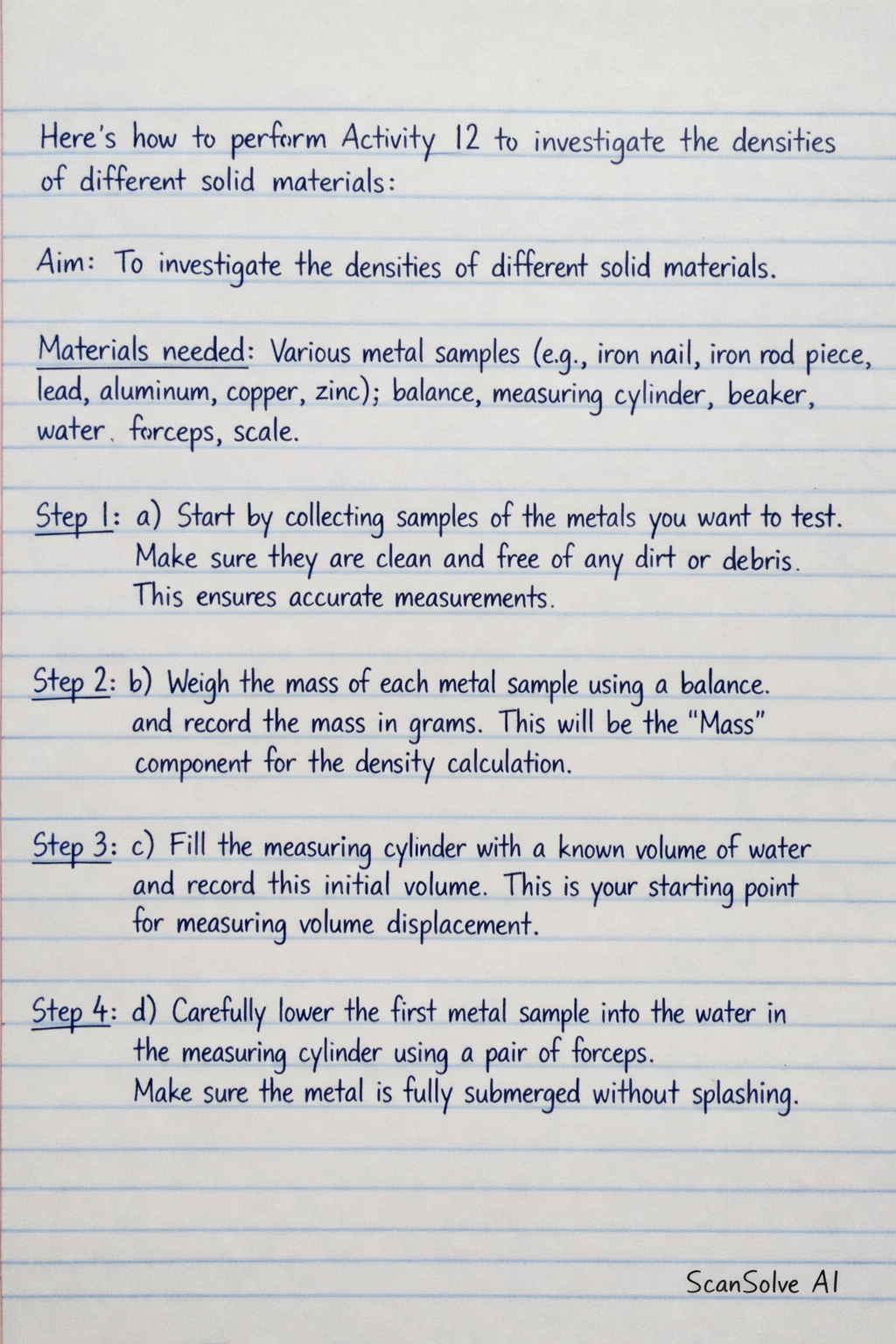
8 stepsHere's how to perform Activity 12 to investigate the densities of different solid materials:
Aim: To investigate the densities of different solid materials.
Materials needed: Various metal samples (e.g., iron nail, iron rod piece, lead, aluminium, copper, zinc), balance, measuring cylinder, beaker, water, forceps, scale.
a)* Start by collecting samples of the metals you want to test.
Make sure they are clean and free of any dirt or debris. This ensures accurate measurements.
b)* Weigh the mass of each metal sample using a balance and record the mass in grams.
This will be the 'Mass' component for the density calculation.
c)* Fill the measuring cylinder with a known volume of water and record this initial volume.
This is your starting point for measuring volume displacement.
d)* Carefully lower the first metal sample into the water in the measuring cylinder using a pair of forceps.
Make sure the metal is fully submerged without splashing.
e)* Measure and record the new increased volume of water after adding the metal sample.
The volume should be measured in or (where ).
f)* Repeat steps b through e for each metal sample you wish to test.
This ensures you have mass and volume data for all samples.
g)* Calculate the volume of each metal sample by subtracting the initial volume of water (from step c) from the final volume of water (from step e).
h)* Use the formula
Density = Mass / Volume to calculate the density of each metal sample.
The unit for density will typically be or .
Still stuck on this one?
Ask a follow-up, and the answer starts from this question.
More Physics Questions
Handwritten Step-by-Step Solution
Get this as a handwritten image on WhatsApp — like a tutor wrote it for you.
Try on WhatsApp