
We read your photo as:
Calculate the temperature change of a 1 cm³ object if its volume expands by 0.0018 cm³ given a linear expansivity of 2.0 x 10⁻⁵ K⁻¹.
Physics
ScanSolve AI Answer
Step-by-step solution
3 stepsTo find the temperature change , we use the formula for volume expansion:
where:
- is the change in volume
- is the coefficient of volume expansivity
- is the initial volume
- is the change in temperature
We are given:
- Initial volume () =
- Change in volume () =
- Linear expansivity () =
Calculate the coefficient of volume expansivity ().
For an isotropic material, the volume expansivity is approximately three times the linear expansivity:
Rearrange the volume expansion formula to solve for .
Substitute the values into the formula.
Since a change in temperature of is equivalent to a change of , the temperature change is .
Comparing this to the given options:
(A)
(B)
(C)
(D)The calculated value matches option (C).
The final answer is
\boxed{\text{(C) 30^\circ C}}
Was this helpful?
Still stuck on this one?
Ask a follow-up, and the answer starts from this question.
Got a different question?Ask your own question
More Physics Questions
QA metal bar increases in length by 0.05% when heated from 0°C to 100°C. Calculate its coefficient of…QA glass flask has a capacity of 60 cm³ at 12 °C. Calculate the capacity of the flask at a…QA glass flask of volume 100 extcm3 is filled to the brim with liquid whose cubical coefficient of…QA liquid has an initial density of 7.00 × 10³ kg/m3 at 10°C. If the coefficient of cubic expansivity…QA solution has a volume of 95 cm³ and a density of 1 g/cm³. The temperature of the solution…
Browse by topic:Thermodynamics
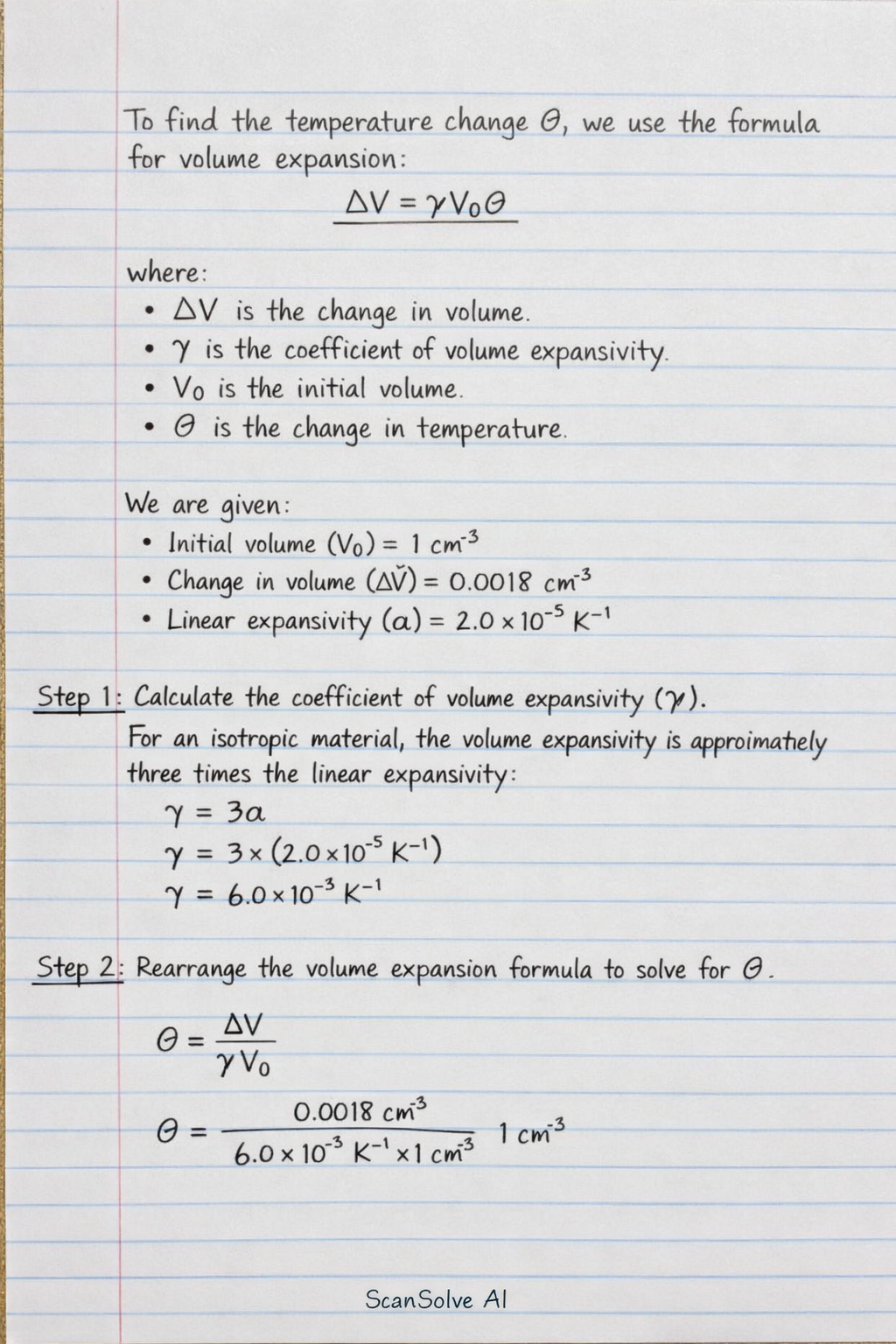
Handwritten Step-by-Step Solution
Get this as a handwritten image on WhatsApp — like a tutor wrote it for you.
Try on WhatsApp