
We read your photo as:
A glass flask of volume 100 extcm3 is filled to the brim with liquid whose cubical coefficient of expansion is 1 imes10⁻³ ext per ^. The flask and its liquid content are originally at 20^. Determine
ScanSolve AI Answer
Answers
2 partsStep-by-step solution
12 stepsHere are the solutions to questions 10, 11, 12, and 13.
10. A glass flask of volume is filled to the brim with liquid whose cubical coefficient of expansion is . The flask and its liquid content are originally at . Determine the volume of liquid which will overflow upon heating the flask to if the coefficient of linear expansion of glass is .
Step 1: Identify the given values and calculate the change in temperature.
Initial volume, .
Cubical coefficient of expansion of liquid, .
Linear coefficient of expansion of glass, .
Initial temperature, .
Final temperature, .
Change in temperature, .
Step 2: Calculate the cubical coefficient of expansion for glass.
The cubical coefficient of expansion for a solid is approximately three times its linear coefficient of expansion:
Step 3: Calculate the change in volume for the liquid and the flask.
The change in volume is given by .
For the liquid:
For the flask:
Step 4: Determine the volume of liquid that overflows.
The volume of liquid that overflows is the difference between the expansion of the liquid and the expansion of the flask.
The volume of liquid that will overflow is .
11. of water is to be heated from room temperature () to in order to prepare hot cup of coffee. (a) What is the minimum heat required? (b) How long will it take to heat the water with a heating coil which has a heating efficiency of ?
Given constants:
- Density of water, .
- Specific heat capacity of water, .
Part a· 3 steps
What is the minimum heat required?
Calculate the mass of the water.
Volume of water, .
Calculate the change in temperature.
Initial temperature, .
Final temperature, .Calculate the minimum heat required using .
The minimum heat required is .
Part b
How long will it take to heat the water with a heating coil which has a heating efficiency of ?
Calculate the useful power of the heating coil.
Power of heating coil, .
Efficiency, .Calculate the time taken using .
To convert to minutes:
It will take approximately (or ).
12. A metal slab at temperature is taken from a furnace and plunged into of oil originally at . The final temperature of the oil/slab is . Determine the specific heat capacity of the metal if that of oil is .
Identify the given values.
Mass of metal, .
Initial temperature of metal, .
Mass of oil, .
Initial temperature of oil, .
Final equilibrium temperature, .
Specific heat capacity of oil, .Apply the principle of calorimetry (Heat lost by metal = Heat gained by oil).
Substitute the values into the equation.
Solve for .
The specific heat capacity of the metal is .
13. A ice-block at is dumped into a thermally insulated container of water at . How much water is frozen if the specific heat of ice is and latent heat of fusion is ?
Identify the given values.
Mass of ice, .
Initial temperature of ice, .
Initial temperature of water, .
Specific heat capacity of ice, .
Latent heat of fusion of ice, .The problem implies that the final equilibrium temperature is , and some water freezes. This means the heat gained by the ice to warm up to is supplied by the freezing of some of the water.
Calculate the heat gained by the ice to warm from to .
Determine the mass of water that freezes
Try one yourself
A new problem that tests the same skill.
Still stuck on this one?
Ask a follow-up, and the answer starts from this question.
More Physics Questions
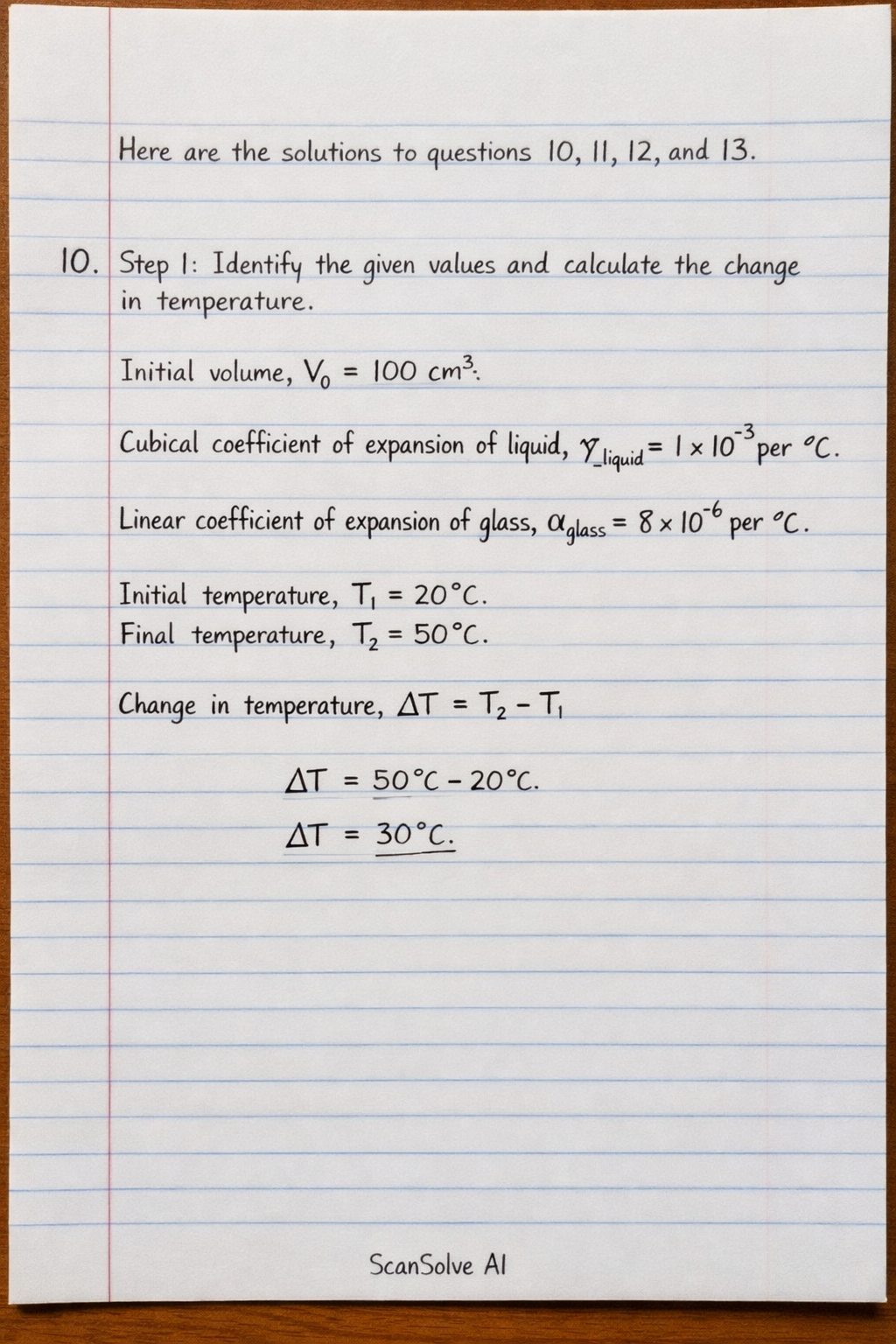
Handwritten Step-by-Step Solution
Get this as a handwritten image on WhatsApp — like a tutor wrote it for you.
Try on WhatsApp