
We read your photo as:
A sharp-edged orifice in the side of a large tank discharges water under a constant pressure head of 4 m. The orifice diameter is 50 mm and the jet diameter is 40 mm. The water jet moves through a horizontal distance of 2.25 m. The jet falls a vertical distance of 0.33 m. Calculate:
ScanSolve AI Answer
Step-by-step solution
10 stepsOkay, I have the full problem now. Let's calculate each part for .
Given:
- Head,
- Orifice diameter,
- Jet diameter,
- Horizontal distance of jet,
- Vertical distance of jet fall,
- Acceleration due to gravity,
Part 3.1· 1 step
The area of the orifice.
Calculate the area of the orifice () using its diameter.
Part 3.2· 1 step
The area of the jet.
Calculate the area of the jet () using its diameter.
Part 3.3· 1 step
The theoretical velocity of the jet.
Calculate the theoretical velocity () using Torricelli's law.
Part 3.4· 2 steps
The actual velocity of the jet.
Calculate the time () it takes for the jet to fall vertically.
The vertical motion is given by .
Calculate the actual velocity () using the horizontal distance and time.
The horizontal motion is given by .
Part 3.5· 1 step
The theoretical discharge.
Calculate the theoretical discharge () using the theoretical velocity and orifice area.
Part 3.6· 1 step
The actual discharge.
Calculate the actual discharge () using the actual velocity and jet area.
Part 3.7· 1 step
The coefficient of delivery (coefficient of discharge, ).
Calculate the coefficient of discharge () using the actual and theoretical discharges.
Part 3.8· 1 step
The coefficient of velocity ().
Calculate the coefficient of velocity () using the actual and theoretical velocities.
Part 3.9· 1 step
The coefficient of contraction ().
Calculate the coefficient of contraction () using the areas of the jet and orifice.
Still stuck on this one?
Ask a follow-up, and the answer starts from this question.
More Physics Questions
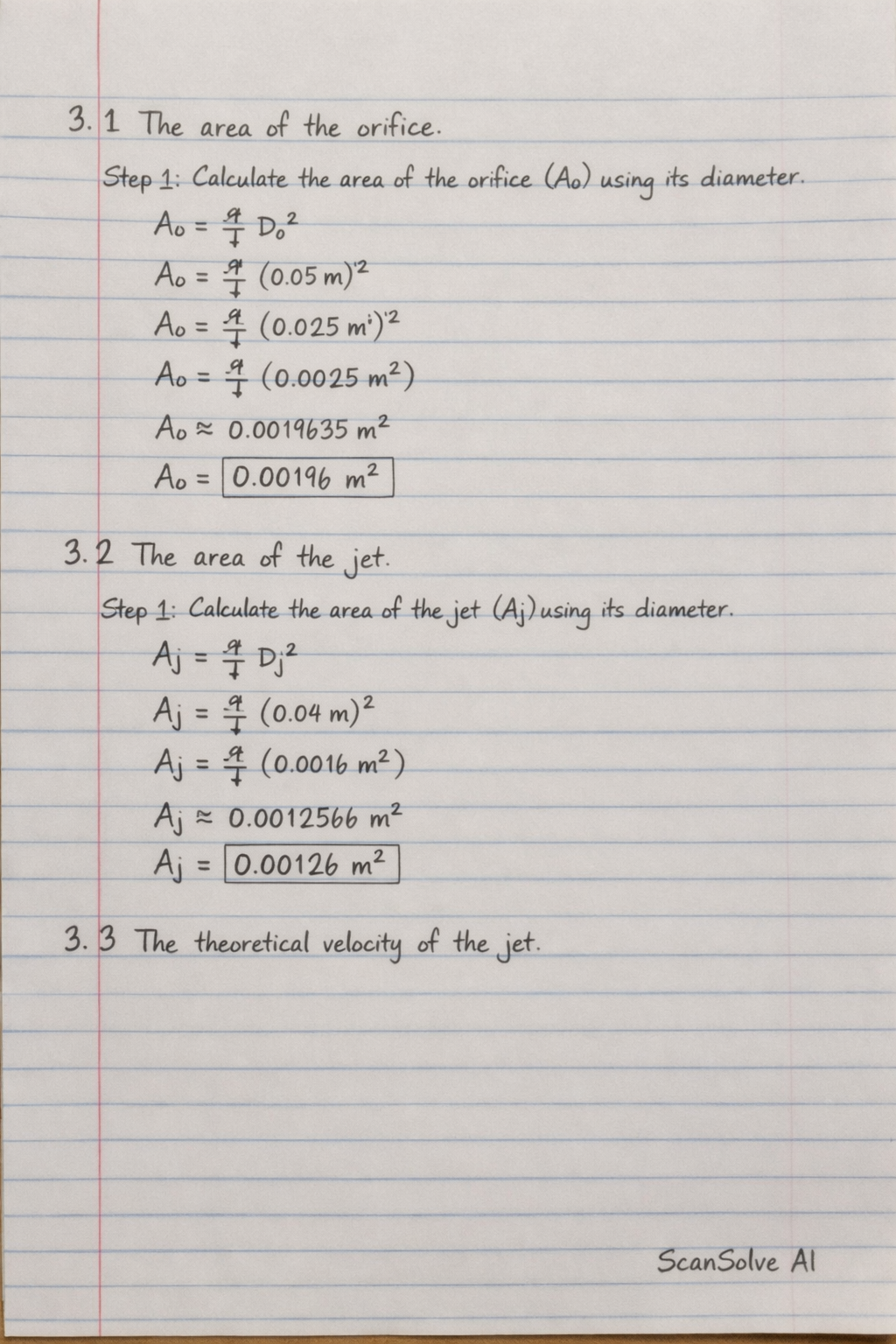
Handwritten Step-by-Step Solution
Get this as a handwritten image on WhatsApp — like a tutor wrote it for you.
Try on WhatsApp