Calculate the coefficient of discharge (Cd) for an orifice with a diameter of 50 mm in the side of a tank containing water at a constant head of 3 m. The actual discharge of water from orifice is 45 000 litres per hour (l/h).
|Physics
Calculate the coefficient of discharge (Cd) for an orifice with a diameter of 50 mm in the side of a tank containing water at a constant head of 3 m. The actual discharge of water from orifice is 45 000 litres per hour (l/h).
ScanSolve AI Answer
Answer
132.39 kPa
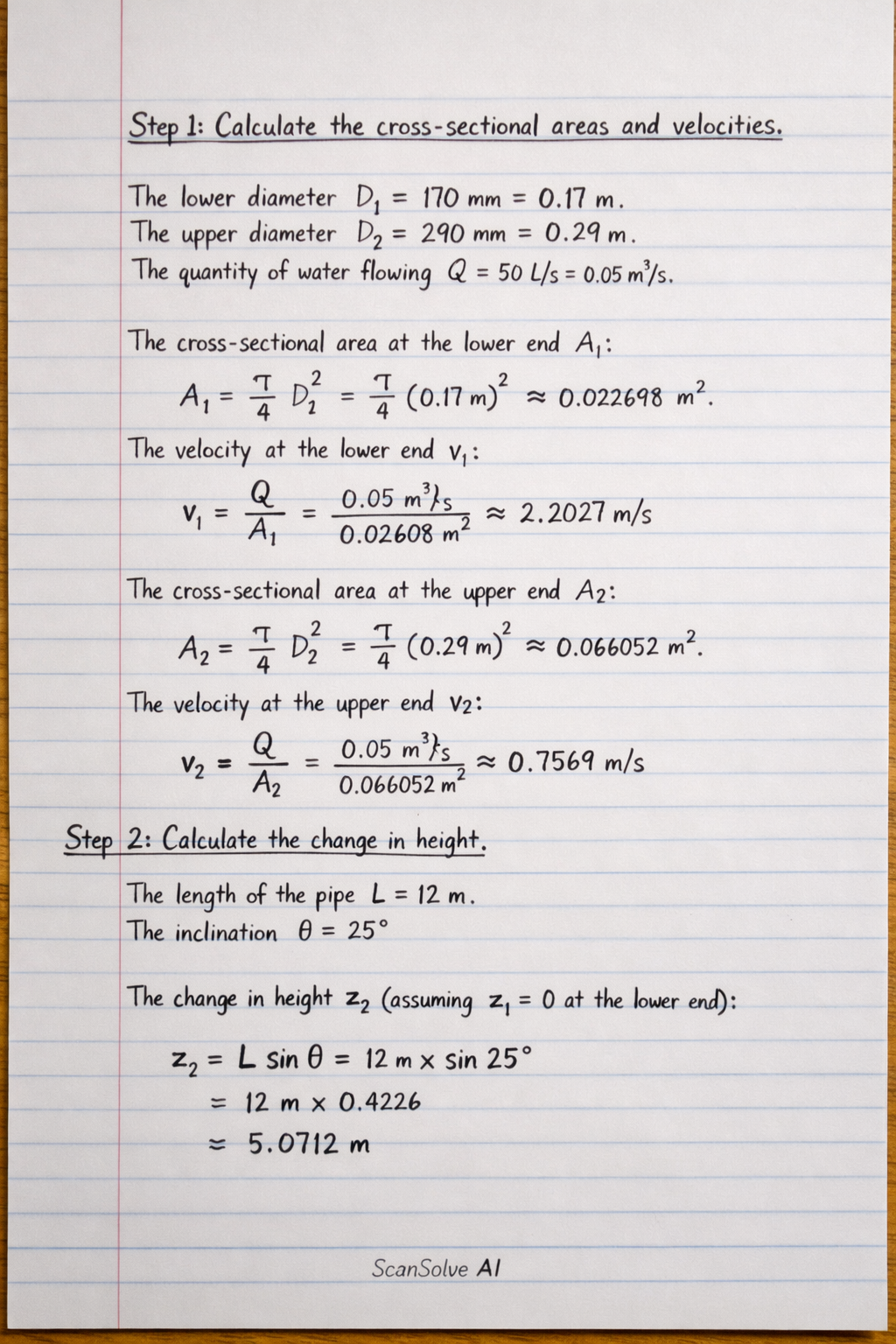
Step 1: Calculate the cross-sectional areas and velocities.
The lower diameter D1=170 mm =0.17 m.
The upper diameter D2=290 mm =0.29 m.
The quantity of water flowing Q=50 L/s =0.05 m3/s.
The cross-sectional area at the lower end A1:
A1=4πD12=4π(0.17m)2≈0.022698m2
The velocity at the lower end v1:
v1=A1Q=0.022698m20.05m3/s≈2.2027m/s
The cross-sectional area at the upper end A2:
A2=4πD22=4π(0.29m)2≈0.066052m2
The velocity at the upper end v2:
v2=A2Q=0.066052m20.05m3/s≈0.7569m/s
Step 2: Calculate the change in height.
The length of the pipe L=12 m.
The inclination θ=25∘.
The change in height z2 (assuming z1=0 at the lower end):
z2=Lsin(θ)=12m×sin(25∘)≈12m×0.4226≈5.0712m
Step 3: Apply Bernoulli's equation to find the pressure at the upper end.
Bernoulli's equation (neglecting head losses):
ρgP1+2gv12+z1=ρgP2+2gv22+z2
Given P1=180 kPa =180×103 Pa, ρ=1000 kg/m3, g=9.81 m/s2.
Rearranging for P2:
P2=P1+21ρ(v12−v22)−ρg(z2−z1)P2=180×103Pa+21(1000kg/m3)((2.2027m/s)2−(0.7569m/s)2)−(1000kg/m3)(9.81m/s2)(5.0712m)P2=180000+500(4.8518−0.5729)−49748.472P2=180000+500(4.2789)−49748.472P2=180000+2139.45−49748.472P2≈132390.978Pa≈132.39kPa
The pressure at the upper end of the pipe is 132.39kPa.
5.1.2 The change in kinetic energy of the liquid over the length of the pipe
Step 1: Calculate the rate of change of kinetic energy.
The change in kinetic energy of the liquid over the length of the pipe refers to the rate of change of kinetic energy (power) of the fluid as it flows from the lower to the upper end.
The mass flow rate m˙=ρQ=1000kg/m3×0.05m3/s=50 kg/s.
The change in kinetic energy rate ΔKE:
ΔKE=21m˙(v22−v12)ΔKE=21(50kg/s)((0.7569m/s)2−(2.2027m/s)2)ΔKE=25(0.5729−4.8518)ΔKE=25(−4.2789)ΔKE≈−106.97W
The change in kinetic energy of the liquid over the length of the pipe is −106.97W.
5.2 Calculate the coefficient of discharge (Cd) for an orifice
Step 1: Convert the actual discharge to m3/s.
The actual discharge Qactual=45000 litres/hour.
Qactual=45000L/h×1000L1m3×3600s1h=360045m3/s=0.0125m3/s
Step 2: Calculate the theoretical discharge.
The orifice diameter d=50 mm =0.05 m.
The area of the orifice A:
A=4πd2=4π(0.05m)2≈0.0019635m2
The constant head H=3 m.
The theoretical velocity vtheoretical:
vtheoretical=2gH=2×9.81m/s2×3m=58.86m/s≈7.672m/s
The theoretical discharge Qtheoretical:
Qtheoretical=A×vtheoretical=0.0019635m2×7.672m/s≈0.01507m3/s
Step 3: Calculate the coefficient of discharge (Cd).
Cd=QtheoreticalQactual=0.01507m3/s0.0125m3/s≈0.82946
The coefficient of discharge (Cd) is 0.83.
6.1 Name the TWO main types of static loads on bearings.
The two main types of static loads on bearings are:
• Radial load
• Axial load (or thrust load)
6.2 Name FOUR of these factors to be considered when selecting the correct type and size of bearing.
Four factors to consider when selecting the correct type and size bearing are:
• Type of load (radial, axial, or combined)
• Magnitude of load (static and dynamic)
• Operating speed
• Required life
6.3 Calculate the expected service life of the bearing in hours.
Step 1: Identify given values and the life formula.
Equivalent dynamic bearing load P=4100 N.
Basic dynamic load rating C=44.3 kN =44300 N.
The bearing is a roller bearing, so the life exponent a=10/3.
The life formula in millions of revolutions (L10):
L10=(PC)a
The life in hours (L10h) is given by:
L10h=60n106(PC)a
where n is the operating speed in revolutions per minute (rpm).
Step 2: Calculate the life in millions of revolutions.
L10=(4100N44300N)10/3=(10.804878)10/3≈1800.7millionrevolutions
The problem asks for the service life in hours but does not provide the operating speed (n) of the bearing. Without the operating speed, it is not possible to convert the life from revolutions to hours.
The expected service life of the bearing in hours cannot be calculated without the operating speed (rpm).
6.4 Calculate the radial force between the 20° involute gears.
Step 1: Calculate the angular velocity.
The speed N=1100 r/min.
ω=602πN=602π×1100rad/s=3110πrad/s≈115.19rad/s
Step 2: Calculate the pitch line velocity.
The pitch circle diameter dp=142 mm =0.142 m.
v=2ωdp=2115.19rad/s×0.142m≈8.1785m/s
Step 3: Calculate the tangential force.
The power transmitted Ppower=200 kW =200×103 W.
Ft=vPpower=8.1785m/s200×103W≈24455.7N
Step 4: Calculate the radial force.
The pressure angle ϕ=20∘.
The radial force Fr is related to the tangential force Ft by:
Fr=Fttan(ϕ)Fr=24455.7N×tan(20∘)Fr≈24455.7N×0.36397Fr≈8900.0N
The radial force between the gears is 8900.0N.
What's next?
Was this helpful?
Need help with your own homework?
Get instant step-by-step solutions to any question. Free to start.
Calculate the cross-sectional areas and velocities. The lower diameter D_1 = 170 mm = 0.17 m.
Calculate the coefficient of discharge (Cd) for an orifice with a diameter of 50 mm in the side of a tank containing water at a constant head of 3 m. The actual discharge of water from orifice is 45 000 litres per hour (l/h).
This physics problem tests your understanding of fundamental physical laws and their applications. The step-by-step solution below breaks down the problem using relevant equations and physical reasoning.
ScanSolve AI Answer
Step 1: Calculate the cross-sectional areas and velocities. The lower diameter D_1 = 170 mm = 0.17 m. The upper diameter D_2 = 290 mm = 0.29 m. The quantity of water flowing Q = 50 L/s = 0.05 m^3/s. The cross-sectional area at the lower end A_1: A_1 = ()/(4) D_1^2 = ()/(4) (0.17 m)^2 ≈ 0.022698 m^2 The velocity at the lower end v_1: v_1 = (Q)/(A_1) = 0.05 m^3/s0.022698 m^2 ≈ 2.2027 m/s The cross-sectional area at the upper end A_2: A_2 = ()/(4) D_2^2 = ()/(4) (0.29 m)^2 ≈ 0.066052 m^2 The velocity at the upper end v_2: v_2 = (Q)/(A_2) = 0.05 m^3/s0.066052 m^2 ≈ 0.7569 m/s Step 2: Calculate the change in height. The length of the pipe L = 12 m. The inclination = 25^. The change in height z_2 (assuming z_1 = 0 at the lower end): z_2 = L () = 12 m × (25^) ≈ 12 m × 0.4226 ≈ 5.0712 m Step 3: Apply Bernoulli's equation to find the pressure at the upper end. Bernoulli's equation (neglecting head losses): (P_1)/( g) + (v_1^2)/(2g) + z_1 = (P_2)/( g) + (v_2^2)/(2g) + z_2 Given P_1 = 180 kPa = 180 × 10^3 Pa, = 1000 kg/m^3, g = 9.81 m/s^2. Rearranging for P_2: P_2 = P_1 + (1)/(2)(v_1^2 - v_2^2) - g (z_2 - z_1) P_2 = 180 × 10^3 Pa + (1)/(2)(1000 kg/m^3)((2.2027 m/s)^2 - (0.7569 m/s)^2) - (1000 kg/m^3)(9.81 m/s^2)(5.0712 m) P_2 = 180000 + 500(4.8518 - 0.5729) - 49748.472 P_2 = 180000 + 500(4.2789) - 49748.472 P_2 = 180000 + 2139.45 - 49748.472 P_2 ≈ 132390.978 Pa ≈ 132.39 kPa The pressure at the upper end of the pipe is 132.39 kPa. 5.1.2 The change in kinetic energy of the liquid over the length of the pipe Step 1: Calculate the rate of change of kinetic energy. The change in kinetic energy of the liquid over the length of the pipe refers to the rate of change of kinetic energy (power) of the fluid as it flows from the lower to the upper end. The mass flow rate m = Q = 1000 kg/m^3 × 0.05 m^3/s = 50 kg/s. The change in kinetic energy rate KE: KE = (1)/(2) m (v_2^2 - v_1^2) KE = (1)/(2) (50 kg/s) ((0.7569 m/s)^2 - (2.2027 m/s)^2) KE = 25 (0.5729 - 4.8518) KE = 25 (-4.2789) KE ≈ -106.97 W The change in kinetic energy of the liquid over the length of the pipe is -106.97 W. 5.2 Calculate the coefficient of discharge (C_d) for an orifice Step 1: Convert the actual discharge to m^3/s. The actual discharge Q_actual = 45000 litres/hour. Q_actual = 45000 L/h × 1 m^31000 L × 1 h3600 s = (45)/(3600) m^3/s = 0.0125 m^3/s Step 2: Calculate the theoretical discharge. The orifice diameter d = 50 mm = 0.05 m. The area of the orifice A: A = ()/(4) d^2 = ()/(4) (0.05 m)^2 ≈ 0.0019635 m^2 The constant head H = 3 m. The theoretical velocity v_theoretical: v_theoretical = sqrt(2gH) = sqrt(2 × 9.81 m/s)^2 × 3 m = sqrt(58.86) m/s ≈ 7.672 m/s The theoretical discharge Q_theoretical: Q_theoretical = A × v_theoretical = 0.0019635 m^2 × 7.672 m/s ≈ 0.01507 m^3/s Step 3: Calculate the coefficient of discharge (C_d). C_d = Q_actualQ_theoretical = 0.0125 m^3/s0.01507 m^3/s ≈ 0.82946 The coefficient of discharge (C_d) is 0.83. 6.1 Name the TWO main types of static loads on bearings. The two main types of static loads on bearings are: • Radial load • Axial load (or thrust load) 6.2 Name FOUR of these factors to be considered when selecting the correct type and size of bearing. Four factors to consider when selecting the correct type and size bearing are: • Type of load (radial, axial, or combined) • Magnitude of load (static and dynamic) • Operating speed • Required life 6.3 Calculate the expected service life of the bearing in hours. Step 1: Identify given values and the life formula. Equivalent dynamic bearing load P = 4100 N. Basic dynamic load rating C = 44.3 kN = 44300 N. The bearing is a roller bearing, so the life exponent a = 10/3. The life formula in millions of revolutions (L_10): L_10 = ((C)/(P))^a The life in hours (L_10h) is given by: L_10h = (10^6)/(60n) ((C)/(P))^a where n is the operating speed in revolutions per minute (rpm). Step 2: Calculate the life in millions of revolutions. L_10 = (44300 N4100 N)^10/3 = (10.804878)^10/3 ≈ 1800.7 million revolutions The problem asks for the service life in hours but does not provide the operating speed (n) of the bearing. Without the operating speed, it is not possible to convert the life from revolutions to hours. The expected service life of the bearing in hours cannot be calculated without the operating speed (rpm). 6.4 Calculate the radial force between the 20° involute gears. Step 1: Calculate the angular velocity. The speed N = 1100 r/min. = (2 N)/(60) = (2 × 1100)/(60) rad/s = (110 )/(3) rad/s ≈ 115.19 rad/s Step 2: Calculate the pitch line velocity. The pitch circle diameter d_p = 142 mm = 0.142 m. v = ( d_p)/(2) = 115.19 rad/s × 0.142 m2 ≈ 8.1785 m/s Step 3: Calculate the tangential force. The power transmitted P_power = 200 kW = 200 × 10^3 W. F_t = P_powerv = 200 × 10^3 W8.1785 m/s ≈ 24455.7 N Step 4: Calculate the radial force. The pressure angle = 20^. The radial force F_r is related to the tangential force F_t by: F_r = F_t () F_r = 24455.7 N × (20^) F_r ≈ 24455.7 N × 0.36397 F_r ≈ 8900.0 N The radial force between the gears is 8900.0 N. What's next?