

This physics problem tests your understanding of fundamental physical laws and their applications. The step-by-step solution below breaks down the problem using relevant equations and physical reasoning.
ScanSolve AI Answer
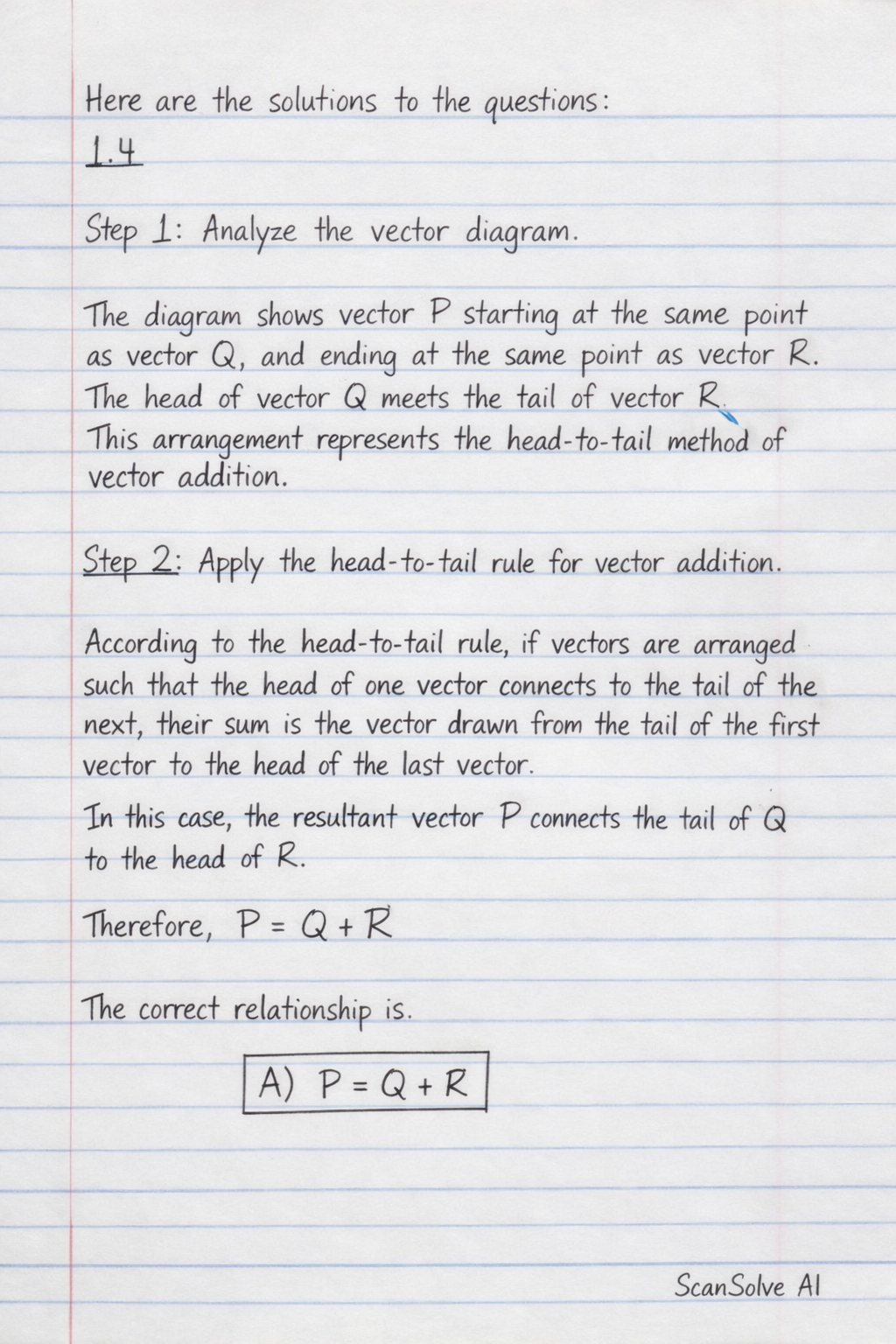
Here are the solutions to the questions: 1.4 Step 1: Analyze the vector diagram. The diagram shows vector P starting at the same point as vector Q, and ending at the same point as vector R. The head of vector Q meets the tail of vector R. This arrangement represents the head-to-tail method of vector addition. Step 2: Apply the head-to-tail rule for vector addition. According to the head-to-tail rule, if vectors are arranged such that the head of one vector connects to the tail of the next, their sum is the vector drawn from the tail of the first vector to the head of the last vector. In this case, the resultant vector P connects the tail of Q to the head of R. Therefore, P = Q + R. The correct relationship is A P = Q + R. 1.5 Step 1: Determine the moles of ammonia (NH_3) produced. At Standard Temperature and Pressure (STP), 1 mole of any gas occupies 22.4 dm^3. Given volume of NH_3 = 22.4 dm^3. Moles of NH_3 = Volume of NH_3Molar volume at STP = 22.4 dm^322.4 dm^3/mol = 1 mol Step 2: Use the mole ratio from the balanced chemical equation to find the moles of hydrogen (H_2) required. The balanced equation is N_2(g) + 3H_2(g) → 2NH_3(g). From the equation, 3 moles of H_2 react to produce 2 moles of NH_3. Moles of H_2 = Moles of NH_3 × 3 mol H_22 mol NH_3 = 1 mol NH_3 × (3)/(2) = 1.5 mol H_2 Step 3: Calculate the volume of hydrogen (H_2) required at STP. Volume of H_2 = Moles of H_2 × Molar volume at STP = 1.5 mol × 22.4 dm^3/mol = 1.5 × 22.4 dm^3 The correct option is C 1.5 × 22.4 dm^3. 1.6 We need to find which option contains 6.02 × 10^23 ATOMS. This is Avogadro's number (N_A) of atoms, which means 1 mole of atoms. A: 1 mole of CO_2 1 mole of CO_2 contains 1 mole of C atoms and 2 moles of O atoms. Total moles of atoms = 1 + 2 = 3 moles of atoms. Number of atoms = 3 × N_A. B: 16 g of O_2 gas Molar mass of O_2 = 2 × 16.00 = 32.00 g/mol. Moles of O_2 = 16 g32 g/mol = 0.5 mol O_2. Since 1 mole of O_2 contains 2 moles of O atoms, 0.5 moles of O_2 contains 0.5 × 2 = 1 mole of O atoms. Number of atoms = 1 × N_A = 6.02 × 10^23 atoms. C: 22.4 dm^3 of N_2 gas at STP At STP, 22.4 dm^3 of any gas is 1 mole of that gas. So, this is 1 mole of N_2. 1 mole of N_2 contains 2 moles of N atoms. Number of atoms = 2 × N_A. D: 18 g of H_2O Molar mass of H_2O = (2 × 1.01) + 16.00 = 18.02 g/mol. Moles of H_2O = 18 g18.02 g/mol ≈ 1 mol H_2O. 1 mole of H_2O contains 2 moles of H atoms and 1 mole of O atoms. Total moles of atoms = 2 + 1 = 3 moles of atoms. Number of atoms = 3 × N_A. Option B contains 6.02 × 10^23 atoms. The correct option is B 16 g of O_2 gas. 1.7 Step 1: Calculate the total molar mass of water (H_2O) in the compound. The compound is Na_2SO_4 · 10H_2O. Molar mass of H_2O = (2 × 1) + 16 = 18 g/mol. Total mass of 10H_2O = 10 × 18 = 180 g/mol. Step 2: Calculate the molar mass of the entire compound Na_2SO_4 · 10H_2O. Molar mass of Na_2SO_4: Na: 2 × 23 = 46 g/mol S: 1 × 32 = 32 g/mol O: 4 × 16 = 64 g/mol Molar mass of Na_2SO_4 = 46 + 32 + 64 = 142 g/mol. Molar mass of Na_2SO_4 · 10H_2O = Molar mass of Na_2SO_4 + Molar mass of 10H_2O = 142 + 180 = 322 g/mol. Step 3: Calculate the percentage composition of water. Percentage of H_2O = Mass of 10H_2OMolar mass of Na_2SO_4 · 10H_2O × 100\% = (180)/(322) × 100\% The correct expression is C (180)/(322) × 100. 1.8 Avogadro's Law states that equal volumes of all gases, at the same temperature and pressure, have the same number of molecules. A direct consequence of this law is that one mole of any gas occupies the same volume under the same conditions of temperature and pressure. The visible part of option A, "A mole of any gas occupies the same volume at the same...", is the beginning of the correct statement of Avogadro's Law. Assuming it completes to "temperature and pressure", it is the correct statement. The correct statement is A A mole of any gas occupies the same volume at the same.... Send me the next one 📸