This mathematics problem involves applying core mathematical principles and formulas. Below you will find a complete step-by-step solution with detailed explanations for each step, helping you understand not just the answer but the method behind it.
ScanSolve AI Answer
Here's the solution to the problem:
Given the vertices of a triangle P(1, -3), Q(7, 5), and R(-3, -5).
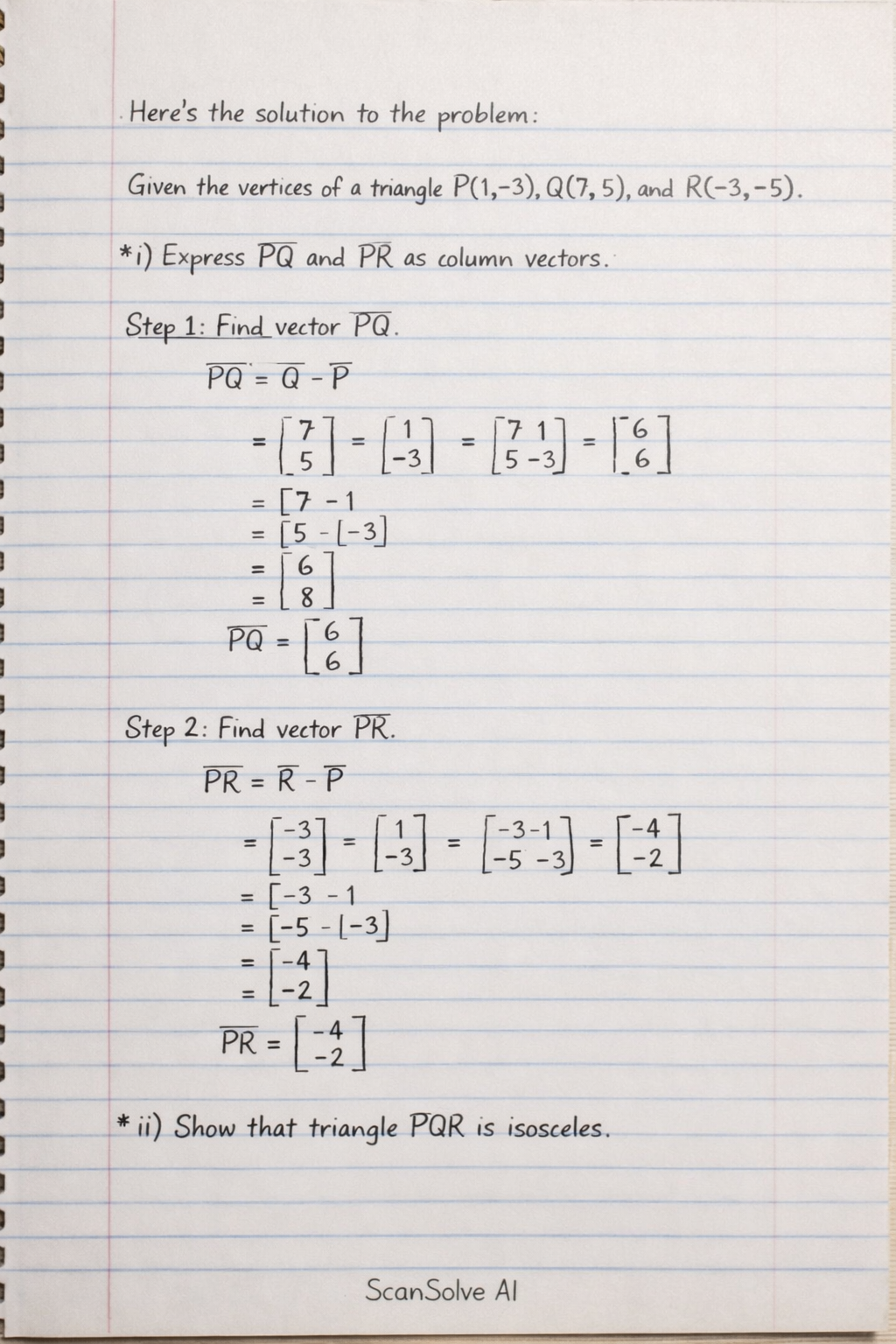
i) Express $\vec{PQ}$ and $\vec{PR}$ as column vectors.
Step 1: Find vector $\vec{PQ}$.
To find the vector from point P to point Q, subtract the coordinates of P from the coordinates of Q.
$$ \vec{PQ} = Q - P = \begin{bmatrix} 7 \\ 5 \end{bmatrix} - \begin{bmatrix} 1 \\ -3 \end{bmatrix} = \begin{bmatrix} 7-1 \\ 5-(-3) \end{bmatrix} = \begin{bmatrix} 6 \\ 5+3 \end{bmatrix} $$
$$ \vec{PQ} = \boxed{\begin{bmatrix} 6 \\ 8 \end{bmatrix}} $$
Step 2: Find vector $\vec{PR}$.
To find the vector from point P to point R, subtract the coordinates of P from the coordinates of R.
$$ \vec{PR} = R - P = \begin{bmatrix} -3 \\ -5 \end{bmatrix} - \begin{bmatrix} 1 \\ -3 \end{bmatrix} = \begin{bmatrix} -3-1 \\ -5-(-3) \end{bmatrix} = \begin{bmatrix} -4 \\ -5+3 \end{bmatrix} $$
$$ \vec{PR} = \boxed{\begin{bmatrix} -4 \\ -2 \end{bmatrix}} $$
ii) Show that triangle PQR is isosceles.
To show that a triangle is isosceles, we need to calculate the lengths of its three sides. If at least two sides have equal length, the triangle is isosceles. The length (magnitude) of a vector $\begin{bmatrix} x \\ y \end{bmatrix}$ is given by $\sqrt{x^2 + y^2}$.
Step 1: Calculate the length of side PQ.
Using $\vec{PQ} = \begin{bmatrix} 6 \\ 8 \end{bmatrix}$:
$$ |\vec{PQ}| = \sqrt{6^2 + 8^2} = \sqrt{36 + 64} = \sqrt{100} = 10 $$
The length of PQ is 10 units.
Step 2: Calculate the length of side PR.
Using $\vec{PR} = \begin{bmatrix} -4 \\ -2 \end{bmatrix}$:
$$ |\vec{PR}| = \sqrt{(-4)^2 + (-2)^2} = \sqrt{16 + 4} = \sqrt{20} $$
The length of PR is $\sqrt{20}$ units, which can be simplified to $2\sqrt{5}$ units.
Step 3: Calculate the length of side QR.
First, find the vector $\vec{QR}$. Subtract the coordinates of Q from the coordinates of R.
$$ \vec{QR} = R - Q = \begin{bmatrix} -3 \\ -5 \end{bmatrix} - \begin{bmatrix} 7 \\ 5 \end{bmatrix} = \begin{bmatrix} -3-7 \\ -5-5 \end{bmatrix} = \begin{bmatrix} -10 \\ -10 \end{bmatrix} $$
Now, calculate the length of $\vec{QR}$:
$$ |\vec{QR}| = \sqrt{(-10)^2 + (-10)^2} = \sqrt{100 + 100} = \sqrt{200} $$
The length of QR is $\sqrt{200}$ units, which can be simplified to $10\sqrt{2}$ units.
Step 4: Compare the lengths of the
Given the vertices of a triangle P(1, -3), Q(7, 5), and R(-3, -5).
|Mathematics
Given the vertices of a triangle P(1, -3), Q(7, 5), and R(-3, -5).
ScanSolve AI Answer
Here's the solution to the problem:
Given the vertices of a triangle P(1, -3), Q(7, 5), and R(-3, -5).
i) Express PQ and PR as column vectors.
Step 1: Find vector PQ.
To find the vector from point P to point Q, subtract the coordinates of P from the coordinates of Q.
PQ=Q−P=[75]−[1−3]=[7−15−(−3)]=[65+3]\vec{PQ} = \begin{bmatrix 6 \\ 8 \end{bmatrix}}
Step 2: Find vector PR.
To find the vector from point P to point R, subtract the coordinates of P from the coordinates of R.
PR=R−P=[−3−5]−[1−3]=[−3−1−5−(−3)]=[−4−5+3]\vec{PR} = \begin{bmatrix -4 \\ -2 \end{bmatrix}}
ii) Show that triangle PQR is isosceles.
To show that a triangle is isosceles, we need to calculate the lengths of its three sides. If at least two sides have equal length, the triangle is isosceles. The length (magnitude) of a vector [xy] is given by x2+y2.
Step 1: Calculate the length of side PQ.
Using PQ=[68]:
∣PQ∣=62+82=36+64=100=10
The length of PQ is 10 units.
Step 2: Calculate the length of side PR.
Using PR=[−4−2]:
∣PR∣=(−4)2+(−2)2=16+4=20
The length of PR is 20 units, which can be simplified to 25 units.
Step 3: Calculate the length of side QR.
First, find the vector QR. Subtract the coordinates of Q from the coordinates of R.
QR=R−Q=[−3−5]−[75]=[−3−7−5−5]=[−10−10]
Now, calculate the length of QR:
∣QR∣=(−10)2+(−10)2=100+100=200
The length of QR is 200 units, which can be simplified to 102 units.
Step 4: Compare the lengths of the
Need help with your own homework?
Get instant step-by-step solutions to any question. Free to start.