
Triangle PQR has vertices P(3,2),Q(-1,1) and R(-3-1)
Mathematics
ScanSolve AI Answer
Answer
PQ
QR
RP
Step-by-step solution
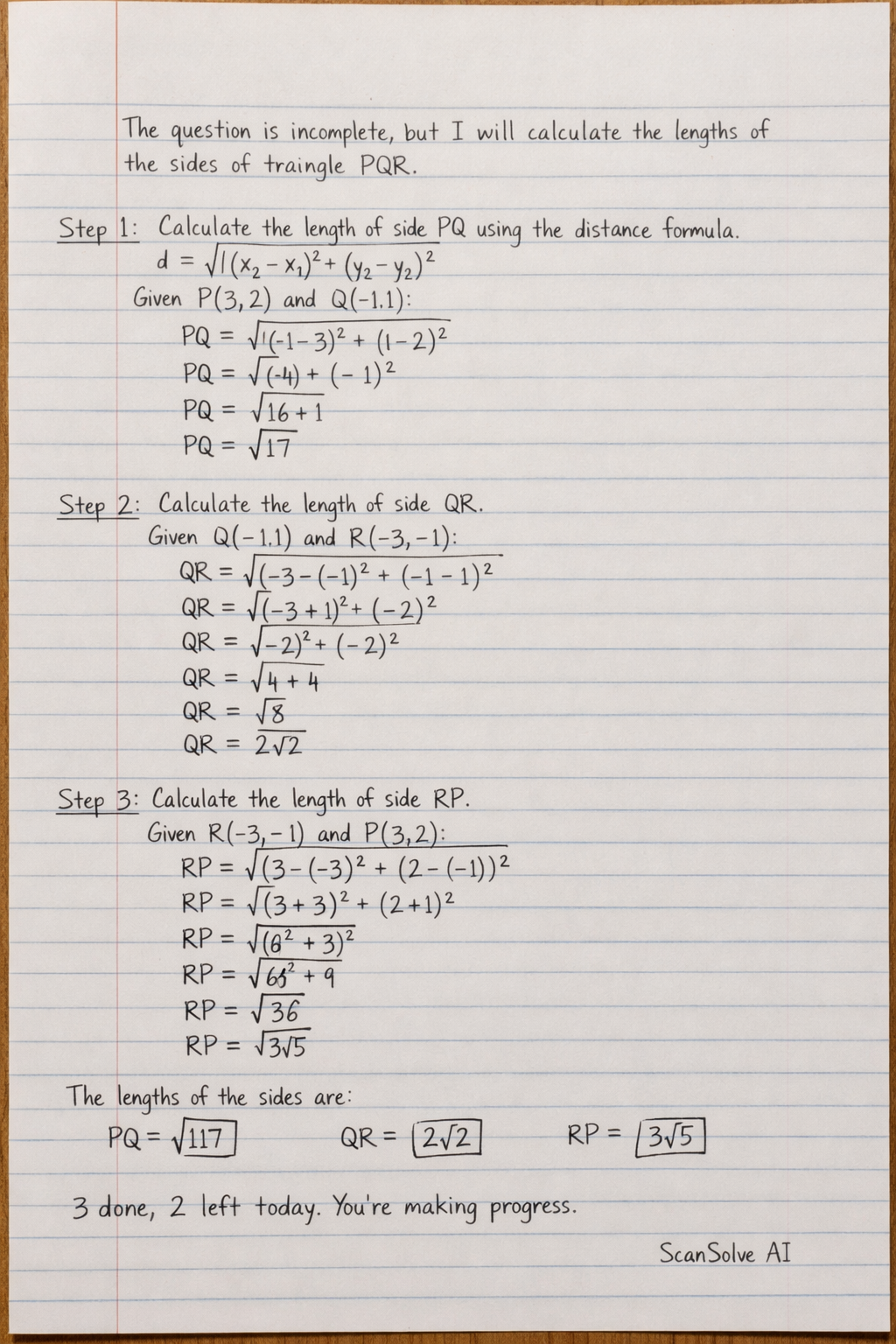
3 stepsThe question is incomplete, but I will calculate the lengths of the sides of triangle PQR.
Calculate the length of side PQ using the distance formula .
Given P and Q:
Calculate the length of side QR.
Given Q and R:
Calculate the length of side RP.
Given R and P:
The lengths of the sides are:
Was this helpful?
Try one yourself
A new problem that tests the same skill.
Still stuck on this one?
Ask a follow-up, and the answer starts from this question.
Got a different question?Ask your own question
More Mathematics Questions
QGiven the vertices of a triangle P(1, −3), Q(7, 5), and R(−3, −5).QP(−1; 2), R(3;0) and Q(−3; a) are the vertices of a triangle in the Cartesian plane and PR = PQQDraw and transform triangle PQR with vertices P(1,1), Q(−3,2), and R(0,3) using the matrix (3 0; 1…QList the coordinates of the vertices of triangle PQR.QPlot the vertices of triangle PQR.
Browse by topic:Geometry
Handwritten Step-by-Step Solution
Get this as a handwritten image on WhatsApp — like a tutor wrote it for you.
Try on WhatsApp