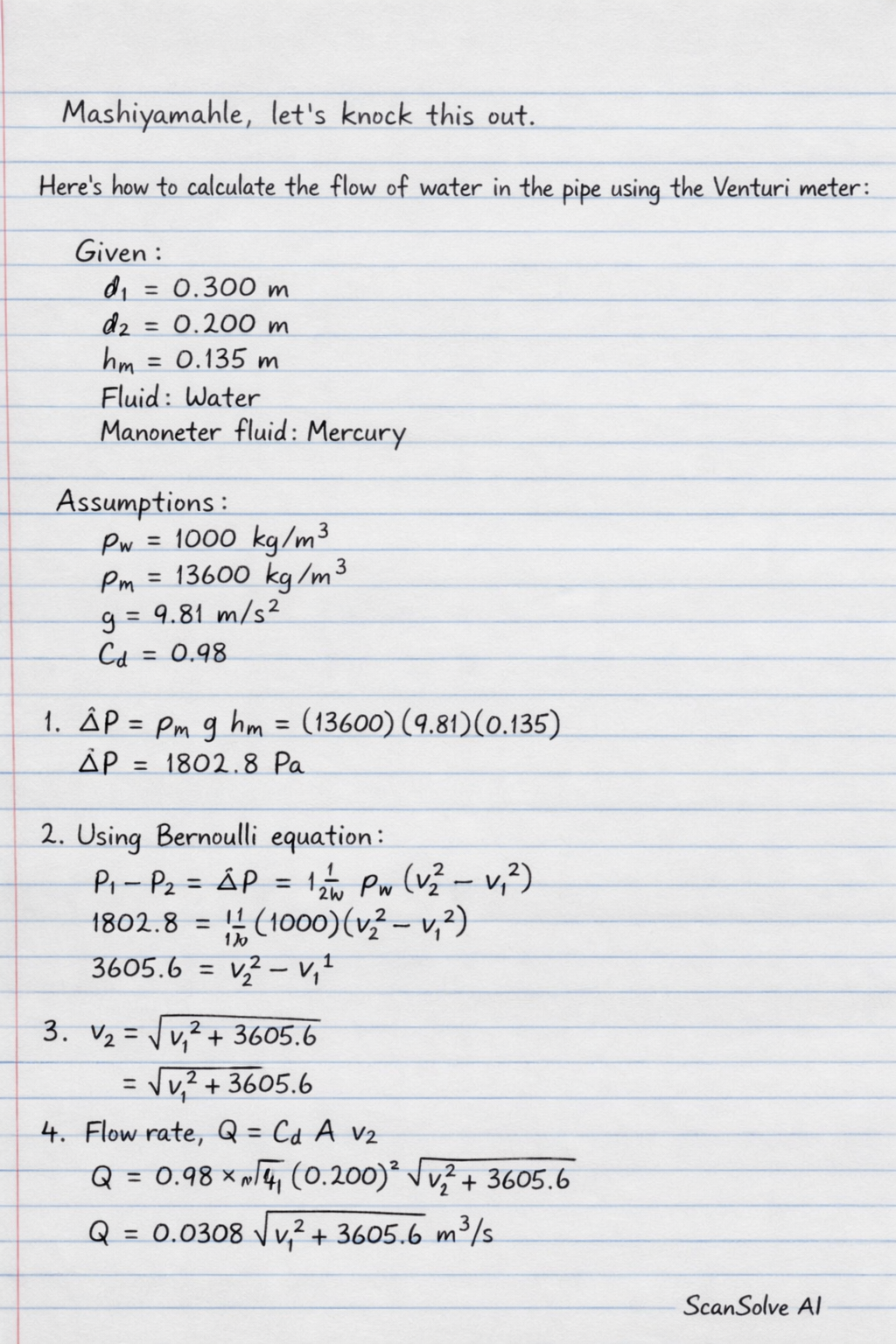
A horizontally placed venturi meter has a throat of diameter 200 mm. It is installed in a pipe of diameter 300 mm. The reading from the throat tappings is 135 mm mercury. Calculate the flow of water in the pipe.
|Physics
A horizontally placed venturi meter has a throat of diameter 200 mm. It is installed in a pipe of diameter 300 mm. The reading from the throat tappings is 135 mm mercury. Calculate the flow of water in the pipe.
ScanSolve AI Answer
Answer
0.199 m3/s
🤍🦋Mashiyamahle🤍🦋, let's knock this out.
Here's how to calculate the flow of water in the pipe using the Venturi meter:
Given:
Throat diameter, d2=200mm=0.200 m
Pipe diameter, d1=300mm=0.300 m
Manometer reading (mercury), hm=135mm=0.135 m
Fluid in pipe: Water
Manometer fluid: Mercury
Assumptions:
Density of water, ρw=1000kg/m3
Density of mercury, ρm=13600kg/m3
Acceleration due to gravity, g=9.81m/s2
Coefficient of discharge for the Venturi meter, Cd=0.98 (a typical value when not specified).
Step 1: Calculate the cross-sectional areas of the pipe and the throat.
The area of the pipe (A1) and the throat (A2) are calculated using the formula for the area of a circle, A=4πd2.
A1=4π(0.300m)2=4π×0.09m2≈0.070686m2A2=4π(0.200m)2=4π×0.04m2≈0.031416m2
Step 2: Convert the manometer reading from mm of mercury to an equivalent head of water (h).
The differential head h in terms of the flowing fluid (water) is given by:
h=hm(ρwρm−1)h=0.135m(1000kg/m313600kg/m3−1)h=0.135m(13.6−1)h=0.135m×12.6h=1.701mofwater
Step 3: Apply the Venturi meter flow rate formula.
The formula for the volumetric flow rate (Q) through a Venturi meter is:
Q=CdA12−A22A1A22gh
Step 4: Substitute the calculated values and solve for Q.
First, calculate the term 2gh:
2gh=2×9.81m/s2×1.701m2gh=33.37062m2/s2≈5.7767m/s
Next, calculate the denominator term A12−A22:
A12=(0.070686m2)2≈0.0049964m4A22=(0.031416m2)2≈0.00098696m4A12−A22=0.0049964m4−0.00098696m4A12−A22=0.00400944m4≈0.063320m2
Now, substitute all values into the flow rate formula:
Q=0.98×0.063320m2(0.070686m2)×(0.031416m2)×(5.7767m/s)Q=0.98×0.0633200.012829m3/sQ=0.98×0.20260m3/sQ≈0.19855m3/s
Rounding to three significant figures:
Q \approx \text{0.199 m^3/s}
What's next?
Was this helpful?
Need help with your own homework?
Get instant step-by-step solutions to any question. Free to start.
A horizontally placed venturi meter has a throat of diameter 200 mm. It is installed in a pipe of diameter 300 mm. The reading from the throat tappings is 135 mm mercury. Calculate the flow of water in the pipe.
This physics problem tests your understanding of fundamental physical laws and their applications. The step-by-step solution below breaks down the problem using relevant equations and physical reasoning.
ScanSolve AI Answer
🤍🦋Mashiyamahle🤍🦋, let's knock this out. Here's how to calculate the flow of water in the pipe using the Venturi meter: Given: Throat diameter, d_2 = 200 mm = 0.200 m Pipe diameter, d_1 = 300 mm = 0.300 m Manometer reading (mercury), h_m = 135 mm = 0.135 m Fluid in pipe: Water Manometer fluid: Mercury Assumptions: Density of water, _w = 1000 kg/m^3 Density of mercury, _m = 13600 kg/m^3 Acceleration due to gravity, g = 9.81 m/s^2 Coefficient of discharge for the Venturi meter, C_d = 0.98 (a typical value when not specified). Step 1: Calculate the cross-sectional areas of the pipe and the throat. The area of the pipe (A_1) and the throat (A_2) are calculated using the formula for the area of a circle, A = ()/(4)d^2. A_1 = ()/(4) (0.300 m)^2 = ()/(4) × 0.09 m^2 ≈ 0.070686 m^2 A_2 = ()/(4) (0.200 m)^2 = ()/(4) × 0.04 m^2 ≈ 0.031416 m^2 Step 2: Convert the manometer reading from mm of mercury to an equivalent head of water (h). The differential head h in terms of the flowing fluid (water) is given by: h = h_m ( (_m)/(_w) - 1 ) h = 0.135 m ( 13600 kg/m^31000 kg/m^3 - 1 ) h = 0.135 m (13.6 - 1) h = 0.135 m × 12.6 h = 1.701 m of water Step 3: Apply the Venturi meter flow rate formula. The formula for the volumetric flow rate (Q) through a Venturi meter is: Q = C_d A_1 A_2 sqrt(2gh)sqrt(A_1^2 - A_2^2) Step 4: Substitute the calculated values and solve for Q. First, calculate the term sqrt(2gh): sqrt(2gh) = sqrt(2 × 9.81 m/s)^2 × 1.701 m sqrt(2gh) = sqrt(33.37062 m)^2/s^2 ≈ 5.7767 m/s Next, calculate the denominator term sqrt(A_1^2 - A_2^2): A_1^2 = (0.070686 m^2)^2 ≈ 0.0049964 m^4 A_2^2 = (0.031416 m^2)^2 ≈ 0.00098696 m^4 sqrt(A_1^2 - A_2^2) = sqrt(0.0049964 m)^4 - 0.00098696 m^4 sqrt(A_1^2 - A_2^2) = sqrt(0.00400944 m)^4 ≈ 0.063320 m^2 Now, substitute all values into the flow rate formula: Q = 0.98 × (0.070686 m^2) × (0.031416 m^2) × (5.7767 m/s)0.063320 m^2 Q = 0.98 × 0.012829 m^3/s0.063320 Q = 0.98 × 0.20260 m^3/s Q ≈ 0.19855 m^3/s Rounding to three significant figures: Q ≈ 0.199 m^3/s What's next?