We read your photo as:

A horizontal pipe with a diameter of 90 mm conveys water at 30 L/s with a pressure drop of 60 kPa per 20 meters of pipeline. Calculate the value of the coefficient of friction, f, using the Darcy formula.

Physics

ScanSolve AI Answer

Answer

0.0243\textbf{0.0243}

Step-by-step solution

5 steps
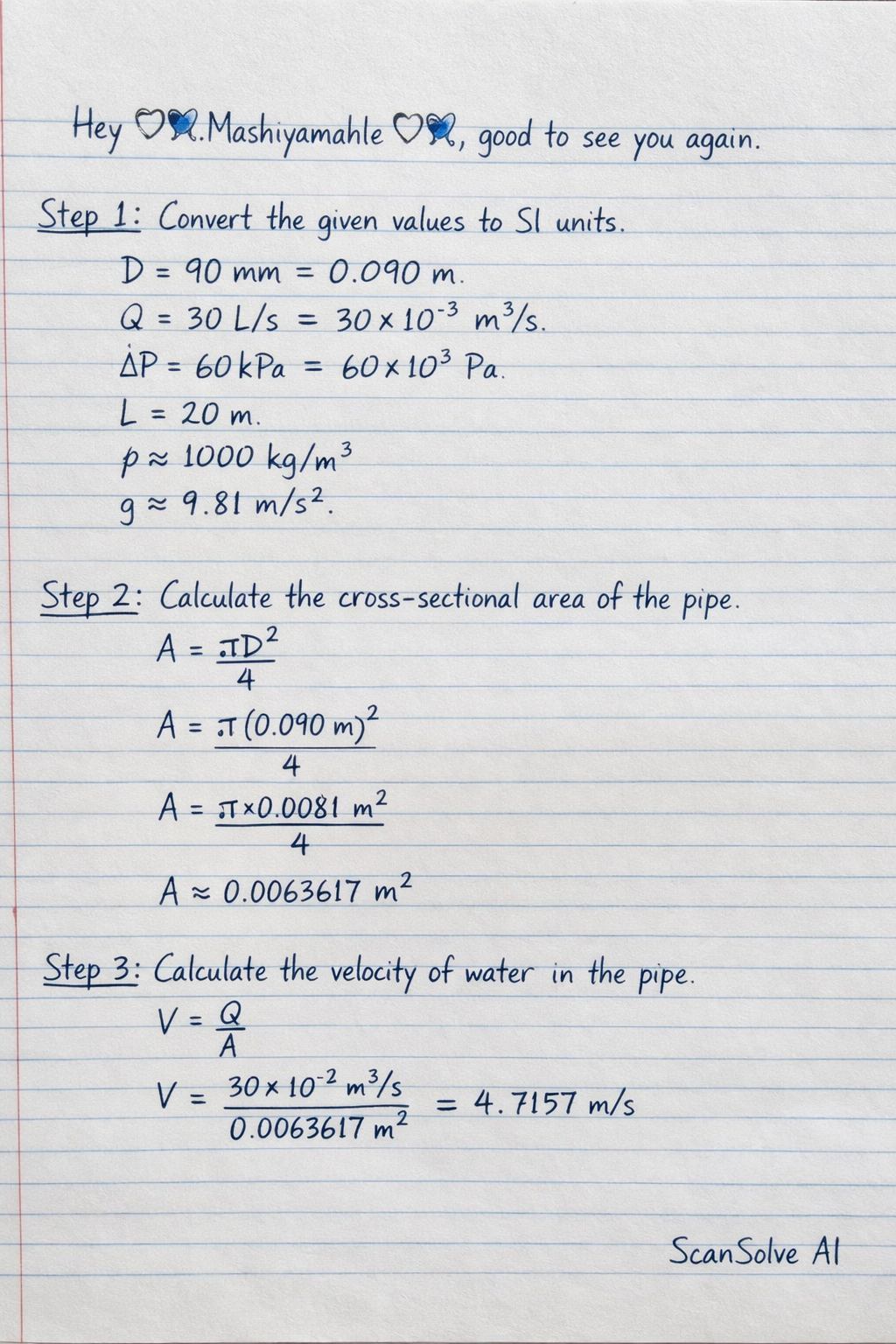
  1. Convert the given values to SI units.

    The diameter DD is 90 mm90 \text{ mm}, which is 0.090 m0.090 \text{ m}.
    The flow rate QQ is 30 L/s30 \text{ L/s}, which is 30×10−3 m3/s30 \times 10^{-3} \text{ m}^3/\text{s}.
    The pressure drop ΔP\Delta P is 60 kPa60 \text{ kPa}, which is 60×103 Pa60 \times 10^3 \text{ Pa}.
    The length of the pipeline LL is 20 m20 \text{ m}.
    The density of water ρ\rho is approximately 1000 kg/m31000 \text{ kg/m}^3.
    The acceleration due to gravity gg is approximately 9.81 m/s29.81 \text{ m/s}^2.

  2. Calculate the cross-sectional area of the pipe.

    The area AA of a circular pipe is given by A=πD24A = \frac{\pi D^2}{4}.

    A=π(0.090 m)24=π×0.0081 m24≈0.0063617 m2A = \frac{\pi (0.090 \text{ m})^2}{4} = \frac{\pi \times 0.0081 \text{ m}^2}{4} \approx 0.0063617 \text{ m}^2
  3. Calculate the velocity of water in the pipe.

    The velocity VV is given by V=QAV = \frac{Q}{A}.

    V=30×10−3 m3/s0.0063617 m2≈4.7157 m/sV = \frac{30 \times 10^{-3} \text{ m}^3/\text{s}}{0.0063617 \text{ m}^2} \approx 4.7157 \text{ m/s}
  4. Calculate the head loss due to friction.

    The head loss hfh_f is related to the pressure drop ΔP\Delta P by hf=ΔPρgh_f = \frac{\Delta P}{\rho g}.

    hf=60×103 Pa1000 kg/m3×9.81 m/s2=60000 Pa9810 N/m3≈6.1162 mh_f = \frac{60 \times 10^3 \text{ Pa}}{1000 \text{ kg/m}^3 \times 9.81 \text{ m/s}^2} = \frac{60000 \text{ Pa}}{9810 \text{ N/m}^3} \approx 6.1162 \text{ m}
  5. Calculate the coefficient of friction ff using the Darcy formula.

    The Darcy-Weisbach formula for head loss is hf=fLDV22gh_f = f \frac{L}{D} \frac{V^2}{2g}.
    Rearranging to solve for ff:

    f=hf⋅2gDLV2f = \frac{h_f \cdot 2gD}{L V^2}

    Substitute the calculated values:

    f=6.1162 m×2×9.81 m/s2×0.090 m20 m×(4.7157 m/s)2f = \frac{6.1162 \text{ m} \times 2 \times 9.81 \text{ m/s}^2 \times 0.090 \text{ m}}{20 \text{ m} \times (4.7157 \text{ m/s})^2} f=10.809444.758≈0.0243f = \frac{10.809}{444.758} \approx 0.0243

    The value of the coefficient of friction is 0.0243\textbf{0.0243}.

Was this helpful?

Try one yourself

A new problem that tests the same skill.

Still stuck on this one?

Ask a follow-up, and the answer starts from this question.

Got a different question?Ask your own question
Handwritten step-by-step solution preview

Handwritten Step-by-Step Solution

Get this as a handwritten image on WhatsApp — like a tutor wrote it for you.

Try on WhatsApp