
We read your photo as:
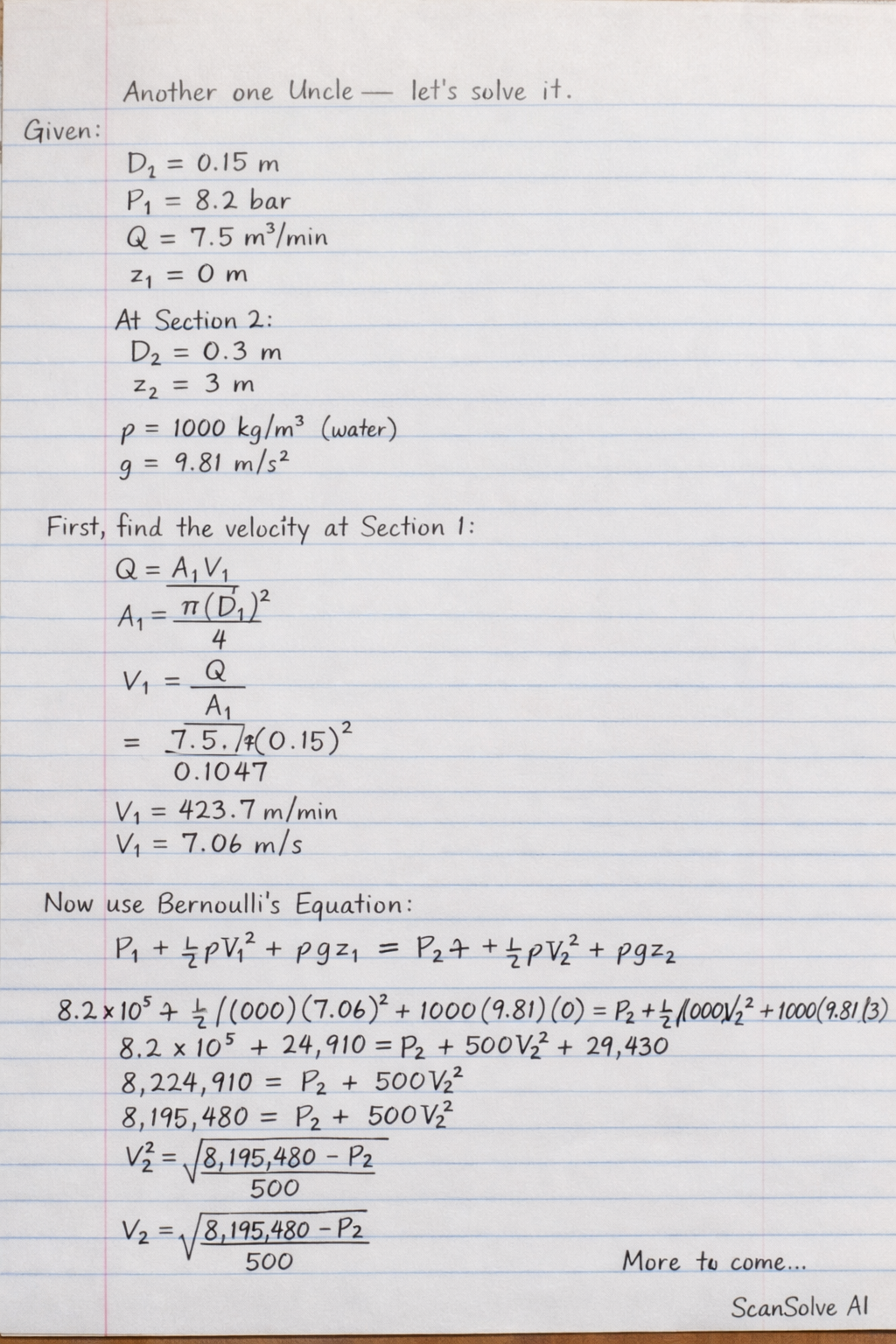
The pressure at the entry to the pipeline of 0.15 m diameter is 8.2 bar, and the flow rate at this section is 7.5 m 3 /min. The pipe diameter gradually increases to 0.3 m, and the levels rise by 3 m above the entrance. Determine the pressure at the location. Neglect losses.
Physics
ScanSolve AI Answer
Answer
Step-by-step solution
5 stepsThis problem involves applying Bernoulli's equation and the continuity equation to determine the pressure in a pipeline where both diameter and elevation change, neglecting losses.
Given:
- At entry (Section 1):
- Diameter,
- Pressure,
- Flow rate,
- Elevation, (reference level)
- At the location (Section 2):
- Diameter,
- Elevation, (3 m above entrance)
- Fluid is water, so density,
- Acceleration due to gravity,
We will use the following equations:
- Flow Rate: , where
- Bernoulli's Equation (neglecting losses):
Convert given values to SI units.
Calculate the cross-sectional areas at both sections.
- Area at Section 1:
- Area at Section 2:
Calculate the flow velocities at both sections using the flow rate.
- Velocity at Section 1:
- Velocity at Section 2:
Apply Bernoulli's equation to determine the pressure at Section 2.
Rearrange Bernoulli's equation to solve for :
Substitute the known values:
Convert the final pressure to bar.
The pressure at the location is .
Was this helpful?
Try one yourself
A new problem that tests the same skill.
Still stuck on this one?
Ask a follow-up, and the answer starts from this question.
Got a different question?Ask your own question
More Physics Questions
QA horizontal pipe with a diameter of 90 mm conveys water at 30 L/s with a pressure drop of 60 kPa…QThe length of a 5cm diameter copper pipe is 20m. If the steam pressure of water in the pipe is…QA U-tube manometer measures the pressure of a gas supply. The water level on the gas supply side is…QNeglecting frictional losses, show that the pressure difference between points 1 and 2 for the flow…QA U-tube manometer contains a liquid with density 0.8 g/cm³. If the liquid levels in the open and…
Handwritten Step-by-Step Solution
Get this as a handwritten image on WhatsApp — like a tutor wrote it for you.
Try on WhatsApp