
We read your photo as:
A river has a flow of water with a velocity of 0.2 m/s in a pipe with a diameter of 250 mm. Calculate the Reynolds number and determine if the flow is laminar or turbulent at a temperature of 20°C.
Physics
ScanSolve AI Answer
Answer
Step-by-step solution
3 stepsTo determine whether the flow is laminar or turbulent, we need to calculate the Reynolds number ().
Identify the given values and necessary fluid properties.
Fluid: Water (from "River")
Velocity of flow () =
Pipe diameter () =
Temperature () =For water at , we use the following properties:
Density () =
Dynamic viscosity () =Calculate the Reynolds number ().
The formula for the Reynolds number is:
Substitute the values:
Determine the type of flow.
For flow in a pipe:
- If , the flow is laminar.
- If , the flow is transitional.
- If , the flow is turbulent.
Since , which is greater than 4000, the flow is turbulent.
The flow is turbulent.
Was this helpful?
Try one yourself
A new problem that tests the same skill.
Still stuck on this one?
Ask a follow-up, and the answer starts from this question.
Got a different question?Ask your own question
More Physics Questions
QCalculate the Reynolds number for the flow of oil in a pipe and determine if it is laminar or…QA horizontal pipe with a diameter of 90 mm conveys water at 30 L/s with a pressure drop of 60 kPa…QA horizontally placed venturi meter has a throat of diameter 200 mm. It is installed in a pipe of…QTo calculate the discharge flowrate, we will use the Darcy-Weisbach equation along with an iterative…QDefine and explain the following terms related to fluid mechanics: Laminar flow, Turbulent flow…
Browse by topic:Mechanics
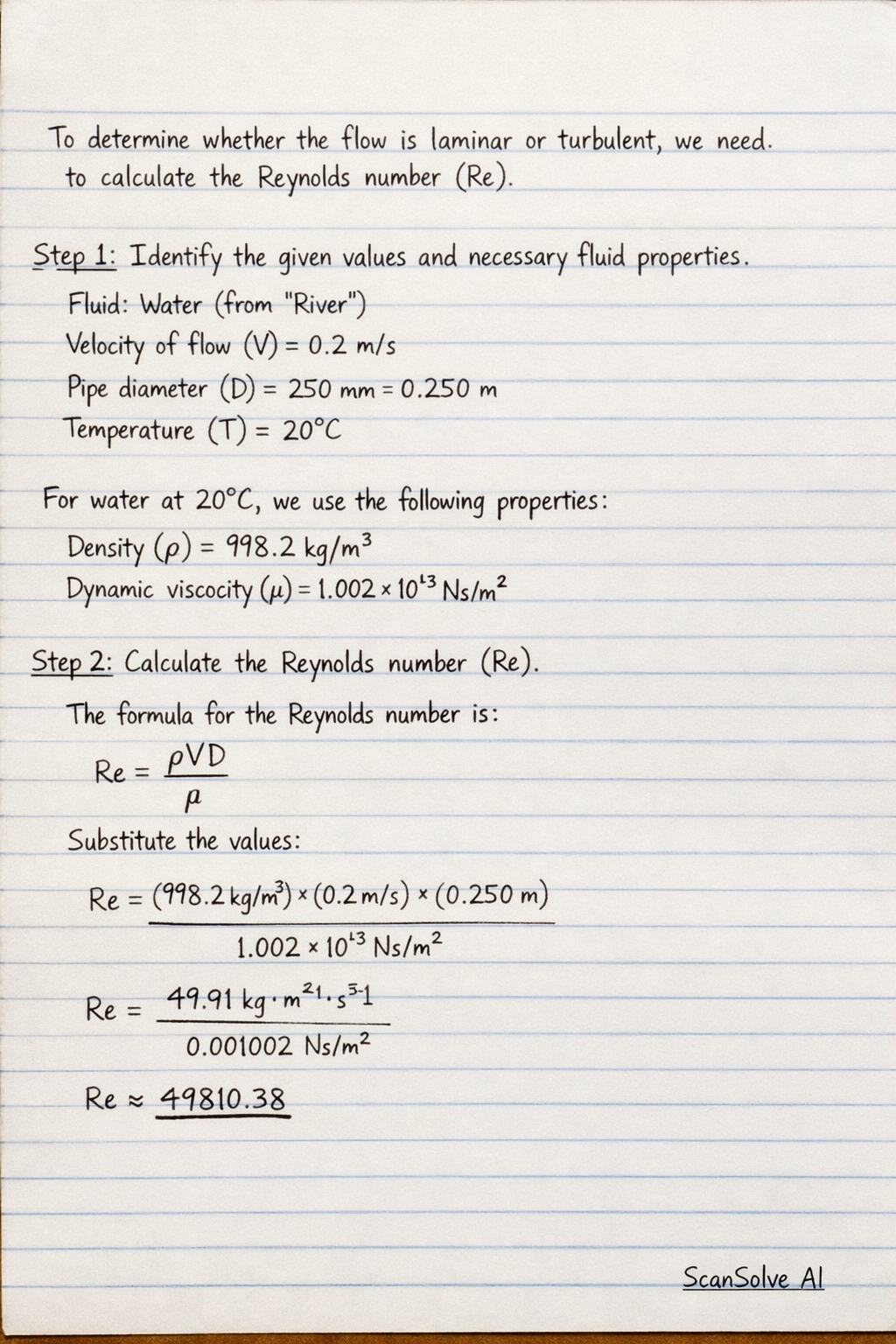
Handwritten Step-by-Step Solution
Get this as a handwritten image on WhatsApp — like a tutor wrote it for you.
Try on WhatsApp