
We read your photo as:
Define and explain the following terms related to fluid mechanics: Laminar flow, Turbulent flow, Boundary layer thickness, and Fully developed flow. Also, state the two fundamental laws used in pipe n
ScanSolve AI Answer
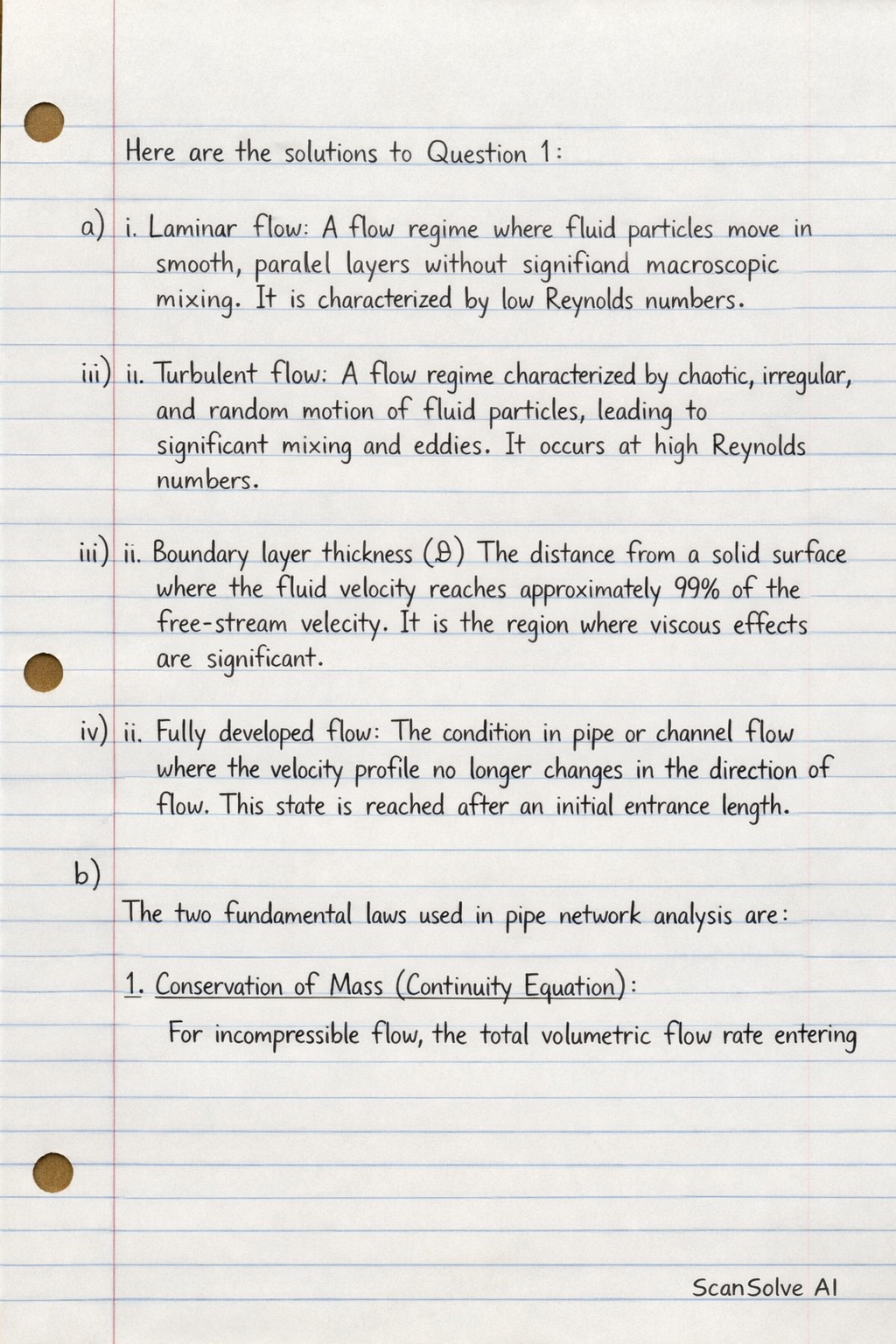
Here are the solutions to Question 1:
a)
*i) Laminar flow: A flow regime where fluid particles move in smooth, parallel layers without significant macroscopic mixing. It is characterized by low Reynolds numbers.
*ii) Turbulent flow: A flow regime characterized by chaotic, irregular, and random motion of fluid particles, leading to significant mixing and eddies. It occurs at high Reynolds numbers.
*iii) Boundary layer thickness (): The distance from a solid surface where the fluid velocity reaches approximately 99% of the free-stream velocity. It is the region where viscous effects are significant.
*iv) Fully developed flow: The condition in pipe or channel flow where the velocity profile no longer changes in the direction of flow. This state is reached after an initial entrance length.
b)
The two fundamental laws used in pipe network analysis are:
- Conservation of Mass (Continuity Equation): For incompressible flow, the total volumetric flow rate entering
Still stuck on this one?
Ask a follow-up, and the answer starts from this question.
More Physics Questions
Handwritten Step-by-Step Solution
Get this as a handwritten image on WhatsApp — like a tutor wrote it for you.
Try on WhatsApp