

This physics problem tests your understanding of fundamental physical laws and their applications. The step-by-step solution below breaks down the problem using relevant equations and physical reasoning.
ScanSolve AI Answer
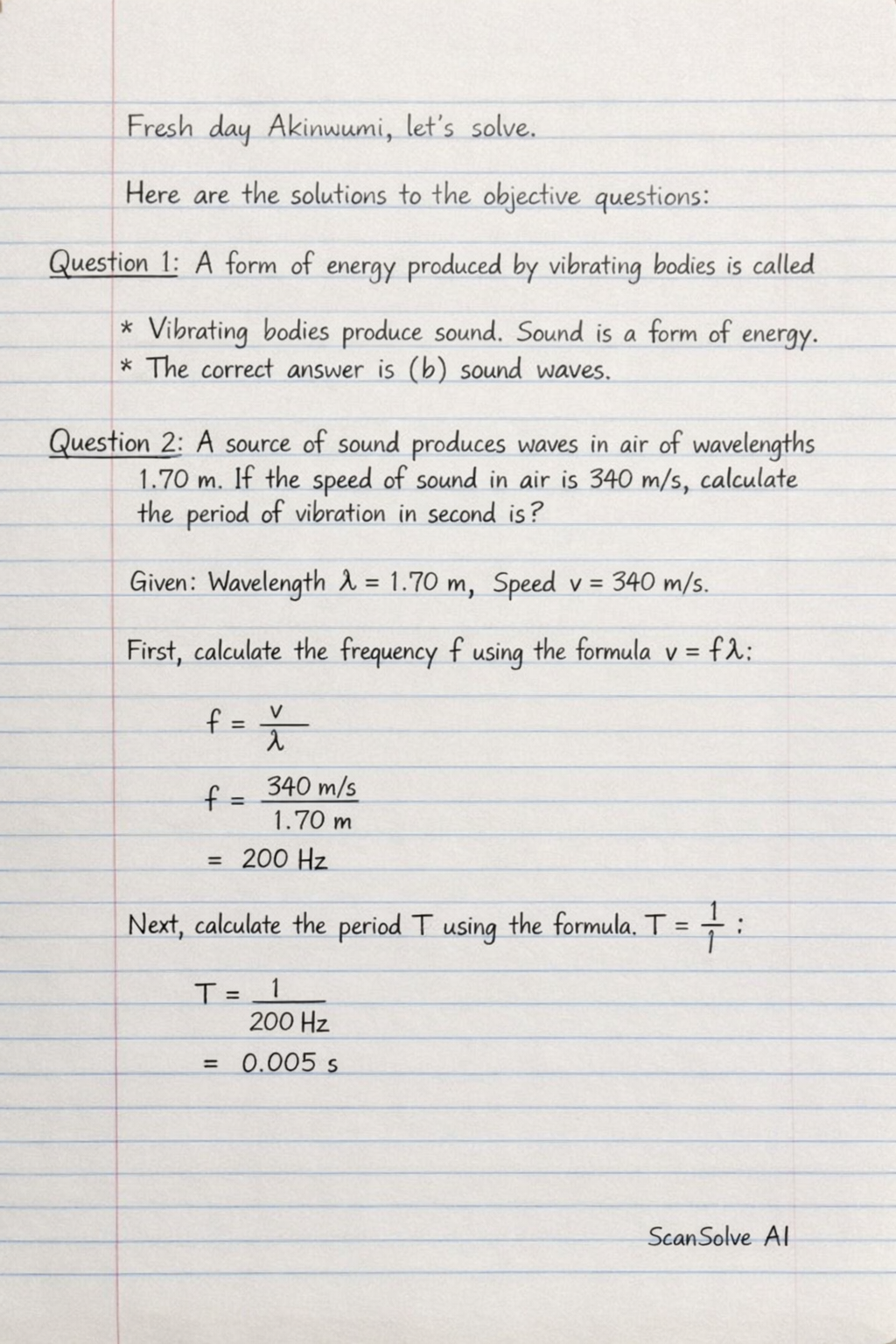
Here are the solutions to the objective questions: Question 1: A form of energy produced by vibrating bodies is called Vibrating bodies produce sound. Sound is a form of energy. The correct answer is (b) sound waves. Question 2: A source of sound produces waves in air of wavelengths 1.70m. If the speed of sound in air is 340ms⁻¹, calculate the period of vibration in second is? Given: Wavelength = 1.70 m, Speed v = 340 m/s. First, calculate the frequency f using the formula v = f: f = (v)/() = 340 m/s1.70 m = 200 Hz Next, calculate the period T using the formula T = (1)/(f): T = (1)/(200 Hz) = 0.005 s The calculated period is 0.005 s, which is not among the given options. There might be a typo in the question or options. If we assume the speed of sound was 34 m/s instead of 340 m/s, then f = 34/1.7 = 20 Hz and T = 1/20 = 0.05 s, which is option (a). Given the instruction to select an option, we will proceed with this assumption. Assuming a typo in the speed of sound, where v = 34 m/s: T = ()/(v) = 1.70 m34 m/s = 0.05 s The correct answer is (a) 0.05s. Question 3: An adjacent reinfactions and compressions are separated by a distance 180m. Find the frequency if the Velocity is 360ms⁻¹. "Adjacent rarefactions and compressions" are separated by half a wavelength (()/(2)). Given: ()/(2) = 180 m, so = 2 × 180 m = 360 m. Given: Velocity v = 360 m/s. Calculate the frequency f using the formula v = f: f = (v)/() = 360 m/s360 m = 1 Hz The calculated frequency is 1 Hz, which is not among the given options. There might be a typo in the question or options. If we assume the distance between adjacent rarefactions and compressions was 1.8 m (meaning = 3.6 m), then f = 360/3.6 = 100 Hz, which is option (a). Given the instruction to select an option, we will proceed with this assumption. Assuming a typo in the distance, where ()/(2) = 1.8 m, so = 3.6 m: f = (v)/() = 360 m/s3.6 m = 100 Hz The correct answer is (a) 100Hz. Question 4: The sound heard after a sound wave has been reflected from the hard plane surface is The reflection of sound from a hard surface is known as an echo. The correct answer is (a) echo. Question 5: An hawk emits a sound wave at a speed of 1700ms⁻¹ and receives the echoes 0.05s later. Find the distance Given: Speed v = 1700 m/s, Total time for echo t = 0.05 s. The time for the sound to travel one way to the object is half of the total time: t_one-way = (t)/(2) = 0.05 s2 = 0.025 s Calculate the distance d using the formula d = v × t_one-way: d = 1700 m/s × 0.025 s = 42.5 m The correct answer is (a) 42.5m. Question 6: A fathometer is used to send a wave down to the sea bed. The reflected wave is received after 0.2s. If the velocity is 1500ms⁻¹, Calculate the depth of the sea if the velocity is 1500ms⁻¹. Given: Total time for reflected wave t = 0.2 s, Velocity v = 1500 m/s. The time for the wave to travel one way to the sea bed (depth) is half of the total time: t_one-way = (t)/(2) = 0.2 s2 = 0.1 s Calculate the depth d using the formula d = v × t_one-way: d = 1500 m/s × 0.1 s = 150 m The calculated depth is 150 m, which is not among the given options. Therefore, I cannot select a correct option from the choices provided. Question 7: A man standing 400m away from a hill, sound a whistle. The echo reached him 5s later. Calculate the velocity Given: Distance to hill d = 400 m, Time for echo t = 5 s. The total distance covered by the sound (to the hill and back) is 2d: Total distance = 2 × 400 m = 800 m Calculate the velocity v using the formula v = Total distanceTime: v = 800 m5 s = 160 m/s The correct answer is (c) 160ms⁻¹. Question 8: How far from a cliff should a girl send in order to hear the echo of her clap 0.5s later (V = 330ms⁻¹) Given: Total time for echo t = 0.5 s, Velocity V = 330 m/s. The time for the sound to travel one way to the cliff is half of the total time: t_one-way = (t)/(2) = 0.5 s2 = 0.25 s Calculate the distance d using the formula d = V × t_one-way: d = 330 m/s × 0.25 s = 82.5 m The correct answer is (a) 82.5m. Question 9: The lowest possible frequency, that can be obtained from the plucked string is called The lowest frequency at which a string can vibrate is known as its fundamental frequency. The correct answer is (d) fundamental frequency. Question 10: Frequencies above the fundamental frequency is referred to to Frequencies that are integer multiples of the fundamental frequency are called harmonics. Frequencies higher than the fundamental are generally referred to as overtones. The correct answer is (a) overtone. Question 11: A string is stretched tightly between two points 50cm a percent with velocity of 300ms⁻¹. Calculate the number of vibration. The phrase "number of vibration" likely refers to the fundamental frequency. Given: Length L = 50 cm = 0.5 m, Velocity v = 300 m/s. For a string fixed at both ends, the fundamental wavelength is 2L: = 2 × 0.5 m = 1 m Calculate the fundamental frequency f using the formula f = (v)/(): f = 300 m/s1 m = 300 Hz The correct answer is (c) 300Hz. Question 12: If tension is maintained on a stretched string of length 0.6m with frequency of 220Hz, determine the Velocity of the wave in the string. Given: Length L = 0.6 m, Frequency f = 220 Hz. For a string fixed at both ends, the fundamental wavelength is 2L: = 2 × 0.6 m = 1.2 m Calculate the velocity v using the formula v = f: v = 220 Hz × 1.2 m = 264 m/s The correct answer is (d) 264ms⁻¹. Question 13: Calculate the wavelength of a note which is one octave lower than a note of 256Hz with a velocity of 352ms⁻¹. Given: Frequency of higher note f_1 = 256 Hz, Velocity v = 352 m/s. A note one octave lower has half the frequency: f_2 = (f_1)/(2) = 256 Hz2 = 128 Hz Calculate the wavelength using the formula = (v)/(f_2): = 352 m/s128 Hz = 2.75 m The correct answer is (a) 2.75m. Question 14: A plucked string produces a note of 200Hz when its length is 1.50m. Determine the frequency of the note produced when a length of 0.75m. For a plucked string (fixed at both ends), the fundamental frequency f is inversely proportional to its length L (assuming constant tension and mass per unit length): f (1)/(L), or fL = constant. Given: L_1 = 1.50 m, f_1 = 200 Hz. Find f_2 when L_2 = 0.75 m. f_1 L_1 = f_2 L_2 200 Hz × 1.50 m = f_2 × 0.75 m 300 = f_2 × 0.75 f_2 = (300)/(0.75) = 400 Hz The correct answer is (b) 400Hz. Question 15: The velocity on the first overtone of a wire in a closed pipe of length 33cm is This question is phrased ambiguously ("velocity on the first overtone of a wire in a closed pipe"). Assuming it asks for the wavelength of the first overtone in a closed pipe* of length 33cm. For a closed pipe, the length L is related to the wavelength _n of its harmonics by L = (n_n)/(4), where n is an odd integer (1 for fundamental, 3 for first overtone, 5 for second overtone, etc.). For the first overtone, n=3. So, L = (3_3)/(4). Given: L = 33 cm. Rearrange to find _3: _3 = (4L)/(3) = 4 × 33 cm3 = 4 × 11 cm = 44 cm The correct answer is (c) 44cm. Question 16: The wavelength of the first overtone of a note in a closed pipe of length 33cm is This is the same question as Question 15. For a closed pipe, the first overtone corresponds to the third harmonic, where the wavelength _3 = (4L)/(3). Given: L = 33 cm. _3 = 4 × 33 cm3 = 4 × 11 cm = 44 cm The correct answer is (c) 44cm. Question 17: If the fundamental frequency of a closed pipe organ on a day when the speed of sound is 340ms⁻¹ is 170Hz, then the length of the pipe is Given: Fundamental frequency f_1 = 170 Hz, Speed of sound v = 340 m/s. For a closed pipe, the fundamental frequency is given by the formula f_1 = (v)/(4L). Rearrange to solve for the length L: L = (v)/(4f_1) = 340 m/s4 × 170 Hz = (340)/(680) m = 0.5 m The correct answer is (a) 0.5m. Question 18: ______ is used to find the velocity of sound in air. A resonance tube (or resonance column apparatus) is a common laboratory instrument used to determine the speed of sound in air. The correct answer is (d) resonance tube. Question 19: A sonometer wire has a frequency of 260Hz. It is sounded against a tuning of 254Hz. Calculate the beat frequency. Beat frequency (f_beat) is the absolute difference between two frequencies (f_1 and f_2): f_beat = |f_1 - f_2| Given: f_1 = 260 Hz, f_2 = 254 Hz. f_beat = |260 Hz - 254 Hz| = 6 Hz The correct answer is (a) 6Hz. Question 20: A note of frequency 200Hz has a velocity of 400ms⁻¹. Find the wavelength. Given: Frequency f = 200 Hz, Velocity v = 400 m/s. Calculate the wavelength using the formula v = f: = (v)/(f) = 400 m/s200 Hz = 2 m The calculated wavelength is 2 m, which is not among the given options. Therefore, I cannot select a correct option from the choices provided. Question 21: The velocity of sound in air will be doubled if its absolute temperature is The velocity of sound in air is directly proportional to the square root of the absolute temperature (v sqrt(T)). If the velocity v is doubled, then sqrt(T) must be doubled. For sqrt(T) to be doubled, the absolute temperature T must be quadrupled. The correct answer is (d) quadrupled. Question 22: A body stands infront of a tall wall and produces a sound. If he hear the echo 3s later. Calculate his distance from the wall (V = 330ms⁻¹) Given: Total time for echo t = 3 s, Velocity $V = ✂️ _That answer was long and got cut off. Reply continue and I'll finish it._