We read your photo as:

Find the moment of inertia of the lamina with a circular hole of 30 mm diameter about the axis AB as shown in Fig. 7.24.

Physics

ScanSolve AI Answer

Answer

14715×103 mm4\text{14715} \times 10^3 \text{ mm}^4

Step-by-step solution

5 steps

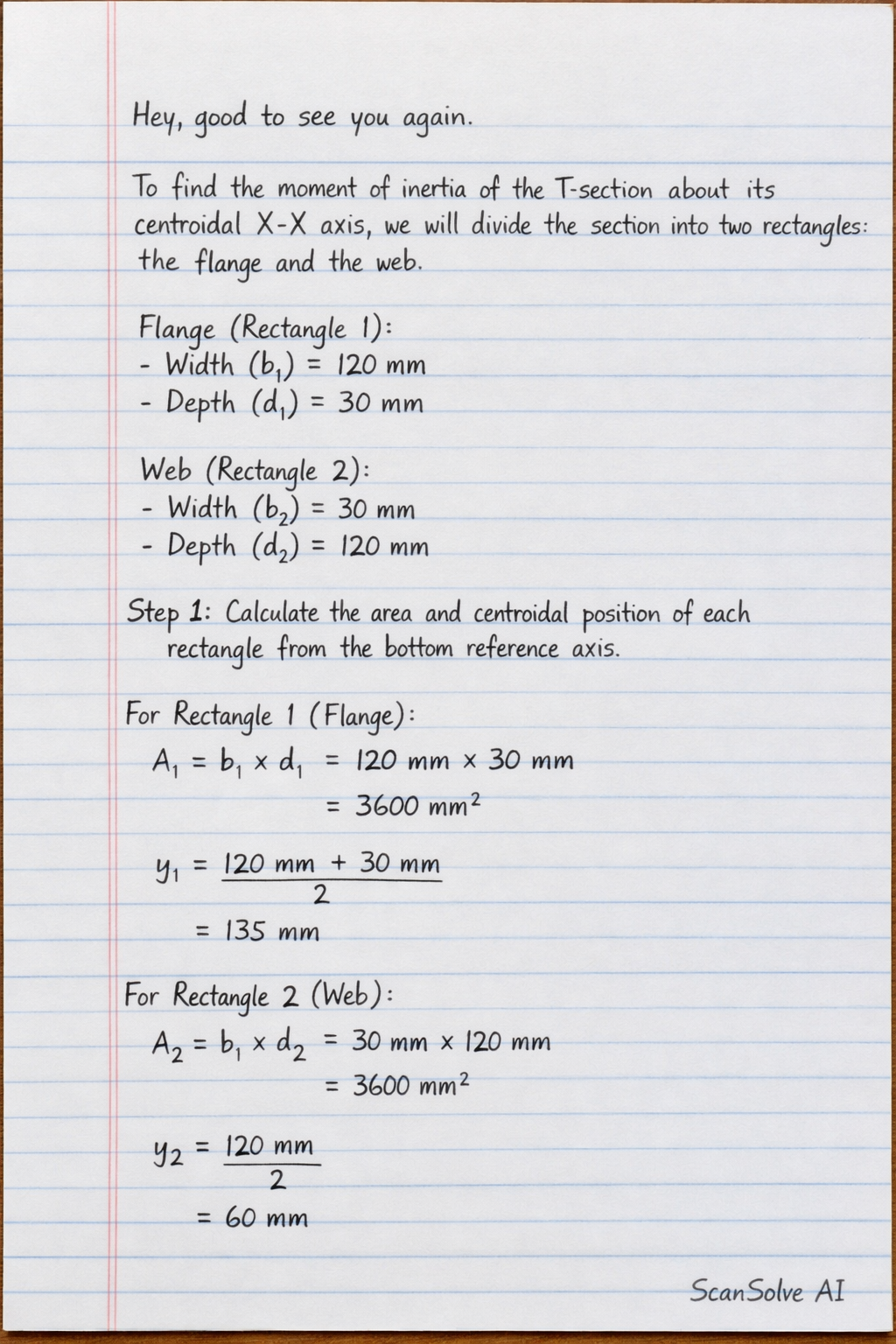
To find the moment of inertia of the T-section about its centroidal X-X axis, we will divide the section into two rectangles: the flange and the web.

  • Flange (Rectangle 1):
    • Width (b1b_1) = 120 mm120 \text{ mm}
    • Depth (d1d_1) = 30 mm30 \text{ mm}
  • Web (Rectangle 2):
    • Width (b2b_2) = 30 mm30 \text{ mm}
    • Depth (d2d_2) = 120 mm120 \text{ mm}
  1. Calculate the area and centroidal position of each rectangle from the bottom reference axis.

    For Rectangle 1 (Flange):

    A1=b1×d1=120 mm×30 mm=3600 mm2A_1 = b_1 \times d_1 = 120 \text{ mm} \times 30 \text{ mm} = 3600 \text{ mm}^2

    The centroid y1y_1 from the bottom of the web is 120 mm+30 mm2=135 mm120 \text{ mm} + \frac{30 \text{ mm}}{2} = 135 \text{ mm}.

    For Rectangle 2 (Web):

    A2=b2×d2=30 mm×120 mm=3600 mm2A_2 = b_2 \times d_2 = 30 \text{ mm} \times 120 \text{ mm} = 3600 \text{ mm}^2

    The centroid y2y_2 from the bottom of the web is 120 mm2=60 mm\frac{120 \text{ mm}}{2} = 60 \text{ mm}.

  2. Calculate the centroid (yˉ\bar{y}) of the entire T-section from the bottom reference axis.

    yˉ=A1y1+A2y2A1+A2\bar{y} = \frac{A_1 y_1 + A_2 y_2}{A_1 + A_2} yˉ=(3600 mm2×135 mm)+(3600 mm2×60 mm)3600 mm2+3600 mm2\bar{y} = \frac{(3600 \text{ mm}^2 \times 135 \text{ mm}) + (3600 \text{ mm}^2 \times 60 \text{ mm})}{3600 \text{ mm}^2 + 3600 \text{ mm}^2} yˉ=486000 mm3+216000 mm37200 mm2=702000 mm37200 mm2=97.5 mm\bar{y} = \frac{486000 \text{ mm}^3 + 216000 \text{ mm}^3}{7200 \text{ mm}^2} = \frac{702000 \text{ mm}^3}{7200 \text{ mm}^2} = 97.5 \text{ mm}

    The centroidal X-X axis is 97.5 mm97.5 \text{ mm} from the bottom of the web.

  3. Calculate the moment of inertia of each rectangle about its own centroidal axis (Ixx,cI_{xx,c}) and the distance from its centroid to the section's centroid (hh).

    The moment of inertia of a rectangle about its own centroidal X-axis is I=bd312I = \frac{bd^3}{12}.

    For Rectangle 1 (Flange):

    Ixx1,c=b1d1312=120 mm×(30 mm)312=120×2700012 mm4=270000 mm4I_{xx1,c} = \frac{b_1 d_1^3}{12} = \frac{120 \text{ mm} \times (30 \text{ mm})^3}{12} = \frac{120 \times 27000}{12} \text{ mm}^4 = 270000 \text{ mm}^4 h1=∣y1−yˉ∣=∣135 mm−97.5 mm∣=37.5 mmh_1 = |y_1 - \bar{y}| = |135 \text{ mm} - 97.5 \text{ mm}| = 37.5 \text{ mm}

    For Rectangle 2 (Web):

    Ixx2,c=b2d2312=30 mm×(120 mm)312=30×172800012 mm4=4320000 mm4I_{xx2,c} = \frac{b_2 d_2^3}{12} = \frac{30 \text{ mm} \times (120 \text{ mm})^3}{12} = \frac{30 \times 1728000}{12} \text{ mm}^4 = 4320000 \text{ mm}^4 h2=∣y2−yˉ∣=∣60 mm−97.5 mm∣=37.5 mmh_2 = |y_2 - \bar{y}| = |60 \text{ mm} - 97.5 \text{ mm}| = 37.5 \text{ mm}
  4. Use the parallel axis theorem to find the moment of inertia of each rectangle about the T-section's centroidal X-X axis.

    The parallel axis theorem states IXX=Ixx,c+Ah2I_{XX} = I_{xx,c} + A h^2.

    For Rectangle 1 (Flange):

    IXX1=Ixx1,c+A1h12=270000 mm4+(3600 mm2×(37.5 mm)2)I_{XX1} = I_{xx1,c} + A_1 h_1^2 = 270000 \text{ mm}^4 + (3600 \text{ mm}^2 \times (37.5 \text{ mm})^2) IXX1=270000 mm4+(3600×1406.25) mm4=270000 mm4+5062500 mm4=5332500 mm4I_{XX1} = 270000 \text{ mm}^4 + (3600 \times 1406.25) \text{ mm}^4 = 270000 \text{ mm}^4 + 5062500 \text{ mm}^4 = 5332500 \text{ mm}^4

    For Rectangle 2 (Web):

    IXX2=Ixx2,c+A2h22=4320000 mm4+(3600 mm2×(37.5 mm)2)I_{XX2} = I_{xx2,c} + A_2 h_2^2 = 4320000 \text{ mm}^4 + (3600 \text{ mm}^2 \times (37.5 \text{ mm})^2) IXX2=4320000 mm4+(3600×1406.25) mm4=4320000 mm4+5062500 mm4=9382500 mm4I_{XX2} = 4320000 \text{ mm}^4 + (3600 \times 1406.25) \text{ mm}^4 = 4320000 \text{ mm}^4 + 5062500 \text{ mm}^4 = 9382500 \text{ mm}^4
  5. Sum the moments of inertia of the individual parts to get the total moment of inertia of the T-section about its centroidal X-X axis.

    IXX=IXX1+IXX2=5332500 mm4+9382500 mm4=14715000 mm4I_{XX} = I_{XX1} + I_{XX2} = 5332500 \text{ mm}^4 + 9382500 \text{ mm}^4 = 14715000 \text{ mm}^4

    Expressing this in scientific notation:

    IXX=14.715×106 mm4=14715×103 mm4I_{XX} = 14.715 \times 10^6 \text{ mm}^4 = 14715 \times 10^3 \text{ mm}^4

    The moment of inertia of the T-section about its centroidal X-X axis is 14715×103 mm4\boxed{\text{14715} \times 10^3 \text{ mm}^4}.

Was this helpful?

Try one yourself

A new problem that tests the same skill.

Still stuck on this one?

Ask a follow-up, and the answer starts from this question.

Got a different question?Ask your own question
Handwritten step-by-step solution preview

Handwritten Step-by-Step Solution

Get this as a handwritten image on WhatsApp — like a tutor wrote it for you.

Try on WhatsApp