
We read your photo as:
Calculate the Reynolds number for the flow of oil in a pipe and determine if it is laminar or turbulent.
ScanSolve AI Answer
Answer
Step-by-step solution
4 stepsTo determine whether the flow is laminar or turbulent, we need to calculate the Reynolds number ().
Identify the given values and convert units.
Specific gravity of oil () = 0.9
Dynamic viscosity of oil () = (assuming Ns/m³ is a typo and should be Ns/m²)
Pipe diameter () =
Velocity of flow () =
Density of water () =Calculate the density of the oil ().
The specific gravity is the ratio of the fluid's density to the density of water.
Calculate the Reynolds number ().
The formula for the Reynolds number is:
Substitute the values:
Determine the type of flow.
For flow in a pipe:
- If , the flow is laminar.
- If , the flow is transitional.
- If , the flow is turbulent.
Since , which is less than 2000, the flow is laminar.
The flow is a laminar one.
Try one yourself
A new problem that tests the same skill.
Still stuck on this one?
Ask a follow-up, and the answer starts from this question.
More Physics Questions
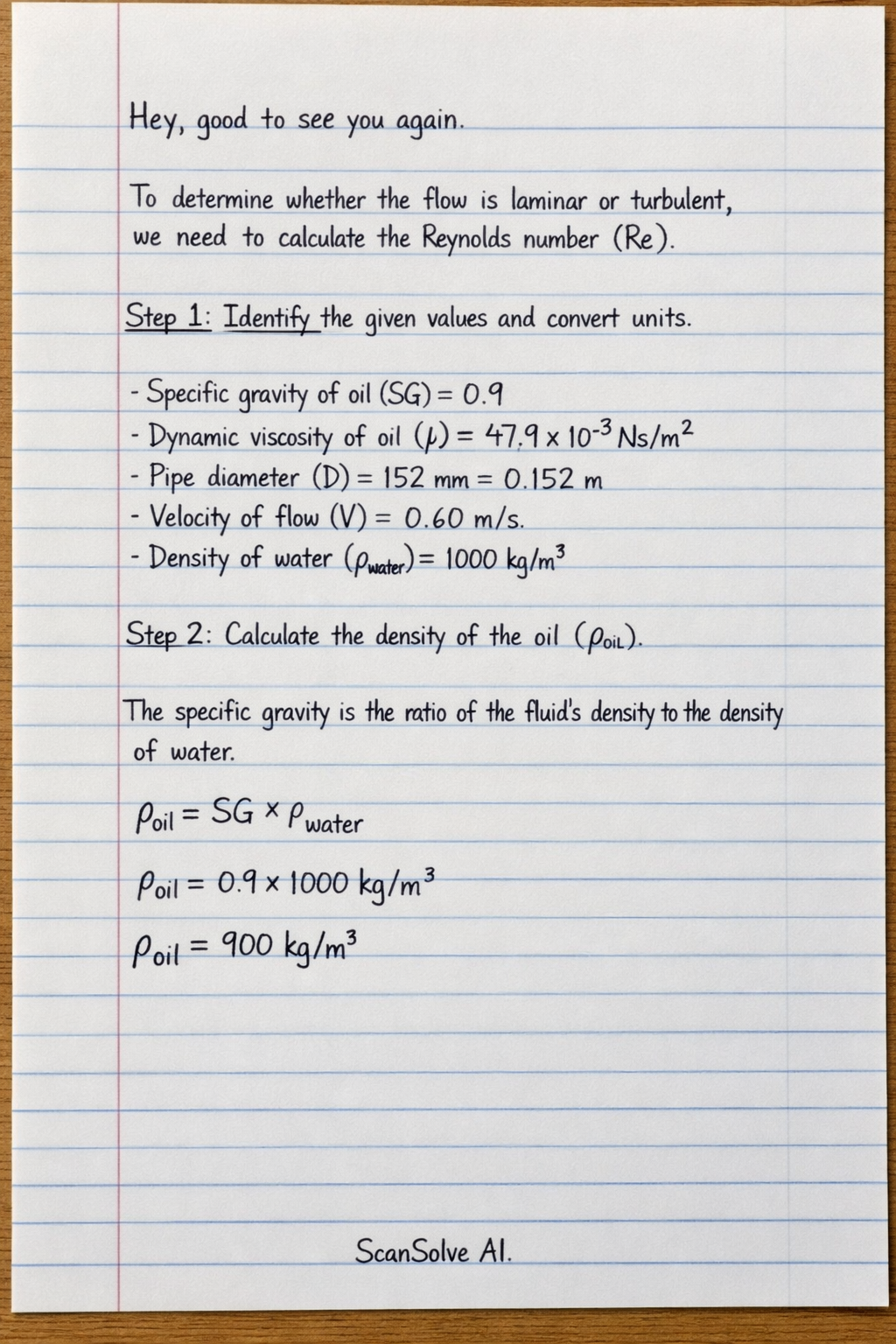
Handwritten Step-by-Step Solution
Get this as a handwritten image on WhatsApp — like a tutor wrote it for you.
Try on WhatsApp