

This physics problem tests your understanding of fundamental physical laws and their applications. The step-by-step solution below breaks down the problem using relevant equations and physical reasoning.
ScanSolve AI Answer
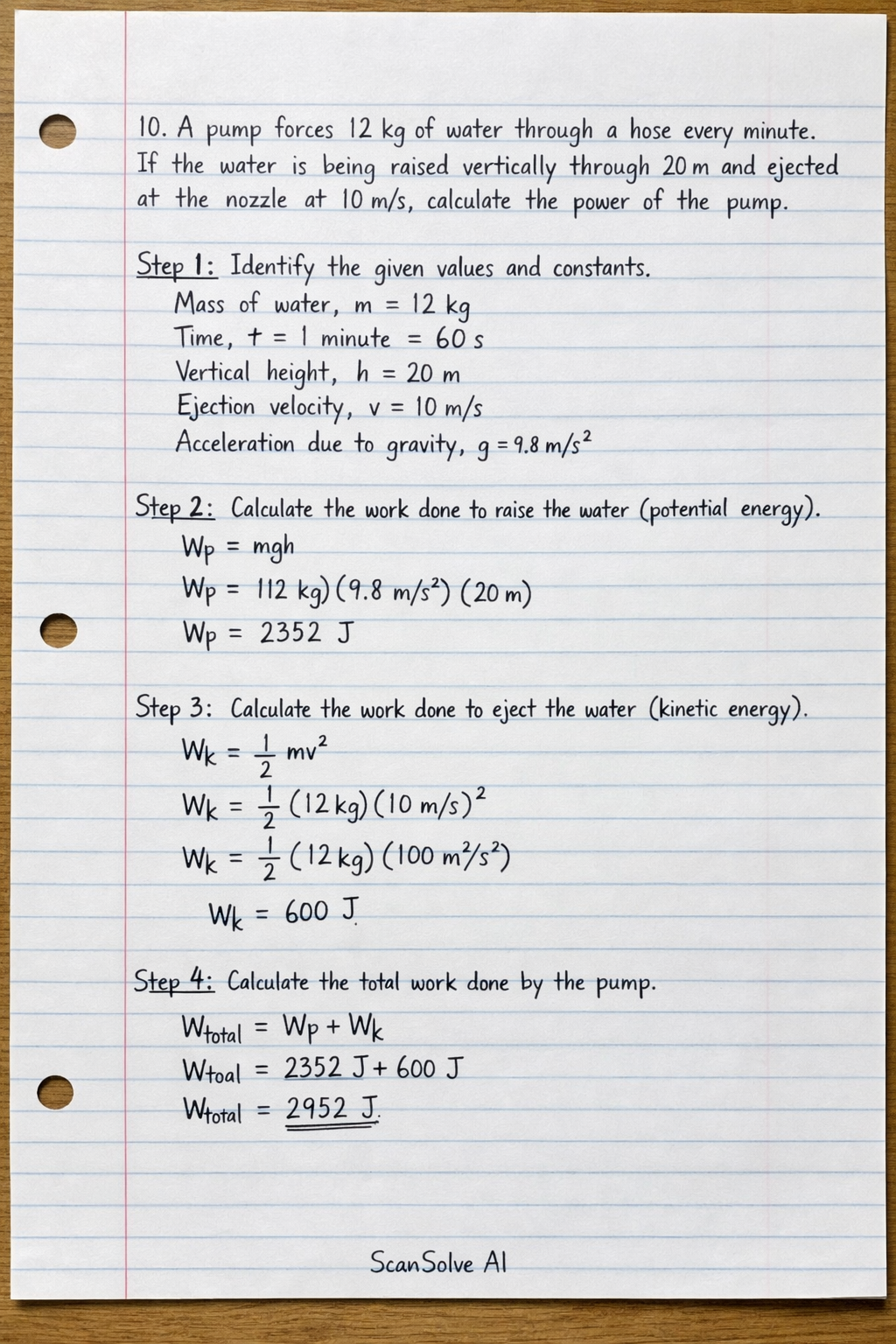
You're on a roll — Here are the solutions to your questions: 10. A pump forces 12kg of water through a hose every minute. If the water is being raised vertically through 20m and ejected at the nozzle at 10m/s, calculate the power of the pump. Step 1: Identify the given values and constants. Mass of water, m = 12 kg Time, t = 1 minute = 60 s Vertical height, h = 20 m Ejection velocity, v = 10 m/s Acceleration due to gravity, g = 9.8 m/s^2 Step 2: Calculate the work done to raise the water (potential energy). W_P = mgh W_P = (12 kg)(9.8 m/s^2)(20 m) W_P = 2352 J Step 3: Calculate the work done to eject the water (kinetic energy). W_K = (1)/(2)mv^2 W_K = (1)/(2)(12 kg)(10 m/s)^2 W_K = (1)/(2)(12 kg)(100 m^2/s^2) W_K = 600 J Step 4: Calculate the total work done by the pump. W_total = W_P + W_K W_total = 2352 J + 600 J W_total = 2952 J Step 5: Calculate the power of the pump. P = W_totalt P = 2952 J60 s P = 49.2 W The power of the pump is 49.2 W. 11. Determine the manometer which will have the lowest level between P, Q and R in the figure below. Explain your answer. [assume the water is flowing continuously from the tap to the tap to the outlet.] Manometer Q will have the lowest level. Explanation: According to the principle of continuity, as water flows through the pipe, its speed increases where the cross-sectional area of the pipe is smaller. At point Q, the pipe is narrower than at P or R, so the water flows fastest at Q. According to Bernoulli's principle, for a horizontal flow, where the fluid velocity is highest, the pressure is lowest. Since the water velocity is highest at Q, the pressure at Q will be the lowest. A lower pressure in the pipe means the water level in the manometer connected to that point will be lower. 12. A block of metal A having a mass 40kg requires a horizontal force of 100N to drag it with uniform velocity along a horizontal surface. Calculate the co-efficient of friction. Step 1: Identify the given values. Mass of block, m = 40 kg Horizontal force, F = 100 N Acceleration due to gravity, g = 9.8 m/s^2 Step 2: Determine the force of friction. Since the block is dragged with uniform velocity, the net force on it is zero. This means the applied horizontal force is equal to the force of friction. F_f = F_applied = 100 N Step 3: Calculate the normal force. On a horizontal surface, the normal force (N) is equal to the weight of the block. N = mg N = (40 kg)(9.8 m/s^2) N = 392 N Step 4: Calculate the coefficient of friction (). The force of friction is given by the formula F_f = N. = (F_f)/(N) = 100 N392 N ≈ 0.255 The coefficient of friction is 0.255. Send me the next one 📸