
We read your photo as:
Calculate the power required to pump 5 m³ of water per minute to a reservoir 30 m above the water level if the efficiency is 80%.
Physics
ScanSolve AI Answer
Answer
Step-by-step solution
4 stepsIdentify the given values and constants.
- Volume of water,
- Time,
- Height,
- Efficiency,
- Density of water, (standard value)
- Acceleration due to gravity, (standard value)
Calculate the mass of water pumped per minute.
The mass () of water can be found using its density () and volume ():
Calculate the useful power (power output) required to lift the water.
Useful power () is the rate at which potential energy is gained by the water.
Calculate the actual power required (power input) by the pump, considering its efficiency.
Efficiency () is defined as the ratio of useful power output to the total power input ():
Rearranging the formula to find :
The power required to pump the water is .
Was this helpful?
Try one yourself
A new problem that tests the same skill.
Still stuck on this one?
Ask a follow-up, and the answer starts from this question.
Got a different question?Ask your own question
More Physics Questions
QA pump lifts 5000 kg of water to a vertical height of 60 inches in 15 minutes. Calculate the power…QA pump forces 12kg of water through a hose every minute. If the water is being raised vertically…QA pump lifts 250 kg of water to a height of 12 m in 2 minutes. Calculate the power dissipated by the…QCalculate the rise in water level for Question 1.QCalculate the following: The indicated power in kilowatts, The induced volume per second, The swept…
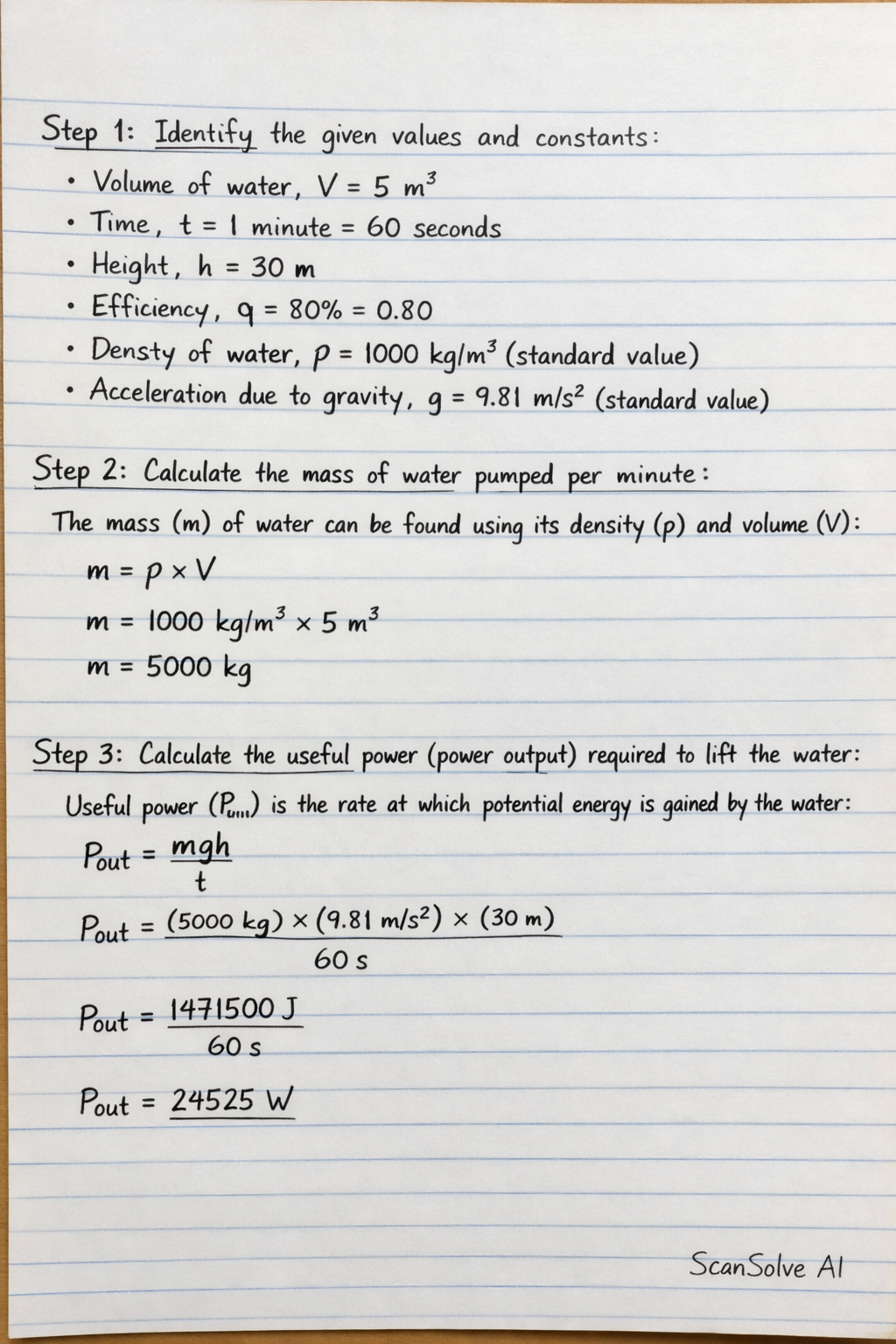
Handwritten Step-by-Step Solution
Get this as a handwritten image on WhatsApp — like a tutor wrote it for you.
Try on WhatsApp