
We read your photo as:
A particle has a velocity of 1i + 6j + 5k m/s. It has a constant tangential acceleration of 4 m/s², and a normal acceleration of 1i + 4j - 5k m/s². Find the x, y, and z components of its net acceleration.
ScanSolve AI Answer
Answer
Step-by-step solution
5 stepsDetermine the unit vector in the direction of velocity.
The velocity vector is given as m/s.
First, calculate the magnitude of the velocity vector:Next, find the unit vector in the direction of velocity:
Calculate the tangential acceleration vector.
The magnitude of the tangential acceleration is given as m/s.
The tangential acceleration vector is in the same direction as the velocity vector:Calculate the net acceleration vector.
The normal acceleration vector is given as m/s.
The net acceleration is the vector sum of the tangential and normal accelerations:Combine the corresponding components:
Determine the x, y, and z components of the net acceleration.
From the net acceleration vector, the components are:
Calculate the numerical values for the components.
Using :
The x, y, and z components of the net acceleration are:
Try one yourself
A new problem that tests the same skill.
Still stuck on this one?
Ask a follow-up, and the answer starts from this question.
More Physics Questions
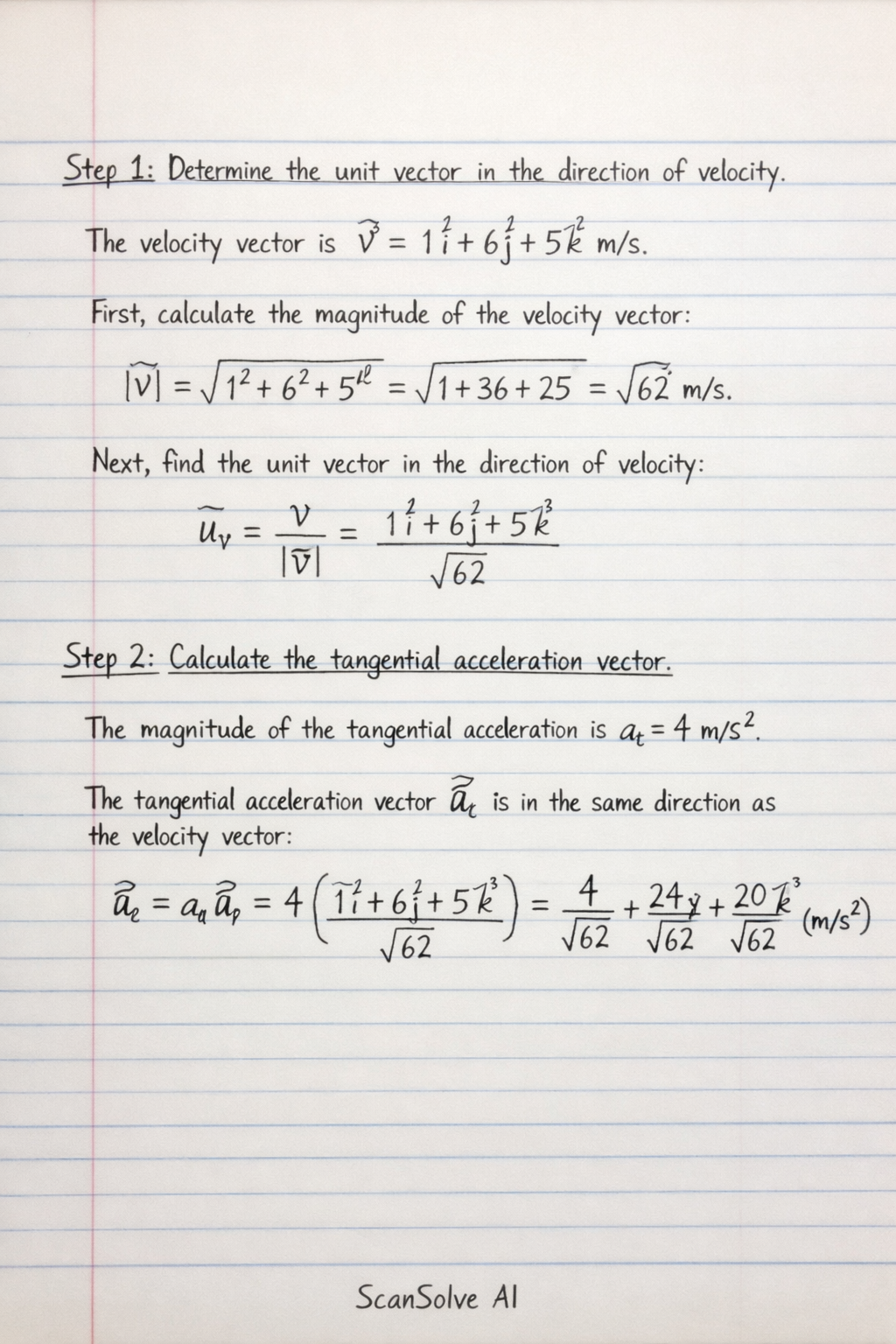
Handwritten Step-by-Step Solution
Get this as a handwritten image on WhatsApp — like a tutor wrote it for you.
Try on WhatsApp