
We read your photo as:
Using the tail-to-head method and a scale of 1 cm represents 10 N, draw an accurate vector diagram to determine the magnitude of the resultant force acting on the box.
ScanSolve AI Answer
Answer
Step-by-step solution
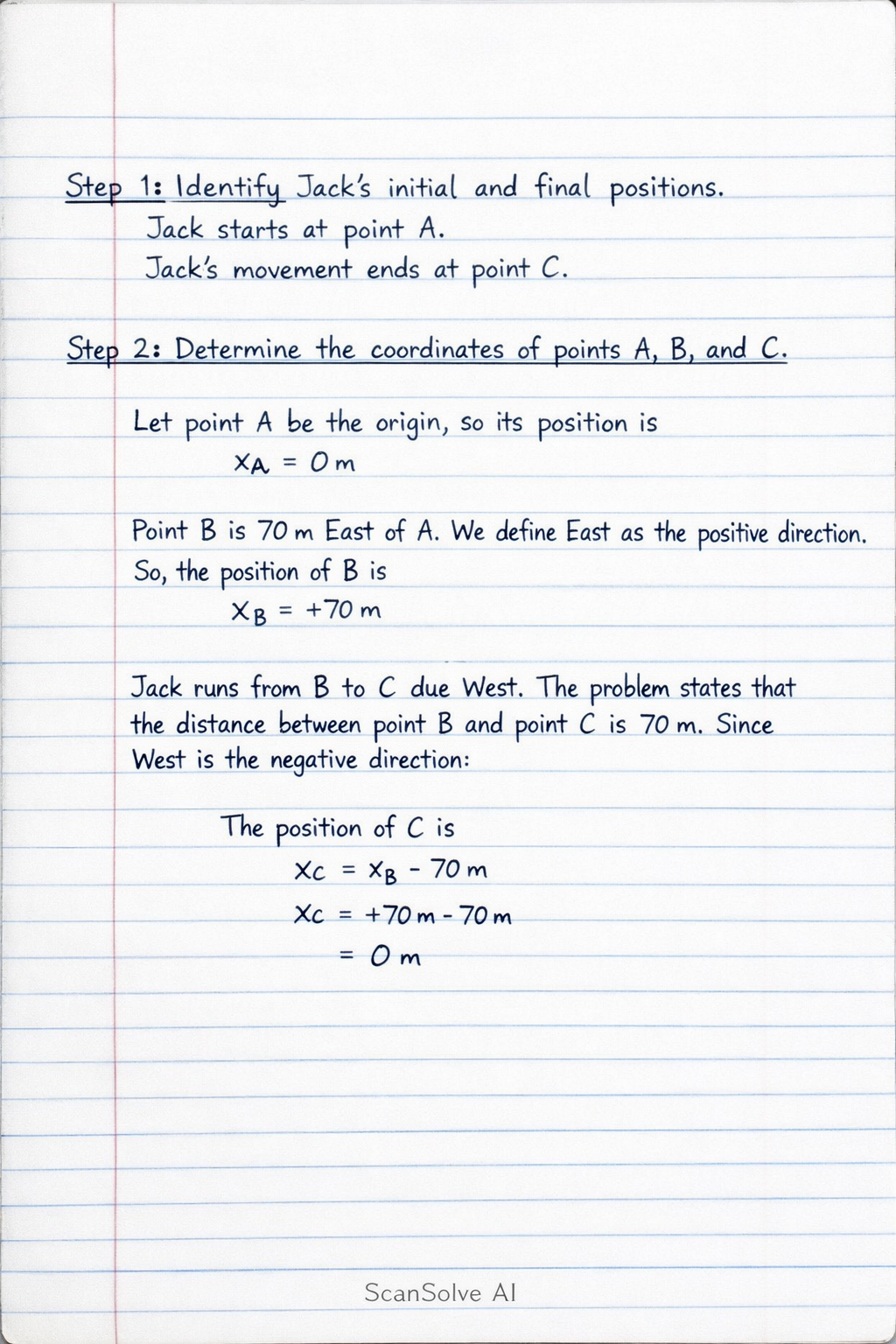
3 stepsIdentify Jack's initial and final positions.
Jack starts at point A.
Jack's movement ends at point C.Determine the coordinates of points A, B, and C.
Let point A be the origin, so its position is .
Point B is East of A. We define East as the positive direction.
So, the position of B is .
Jack runs from B to C due West. The problem states that the distance between point B and point C is . Since West is the negative direction:
The position of C is .Calculate Jack's displacement.
Displacement () is the change in position from the initial point to the final point.
Note: The information about Jack's velocity () and time () for the B to C segment would imply a distance of . However, the problem explicitly states "The distance between point B and point C is 70 m". We use the explicitly stated distance to define the positions of the points.
Jack's displacement is .
Try one yourself
A new problem that tests the same skill.
Still stuck on this one?
Ask a follow-up, and the answer starts from this question.
More Physics Questions
Handwritten Step-by-Step Solution
Get this as a handwritten image on WhatsApp — like a tutor wrote it for you.
Try on WhatsApp