
We read your photo as:
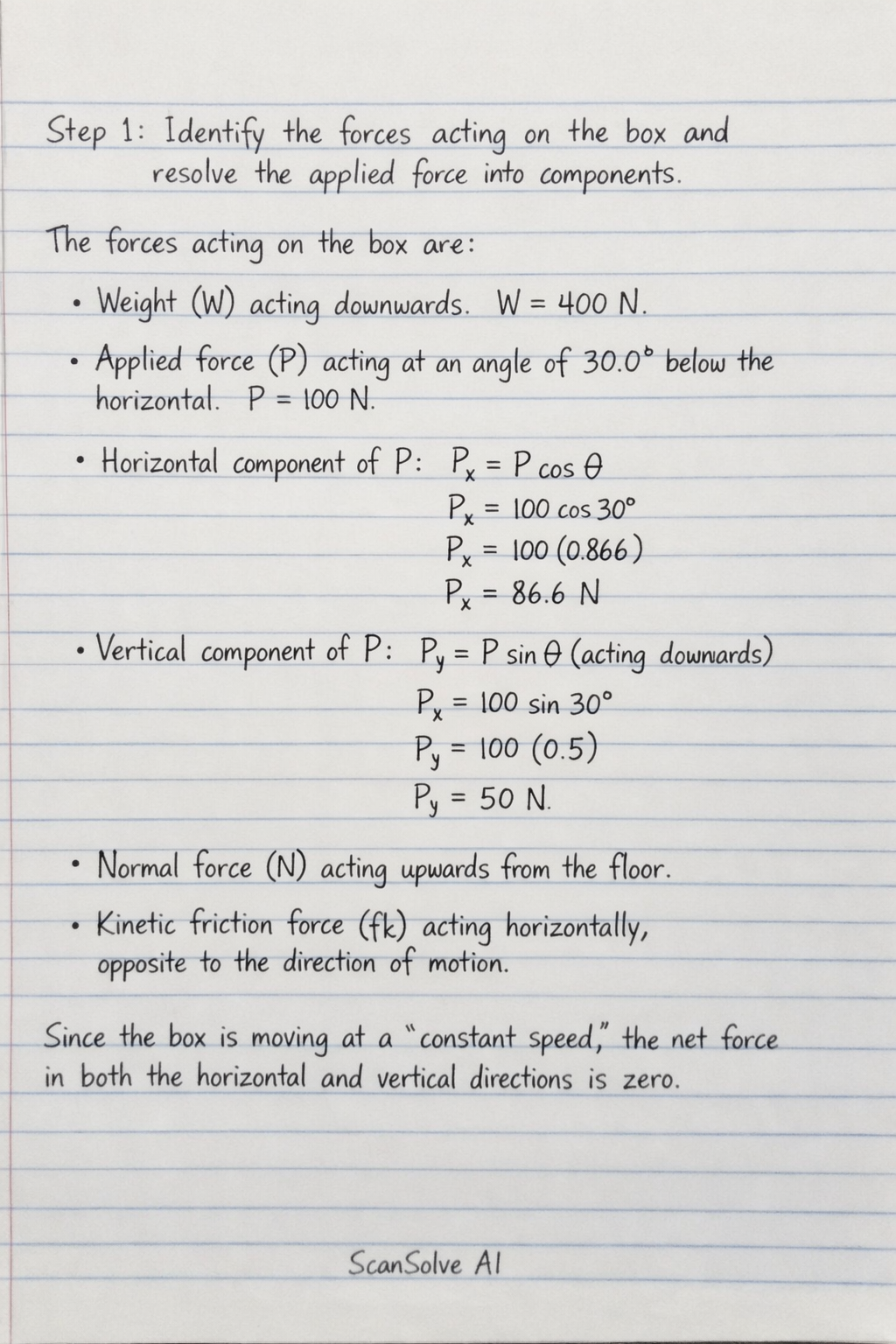
Identify the forces acting on the box and resolve the applied force into components.
ScanSolve AI Answer
Step-by-step solution
4 stepsIdentify the forces acting on the box and resolve the applied force into components.
The forces acting on the box are:
- Weight () acting downwards. N.
- Applied force () acting at an angle of below the horizontal. N.
- Horizontal component of :
- Vertical component of : (acting downwards)
- Normal force () acting upwards from the floor.
- Kinetic friction force () acting horizontally, opposite to the direction of motion.
Since the box is moving at a constant speed, the net force in both the horizontal and vertical directions is zero.
Apply Newton's second law in the vertical direction to find the normal force ().
The forces in the vertical direction are the normal force () upwards, the weight () downwards, and the vertical component of the applied force () downwards.
Substitute :
Substitute the given values: N, N, .
Apply Newton's second law in the horizontal direction to find the kinetic friction force ().
The forces in the horizontal direction are the horizontal component of the applied force () in the direction of motion and the kinetic friction force () opposite to the direction of motion.
Substitute :
Substitute the given values: N, .
Calculate the coefficient of kinetic friction ().
The kinetic friction force is related to the normal force by the formula:
Rearrange to solve for :
Substitute the calculated values for and :
Comparing this value to the given options:
A. 0.19
B. 0.24
C. 0.40
D. 0.22The calculated value 0.1924 is closest to 0.19.
The final answer is .
Still stuck on this one?
Ask a follow-up, and the answer starts from this question.
More Physics Questions
Handwritten Step-by-Step Solution
Get this as a handwritten image on WhatsApp — like a tutor wrote it for you.
Try on WhatsApp