
We read your photo as:
The figure below shows a toolbox of weight 300N on a rough horizontal plane having a coefficient of friction as 0.2. Calculate the magnitude of the force which can pull the box while acting at an angle of 25 degrees with the horizontal.
ScanSolve AI Answer
Answer
Step-by-step solution
5 stepsIdentify the given values and set up the force equilibrium equations.
The weight of the toolbox, (taken from the diagram, as it is more clearly indicated than the text).
The coefficient of friction, .
The angle of the pulling force with the horizontal, .Let be the magnitude of the pulling force and be the normal force exerted by the surface on the toolbox. The friction force opposes the motion.
The friction force is given by:For vertical equilibrium (no vertical acceleration):
The sum of upward forces equals the sum of downward forces.
The upward forces are the normal force and the vertical component of the pulling force .
The downward force is the weight .For horizontal equilibrium (constant velocity or on the verge of motion):
The sum of forces in the direction of motion equals the sum of forces opposing motion.
The force in the direction of motion is the horizontal component of the pulling force .
The force opposing motion is the friction force .Substitute the friction force into the horizontal equilibrium equation.
Substitute into equation (2):
Substitute the expression for the normal force from equation (1).
Rearrange the equation to solve for .
Move all terms containing to one side:
Factor out :
Solve for :
Substitute the numerical values and calculate .
Given , , and .
First, calculate and :
Now substitute these values into the equation for :
Rounding to three significant figures:
The magnitude of the force required to pull the box is .
Try one yourself
A new problem that tests the same skill.
Still stuck on this one?
Ask a follow-up, and the answer starts from this question.
More Physics Questions
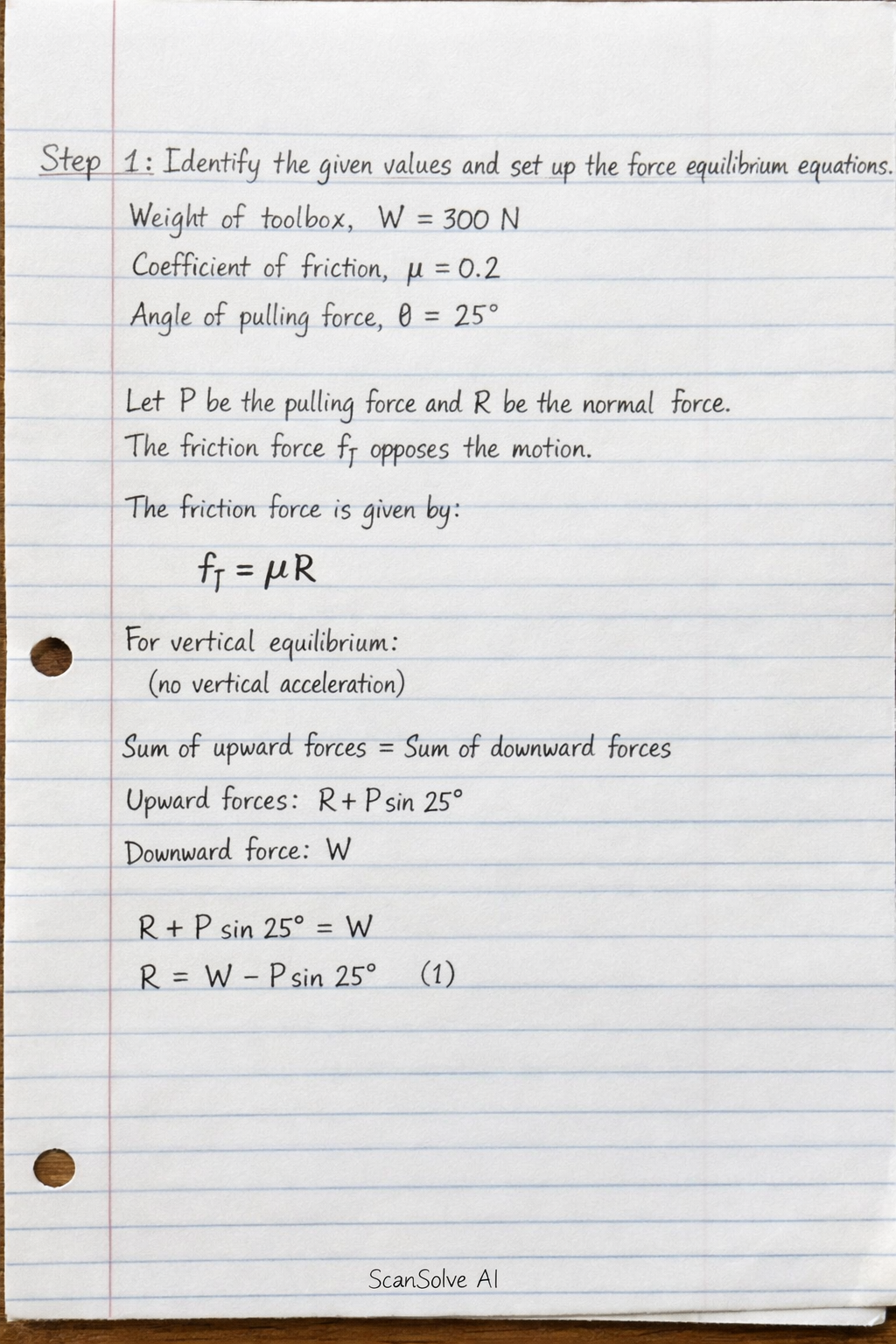
Handwritten Step-by-Step Solution
Get this as a handwritten image on WhatsApp — like a tutor wrote it for you.
Try on WhatsApp