
We read your photo as:
A 10 kg box is on a horizontal surface. A force of 200 N is applied at an angle of 30 degrees below the horizontal. The box moves at a constant speed. Calculate the normal force and the friction force
ScanSolve AI Answer
Answer
Step-by-step solution
4 stepsPart a
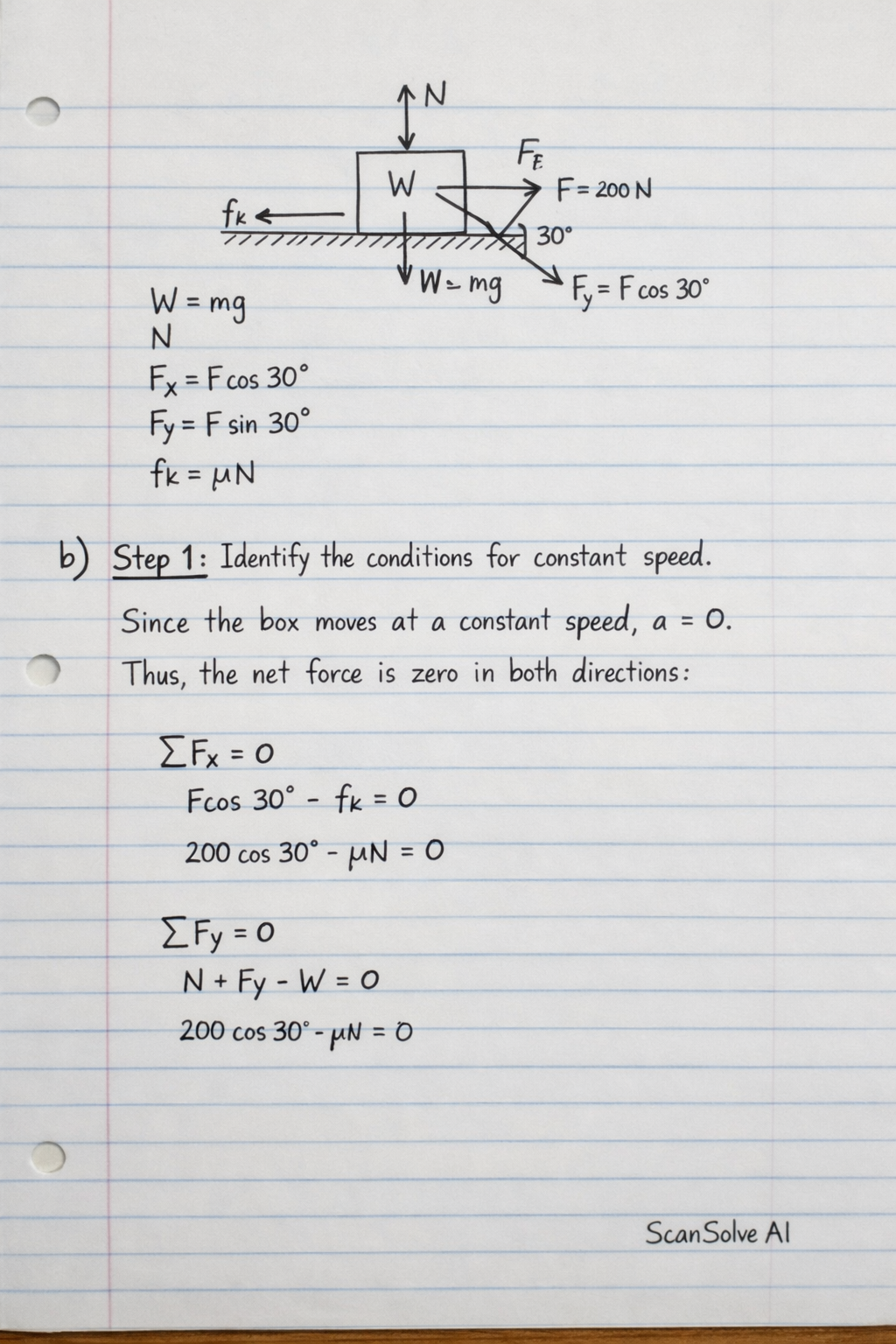
A diagram illustrating the forces acting on the box would show
- A horizontal surface with a box on it.
- The weight of the box, , acting vertically downwards from the center of the box.
- The normal force, , acting vertically upwards from the surface, perpendicular to the floor.
- The applied force, , acting at an angle of below the horizontal, pushing the box. This force can be resolved into two components:
- A horizontal component, , acting in the direction of motion.
- A vertical component, , acting vertically downwards.
- The kinetic friction force, , acting horizontally opposite to the direction of motion.
Part b
Identify the conditions for constant speed.
Since the box moves at a constant speed, its acceleration is zero. This means the net force acting on the box in both the horizontal and vertical directions is zero.
Resolve forces in the vertical direction.
The forces acting vertically are the normal force () upwards, the weight () downwards, and the vertical component of the applied force () downwards.
Resolve forces in the horizontal direction.
The forces acting horizontally are the horizontal component of the applied force () in the direction of motion and the kinetic friction force () opposite to the direction of motion.
Substitute the expression for into the horizontal force equation and solve for .
We are given , , , and .
Substitute the known values:
Using and :
Rearrange to solve for :
Calculate the numerical value:
The value of is .
Try one yourself
A new problem that tests the same skill.
Still stuck on this one?
Ask a follow-up, and the answer starts from this question.
More Physics Questions
Handwritten Step-by-Step Solution
Get this as a handwritten image on WhatsApp — like a tutor wrote it for you.
Try on WhatsApp