

This physics problem tests your understanding of fundamental physical laws and their applications. The step-by-step solution below breaks down the problem using relevant equations and physical reasoning.
ScanSolve AI Answer
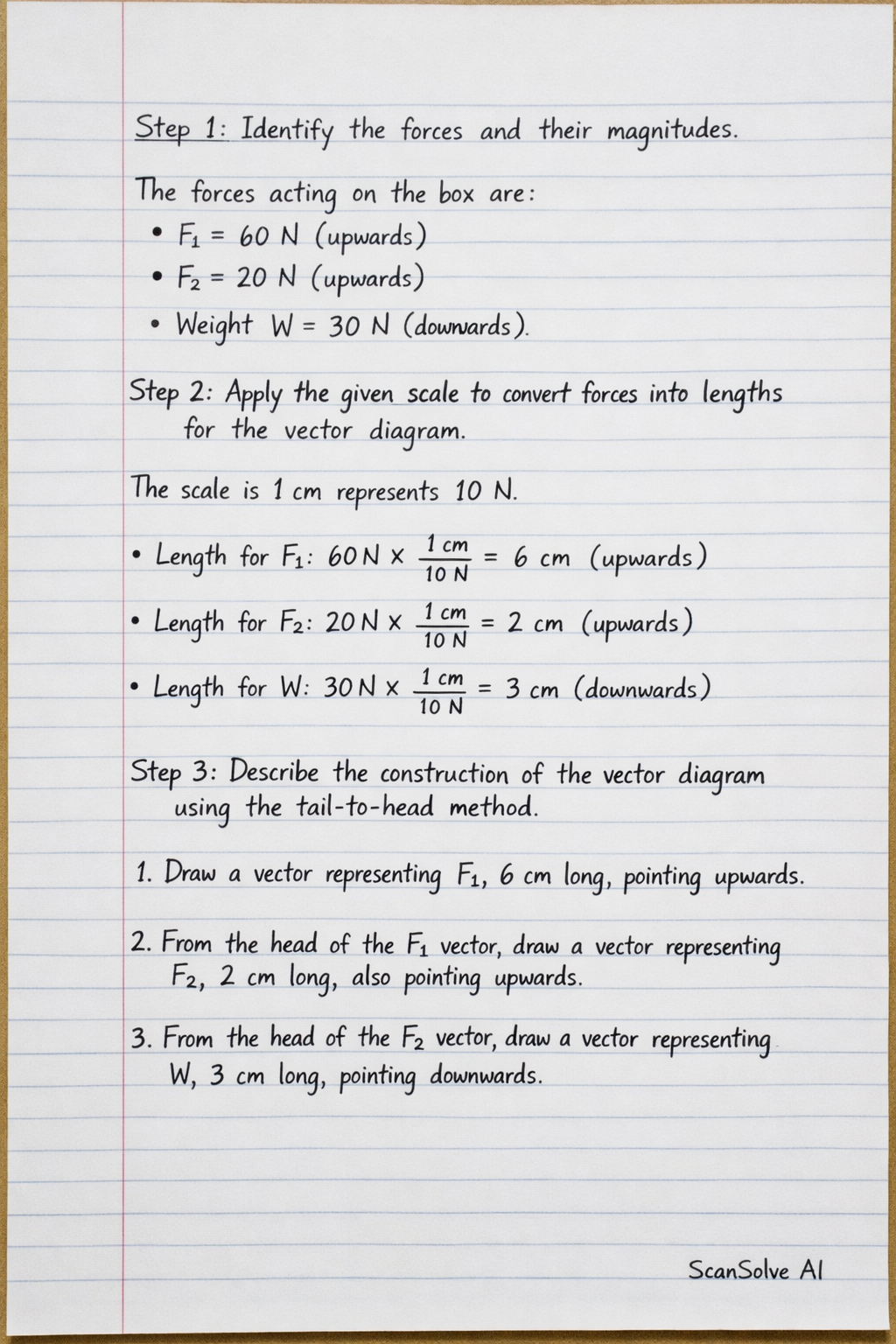
Step 1: Identify the forces and their magnitudes. The forces acting on the box are: F_1 = 60 N (upwards) F_2 = 20 N (upwards) Weight W = 30 N (downwards) Step 2: Apply the given scale to convert forces into lengths for the vector diagram. The scale is 1 cm represents 10 N. Length for F_1: 60 N × 1 cm10 N = 6 cm (upwards) Length for F_2: 20 N × 1 cm10 N = 2 cm (upwards) Length for W: 30 N × 1 cm10 N = 3 cm (downwards) Step 3: Describe the construction of the vector diagram using the tail-to-head method. 1. Draw a vector representing F_1, 6 cm long, pointing upwards. 2. From the head of the F_1 vector, draw a vector representing F_2, 2 cm long, also pointing upwards. 3. From the head of the F_2 vector, draw a vector representing W, 3 cm long, pointing downwards. Step 4: Determine the magnitude of the resultant force from the diagram. The resultant vector is drawn from the tail of the first vector (F_1) to the head of the last vector (W). Since all forces are collinear (acting along the same vertical line), we can find the net displacement: Total upward length = 6 cm + 2 cm = 8 cm Total downward length = 3 cm Resultant length = Total upward length - Total downward length Resultant length = 8 cm - 3 cm = 5 cm (pointing upwards) Step 5: Convert the resultant length back to force magnitude using the scale. Resultant force magnitude = Resultant length × Scale factor Resultant force magnitude = 5 cm × 10 N1 cm = 50 N The magnitude of the resultant force is 50 N. 3 done, 2 left today. You're making progress.