This mathematics problem involves applying core mathematical principles and formulas. Below you will find a complete step-by-step solution with detailed explanations for each step, helping you understand not just the answer but the method behind it.
ScanSolve AI Answer
The resultant of two vectors is a single vector that produces the same effect as the original two vectors combined. It is the vector sum of the two vectors.
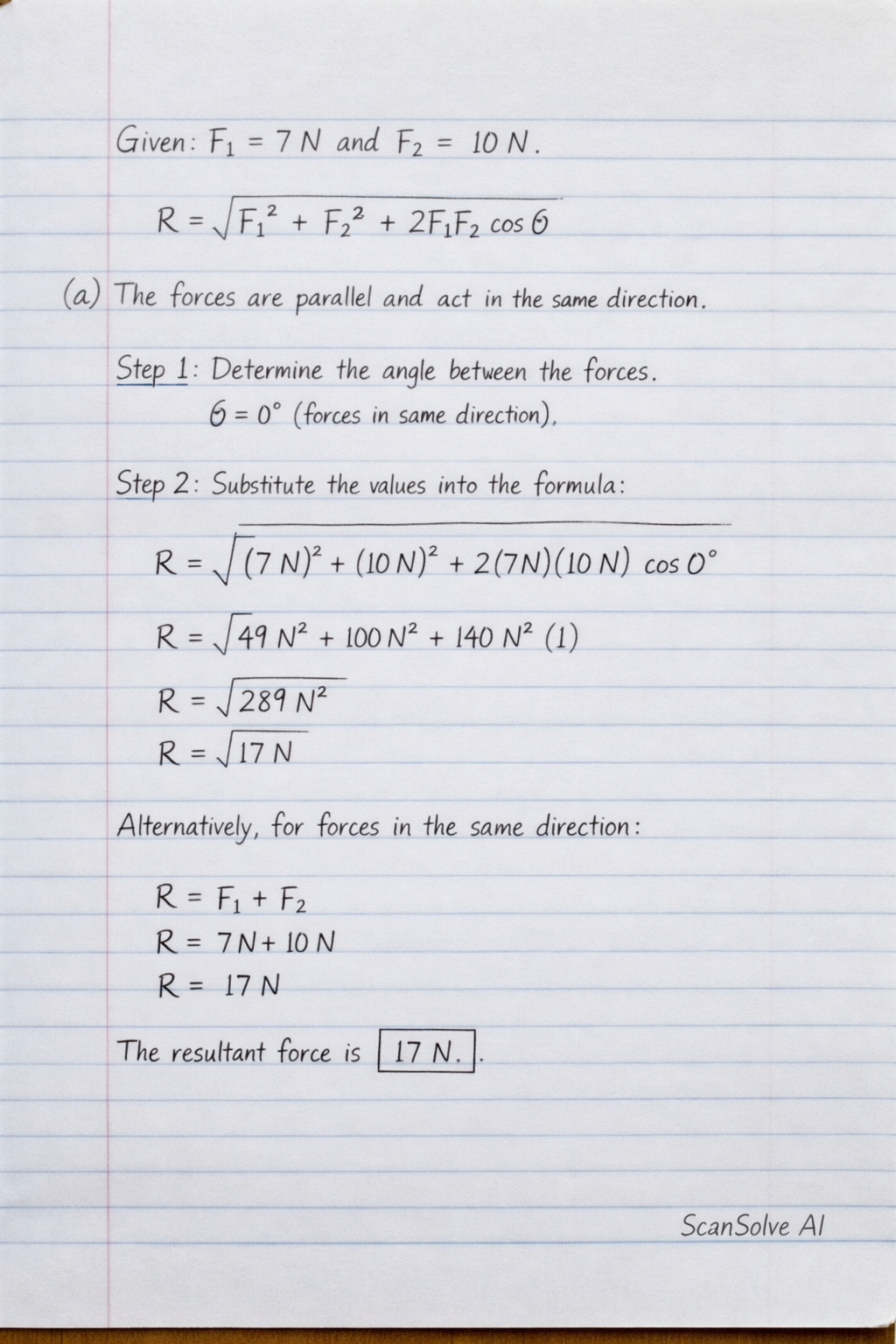
Given forces: $F_1 = 7$ N and $F_2 = 10$ N.
The magnitude of the resultant force $R$ of two forces $F_1$ and $F_2$ with an angle $\theta$ between them is given by the formula:
$$R = \sqrt{F_1^2 + F_2^2 + 2F_1F_2 \cos\theta}$$
a) The forces are parallel and act in the same direction.
Step 1: Determine the angle between the forces.
When forces are parallel and act in the same direction, $\theta = 0^\circ$.
Step 2: Substitute the values into the formula.
$$\begin{align} R &= \sqrt{(7 \text{ N})^2 + (10 \text{ N})^2 + 2(7 \text{ N})(10 \text{ N}) \cos(0^\circ)} \\ &= \sqrt{49 \text{ N}^2 + 100 \text{ N}^2 + 140 \text{ N}^2 (1)} \\ &= \sqrt{289 \text{ N}^2} \\ &= 17 \text{ N}\end{align}$$
Alternatively, for forces in the same direction, $R = F_1 + F_2$.
$$R = 7 \text{ N} + 10 \text{ N} = 17 \text{ N}$$
The resultant force is $\boxed{\text{17 N}}$.
b) The forces are parallel and act in opposite directions.
Step 1: Determine the angle between the forces.
When forces are parallel and act in opposite directions, $\theta = 180^\circ$.
Step 2: Substitute the values into the formula.
$$\begin{align} R &= \sqrt{(7 \text{ N})^2 + (10 \text{ N})^2 + 2(7 \text{ N})(10 \text{ N}) \cos(180^\circ)} \\ &= \sqrt{49 \text{ N}^2 + 100 \text{ N}^2 + 140 \text{ N}^2 (-1)} \\ &= \sqrt{149 \text{ N}^2 - 140 \text{ N}^2} \\ &= \sqrt{9 \text{ N}^2} \\ &= 3 \text{ N}\end{align}$$
Alternatively, for forces in opposite directions, $R = |F_2 - F_1|$.
$$R = |10 \text{ N} - 7 \text{ N}| = 3 \text{ N}$$
The resultant force is $\boxed{\text{3 N}}$.
c) The two forces are inclined at an angle of $60^\circ$ to each other.
Step 1: Determine the angle between the forces.
$\theta = 60^\circ$.
Step 2: Substitute the values into the formula.
$$\begin{align} R &= \sqrt{(7 \text{ N})^2 + (10 \text{ N})^2 + 2(7 \text{ N})(10 \text{ N}) \cos(60^\circ)} \\ &= \sqrt{49 \text{ N}^2 + 100 \text{ N}^2 + 140 \text{ N}^2 (0.5)} \\ &= \sqrt{149 \text{ N}^2 + 70 \text{ N}^2} \\ &= \sqrt{219 \text{ N}^2} \\ &\approx 14.80 \text{ N}\end{align}$$
The resultant force is $\boxed{\text{14.80 N}}$.
d) The two forces are inclined at an angle of $160^\circ$.
Step 1: Determine the angle between the forces.
$\theta = 160^\circ$.
Step 2: Substitute the values into the formula.
$$\begin{align} R &= \sqrt{(7 \text{ N})^2 + (10 \text{ N})^2 + 2(7 \text{ N})(10 \text{ N}) \cos(160^\circ)} \\ &= \sqrt{49 \text{ N}^2 + 100 \text{ N}^2 + 140 \text{ N}^2 (-0.9397)} \\ &= \sqrt{149 \text{ N}^2 - 131.558 \text{ N}^2} \\ &= \sqrt{17.442 \text{ N}^2} \\ &\approx 4.18 \text{ N}\end{align}$$
The resultant force is $\boxed{\text{4.18 N}}$.
Send me the next one 📸
Given forces: F1 = 7 N and F2 = 10 N.
|Mathematics
Given forces: F1 = 7 N and F2 = 10 N.
ScanSolve AI Answer
The resultant of two vectors is a single vector that produces the same effect as the original two vectors combined. It is the vector sum of the two vectors.
Given forces: F1=7 N and F2=10 N.
The magnitude of the resultant force R of two forces F1 and F2 with an angle θ between them is given by the formula:
R=F12+F22+2F1F2cosθ
a) The forces are parallel and act in the same direction.
Step 1: Determine the angle between the forces.
When forces are parallel and act in the same direction, θ=0∘.
Step 2: Substitute the values into the formula.
\begin{align*} R &= \sqrt{(7 N)^2 + (10 N)^2 + 2(7 N)(10 N) \cos(0^\circ)} \\ &= \sqrt{49 N^2 + 100 N^2 + 140 N^2 (1)} \\ &= \sqrt{289 N^2} \\ &= 17 N\end{align*}
Alternatively, for forces in the same direction, R=F1+F2.
R=7N+10N=17 N
The resultant force is ∗17N∗.
b) The forces are parallel and act in opposite directions.
Step 1: Determine the angle between the forces.
When forces are parallel and act in opposite directions, θ=180∘.
Step 2: Substitute the values into the formula.
\begin{align*} R &= \sqrt{(7 N)^2 + (10 N)^2 + 2(7 N)(10 N) \cos(180^\circ)} \\ &= \sqrt{49 N^2 + 100 N^2 + 140 N^2 (-1)} \\ &= \sqrt{149 N^2 - 140 N^2} \\ &= \sqrt{9 N^2} \\ &= 3 N\end{align*}
Alternatively, for forces in opposite directions, R=∣F2−F1∣.
R=∣10N−7N∣=3 N
The resultant force is ∗3N∗.
c) The two forces are inclined at an angle of 60∘ to each other.
Step 1: Determine the angle between the forces.
θ=60∘.
Step 2: Substitute the values into the formula.
\begin{align*} R &= \sqrt{(7 N)^2 + (10 N)^2 + 2(7 N)(10 N) \cos(60^\circ)} \\ &= \sqrt{49 N^2 + 100 N^2 + 140 N^2 (0.5)} \\ &= \sqrt{149 N^2 + 70 N^2} \\ &= \sqrt{219 N^2} \\ &\approx 14.80 N\end{align*}
The resultant force is ∗14.80N∗.
d) The two forces are inclined at an angle of 160∘.
Step 1: Determine the angle between the forces.
θ=160∘.
Step 2: Substitute the values into the formula.
\begin{align*} R &= \sqrt{(7 N)^2 + (10 N)^2 + 2(7 N)(10 N) \cos(160^\circ)} \\ &= \sqrt{49 N^2 + 100 N^2 + 140 N^2 (-0.9397)} \\ &= \sqrt{149 N^2 - 131.558 N^2} \\ &= \sqrt{17.442 N^2} \\ &\approx 4.18 N\end{align*}
The resultant force is ∗4.18N∗.
Send me the next one 📸
Need help with your own homework?
Get instant step-by-step solutions to any question. Free to start.