
We read your photo as:
A particle is subjected to two forces, F1 and F2. F1 has a magnitude of 10 N and acts at 30^ counter-clockwise from the positive x-axis. F2 has a magnitude of 15 N and acts at 70^ with the negative y-
Physics
ScanSolve AI Answer
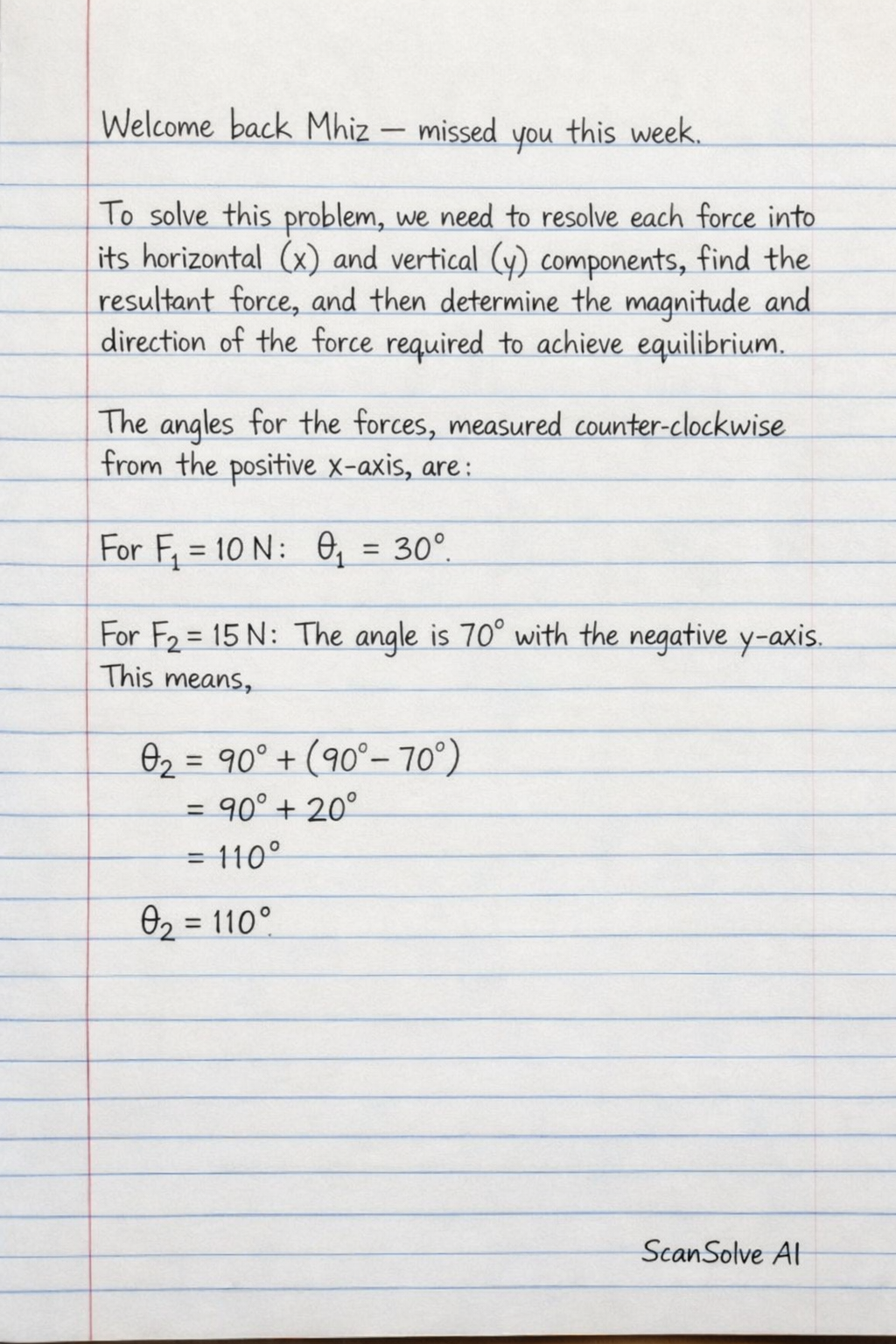
To solve this problem, we need to resolve each force into its horizontal (x) and vertical (y) components, find the resultant force, and then determine the magnitude and direction of the force required to achieve equilibrium.
The angles for the forces, measured counter-clockwise from the positive x-axis, are:
- For : .
- For : The angle is with the negative y-axis. This means $\theta_2 = 90^\circ + (90^\circ - 70^\circ) =
Was this helpful?
Still stuck on this one?
Ask a follow-up, and the answer starts from this question.
Got a different question?Ask your own question
More Physics Questions
QGiven forces: F1 = 7 N and F2 = 10 N.QTwo forces are acting on an object. Force F1 has a magnitude of 75 N and acts at 53 degrees west of…QTwo forces, F1 and F2 of magnitude 60 N and 20 N respectively act on a suspended box of weight 30 N…QThree forces act on a point object. Force 1 has magnitude 30 N at 45 degrees. Force 2 has magnitude…QForce F1 = 30 N: Applied at the left end. The diagram shows it pulling upwards and to the left…
Browse by topic:Mechanics
Handwritten Step-by-Step Solution
Get this as a handwritten image on WhatsApp — like a tutor wrote it for you.
Try on WhatsApp