
We read your photo as:
Three forces act on a point object. Force 1 has magnitude 30 N at 45 degrees. Force 2 has magnitude 40 N at 0 degrees. Force 3 has magnitude 25 N at 270 degrees. Determine the Cartesian components, ma
Physics
ScanSolve AI Answer
Answers
2 partsStep-by-step solution
3 stepsHere are the next parts of Question 1:
Part b· 2 steps
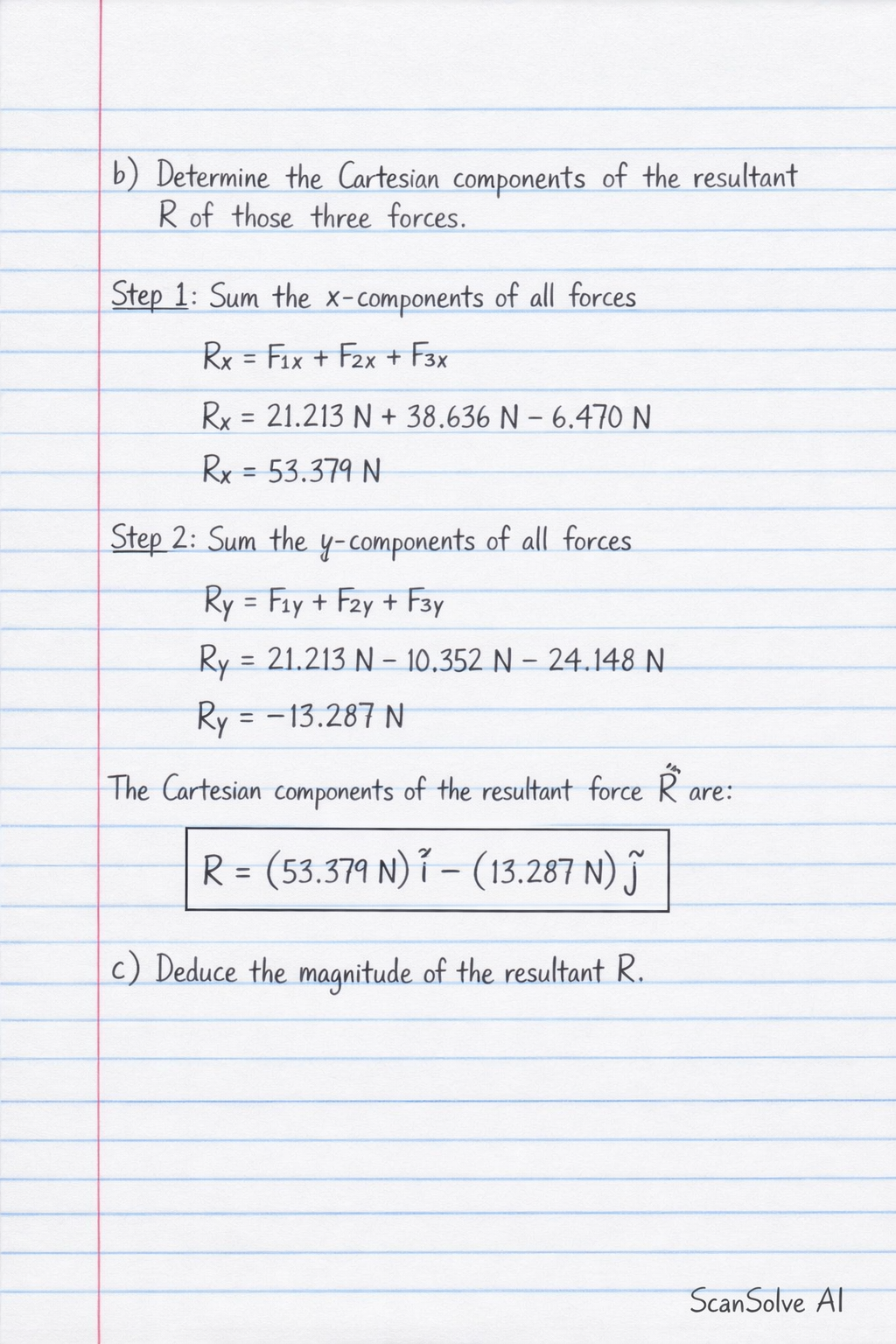
Determine the Cartesian components of the resultant R of those three forces.
Sum the x-components of all forces.
Using the values from the previous calculation:
Sum the y-components of all forces.
The Cartesian components of the resultant force are:
Part c
Deduce the magnitude of the resultant R.
Calculate the magnitude of the resultant force.
The magnitude of the resultant vector is found using the Pythagorean theorem:
Was this helpful?
Still stuck on this one?
Ask a follow-up, and the answer starts from this question.
Got a different question?Ask your own question
More Physics Questions
QTwo forces, 30 N and 40 N, act at right angles to each other. Using a scale of 1 cm = 5 N, find the…QA system has three forces acting on it: 3N upwards, 5N to the right, and 6N at 45 degrees upwards…QTwo forces are acting on an object. Force F1 has a magnitude of 75 N and acts at 53 degrees west of…QA particle is subjected to two forces, F1 and F2. F1 has a magnitude of 10 N and acts at 30^…QA point P is in equilibrium under the action of four forces. Three of the forces are 2 N at 45…
Browse by topic:Mechanics
Handwritten Step-by-Step Solution
Get this as a handwritten image on WhatsApp — like a tutor wrote it for you.
Try on WhatsApp