
We read your photo as:
Two forces are acting on an object. Force F1 has a magnitude of 75 N and acts at 53 degrees west of north. Force F2 has a magnitude of 100 N and acts at 37 degrees east of north. Calculate the resulta
ScanSolve AI Answer
Step-by-step solution
4 stepsResolve the forces into their x and y components.
We are given the following values from question 40: and .
Let North be the positive y-axis and East be the positive x-axis.For force at west of north:
The angle with the positive y-axis towards the negative x-axis is .
The x-component is negative, and the y-component is positive.For force at east of north:
The angle with the positive y-axis towards the positive x-axis is .
The x-component is positive, and the y-component is positive.Calculate the components of the resultant force.
The resultant force has components and :
Determine the magnitude and direction of the resultant force.
The magnitude of the resultant force is:
Since and is positive, the resultant force is directed purely along the positive y-axis, which corresponds to North.
Apply the graphical scale to find the length of the arrow line.
The given graphical scale is for force.
Length of the arrow line =The possible length of the arrow line is and its direction is North.
Comparing this with the given options:
A. to the North
B. to North of East
C. to the North
D. to North of EastThe calculated result matches option A.
The final answer is .
Still stuck on this one?
Ask a follow-up, and the answer starts from this question.
More Physics Questions
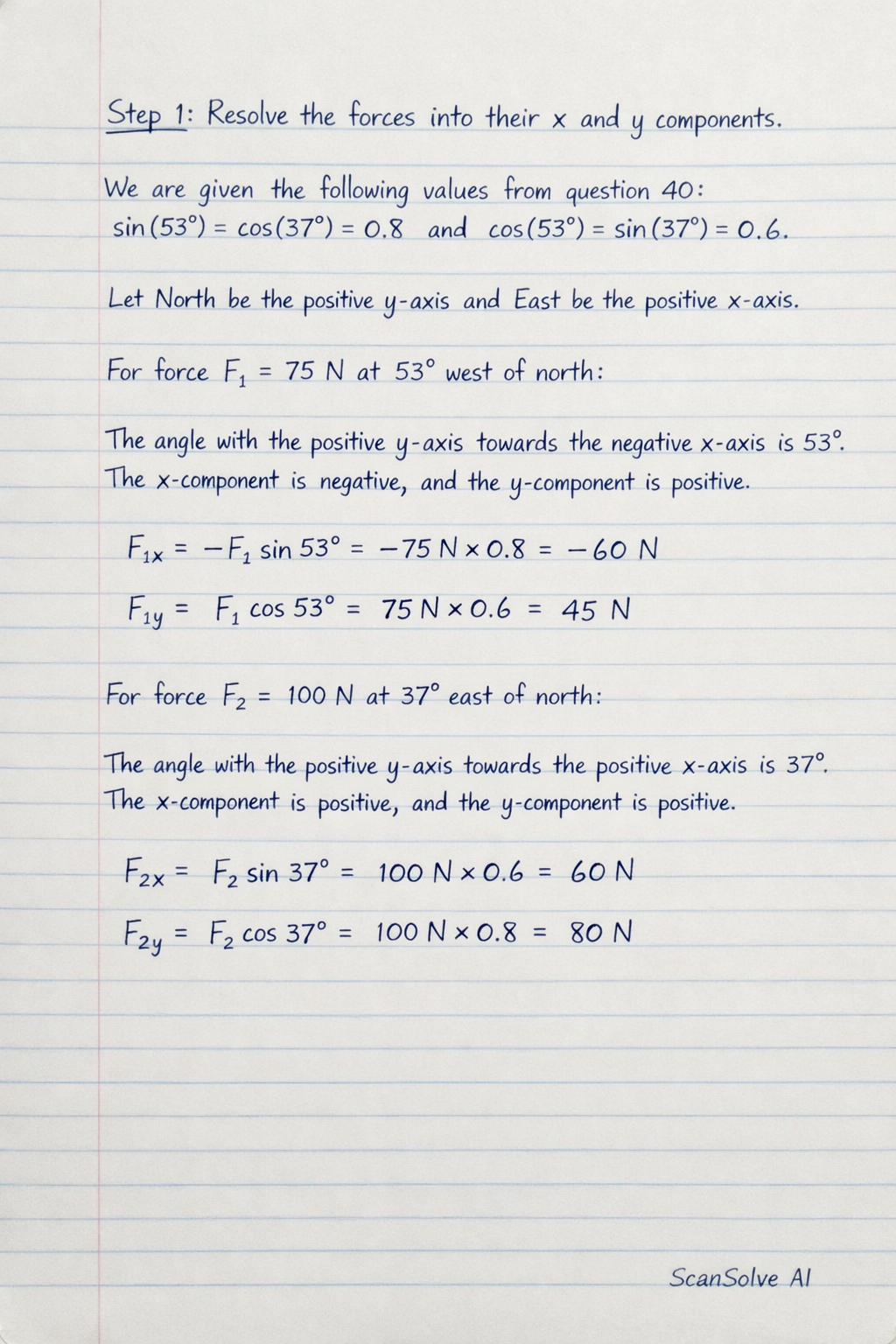
Handwritten Step-by-Step Solution
Get this as a handwritten image on WhatsApp — like a tutor wrote it for you.
Try on WhatsApp