
We read your photo as:
Two forces, 30 N and 40 N, act at right angles to each other. Using a scale of 1 cm = 5 N, find the magnitude and direction of their resultant force using a scale drawing.
Physics
ScanSolve AI Answer
Answer
Step-by-step solution
5 stepsIdentify the given forces and the scale.
We have two forces acting at a right angle:
The given scale for drawing is .Convert the forces to lengths for the scale drawing.
To represent on the drawing:
To represent on the drawing:
Explain the graphical method for determining the resultant force.
- Draw the first force vector () as a line segment long. Let's assume it acts horizontally.
- From the head (end) of the first vector, draw the second force vector () as a line segment long, perpendicular to the first vector (since they act at a right angle).
- The resultant force vector () is drawn from the tail (start) of the first vector to the head of the second vector.
- Measure the length of this resultant vector () with a ruler. Convert this length back to Newtons using the scale ().
- Measure the angle () the resultant vector makes with the first force vector using a protractor. This angle represents the direction.
Calculate the magnitude of the resultant force analytically (as a scale drawing should yield this result).
Since the forces are at a right angle, we can use the Pythagorean theorem:
Substitute the force values:
Calculate the direction of the resultant force analytically.
The direction can be found using the tangent function, where is the angle the resultant makes with the force:
The magnitude of the resultant force is .
The direction of the resultant force is .
Was this helpful?
Try one yourself
A new problem that tests the same skill.
Still stuck on this one?
Ask a follow-up, and the answer starts from this question.
Got a different question?Ask your own question
More Physics Questions
QTwo forces of magnitudes 10 N and 6 N act at an angle of 60 degrees to each other. Find the…QThree forces act on a point object. Force 1 has magnitude 30 N at 45 degrees. Force 2 has magnitude…QThe angle between two forces of magnitude 7N and 4N is 120°. Find in N, the magnitude of their…QCalculate the magnitude and direction of the resultant force of two forces: an 8 N horizontal force…QTwo forces, F1 and F2 of magnitude 60 N and 20 N respectively act on a suspended box of weight 30 N…
Browse by topic:Mechanics
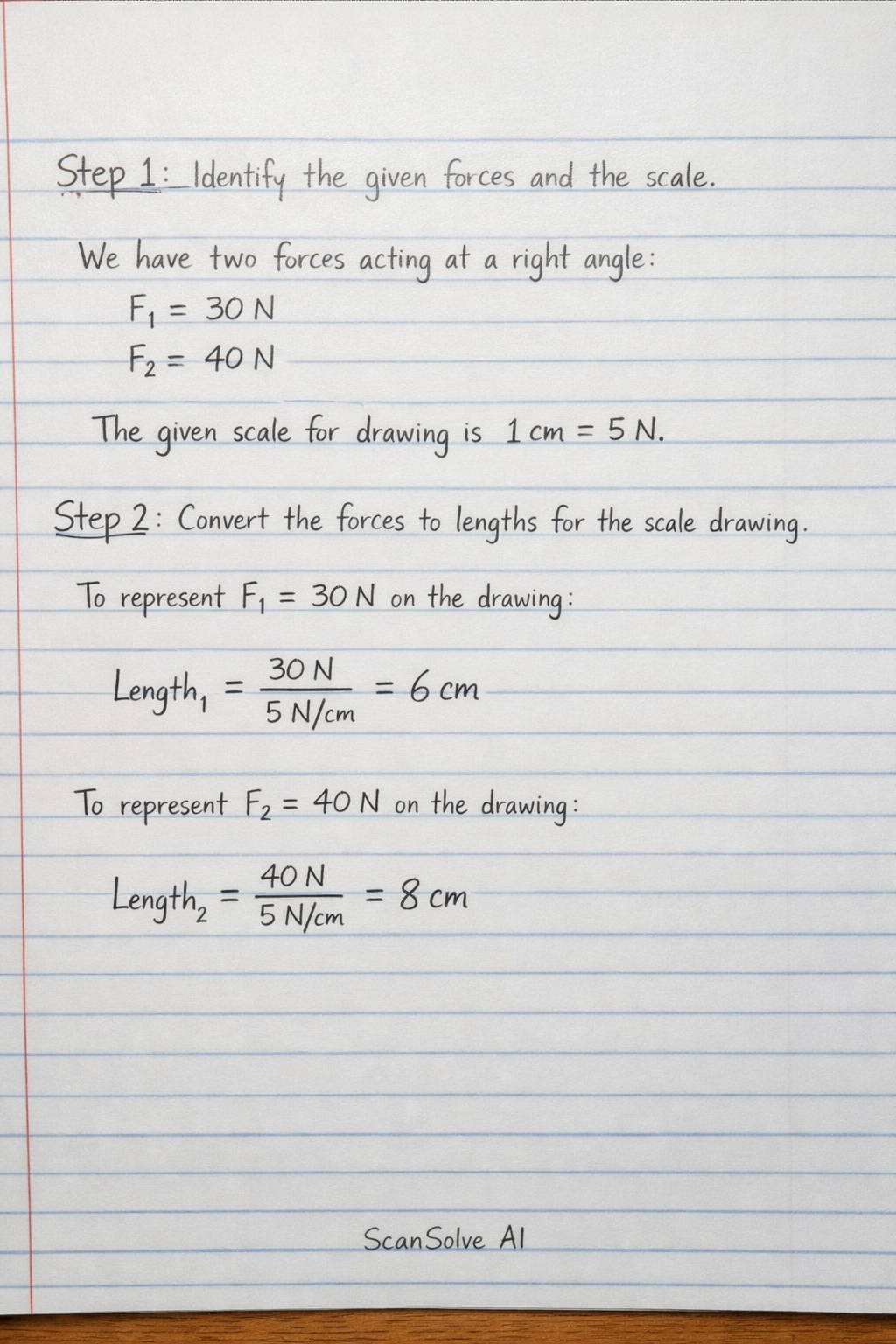
Handwritten Step-by-Step Solution
Get this as a handwritten image on WhatsApp — like a tutor wrote it for you.
Try on WhatsApp