
Assignment.. For chm 102 ... Ten ten per group take noted ✅️.... Explain the following terms with examples.... 1=SN¹,SN² 2=E1,E2 3=CHEMICAL KINETICS Submission next week it serve as C.A Test
ScanSolve AI Answer
Step-by-step solution
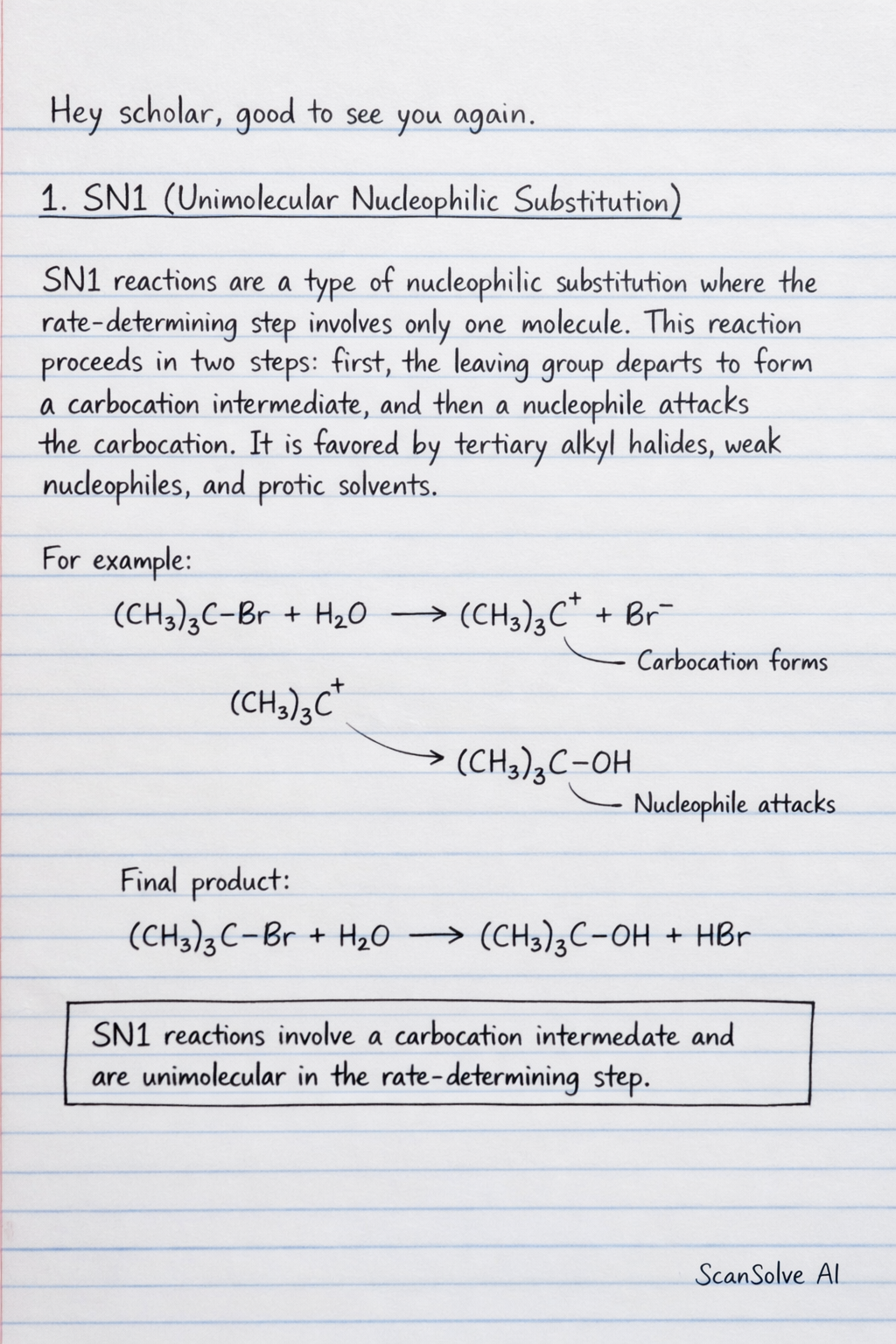
5 stepsSN1 (Unimolecular Nucleophilic Substitution)
SN1 reactions are a type of nucleophilic substitution where the rate-determining step involves only one molecule. This reaction proceeds in two steps: first, the leaving group departs to form a carbocation intermediate, and then a nucleophile attacks the carbocation. It is favored by tertiary alkyl halides, weak nucleophiles, and protic solvents.
For example, the hydrolysis of tert-butyl bromide:
SN2 (Bimolecular Nucleophilic Substitution)
SN2 reactions are a type of nucleophilic substitution where the rate-determining step involves two molecules. This reaction occurs in a single, concerted step where the nucleophile attacks the carbon atom from the backside, simultaneously displacing the leaving group. It results in an inversion of configuration and is favored by primary alkyl halides, strong nucleophiles, and aprotic solvents.
For example, the reaction of methyl bromide with hydroxide:
E1 (Unimolecular Elimination)
E1 reactions are a type of elimination reaction where the rate-determining step involves only one molecule. Similar to SN1, it proceeds in two steps: first, the leaving group departs to form a carbocation, and then a base removes a proton from an adjacent carbon to form an alkene. It is favored by tertiary alkyl halides, weak bases, and protic solvents, often competing with SN1.
For example, the dehydration of tert-butyl alcohol in the presence of an acid catalyst:
E2 (Bimolecular Elimination)
E2 reactions are a type of elimination reaction where the rate-determining step involves two molecules. This reaction occurs in a single, concerted step where a strong base removes a proton from one carbon while the leaving group departs from an adjacent carbon, forming an alkene. It requires an anti-periplanar arrangement of the proton and leaving group.
For example, the dehydrohalogenation of 2-bromopropane with potassium hydroxide:
CHEMICAL KINETICS
Chemical kinetics is the branch of physical chemistry that studies the rates of chemical reactions, the factors affecting these rates, and the mechanisms by which reactions occur. It investigates how fast reactants are converted into products and the sequence of elementary steps involved in a reaction.
For example, chemical kinetics can be used to determine how quickly hydrogen gas () and iodine gas () react to form hydrogen iodide () under specific conditions.
Still stuck on this one?
Ask a follow-up, and the answer starts from this question.
More Chemistry Questions
Handwritten Step-by-Step Solution
Get this as a handwritten image on WhatsApp — like a tutor wrote it for you.
Try on WhatsApp