
We read your photo as:
Explain the differences in observations when magnesium ribbon and potassium manganate (VII) are heated in air.
ScanSolve AI Answer
Answer
Step-by-step solution
5 stepsI need some additional information to solve parts (iii), (iv), and (v) of question 1. The image provided does not contain the concentration of the solution that reacted with solution X in the titration, nor the initial mass of X used to prepare the 250 solution. Without this information, I cannot calculate the moles, molar mass, or concentration of solution X.
PART B
2. In an experiment magnesium ribbon was heated in air. The product formed was found to be heavier than the original ribbon. Potassium manganate (VII) was on the other hand, heated in air and product formed was found to be lighter. Explain the differences on the observation made.
When magnesium ribbon is heated in air, it reacts with oxygen from the air to form magnesium oxide. The mass of the oxygen adds to the mass of the magnesium, making the product heavier than the original ribbon.
When potassium manganate (VII) is heated in air, it decomposes to form potassium manganate (VI), manganese (IV) oxide, and oxygen gas. The oxygen gas escapes, causing the solid products to be lighter than the original potassium manganate (VII).
3. In a titration experiment 25 of a solution of Sodium Hydroxide containing 8g per litre was required for complete neutralization of 0.245g of a dibasic acid. Calculate the relative molecular mass of the acid (Na = 23.0, O = 16, H = 1).
Calculate the molar concentration of Sodium Hydroxide ().
Molar mass of
Concentration of in :Calculate the moles of used.
Volume of
Determine the mole ratio from the balanced equation.
A dibasic acid () reacts with in a mole ratio.
Calculate the moles of the dibasic acid.
Calculate the relative molecular mass of the dibasic acid.
Given mass of dibasic acid = 0.245 g
The relative molecular mass of the acid is 98.
Try one yourself
A new problem that tests the same skill.
Still stuck on this one?
Ask a follow-up, and the answer starts from this question.
More Chemistry Questions
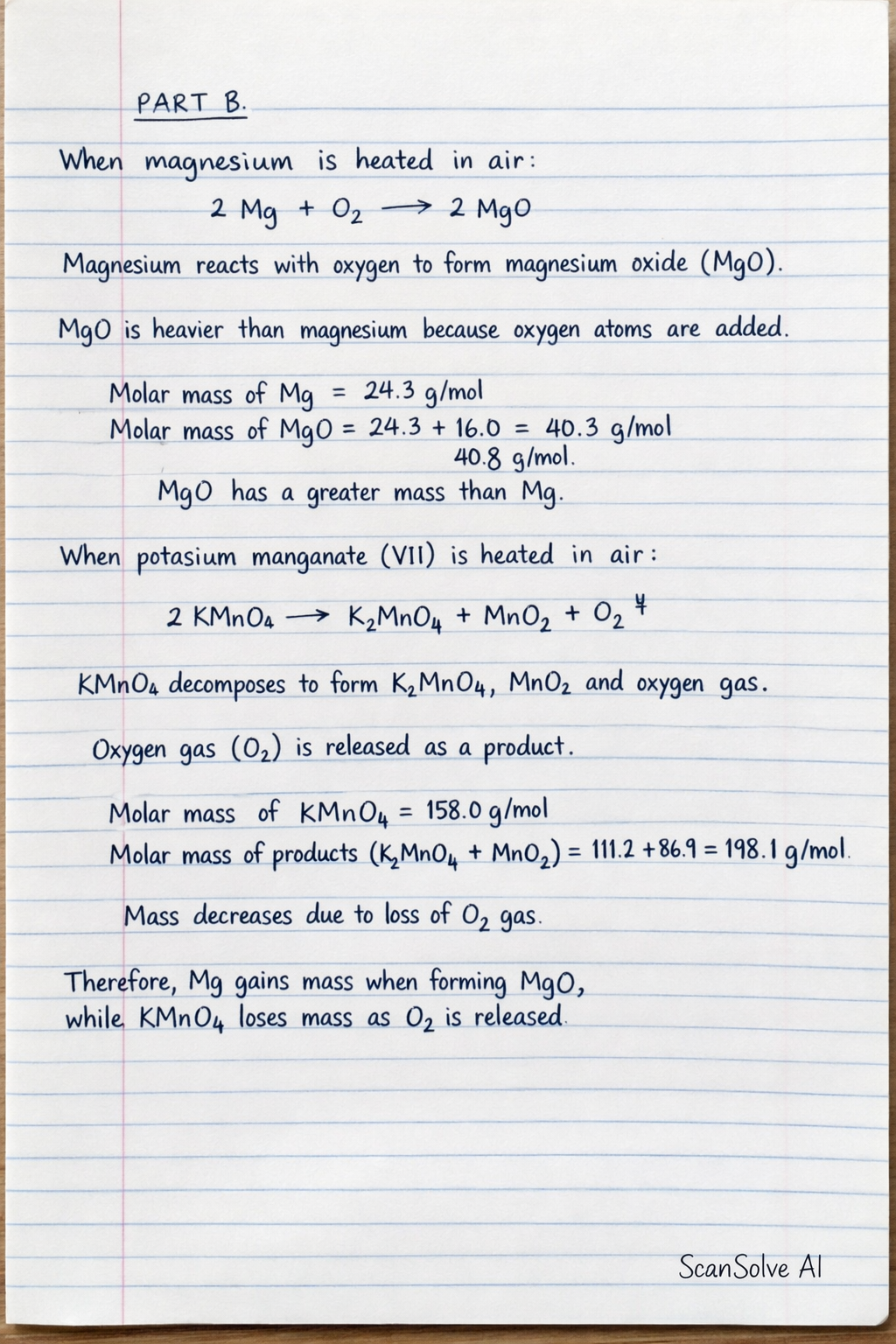
Handwritten Step-by-Step Solution
Get this as a handwritten image on WhatsApp — like a tutor wrote it for you.
Try on WhatsApp