
We read your photo as:
A) State and explain the observations made when burning magnesium is lowered into a glass jar of carbon (IV) oxide. b) Write an equation for the reaction that takes place in (a). 22. Calculate the mol
Chemistry
ScanSolve AI Answer
Answer
b
90.1
Step-by-step solution
5 steps21.
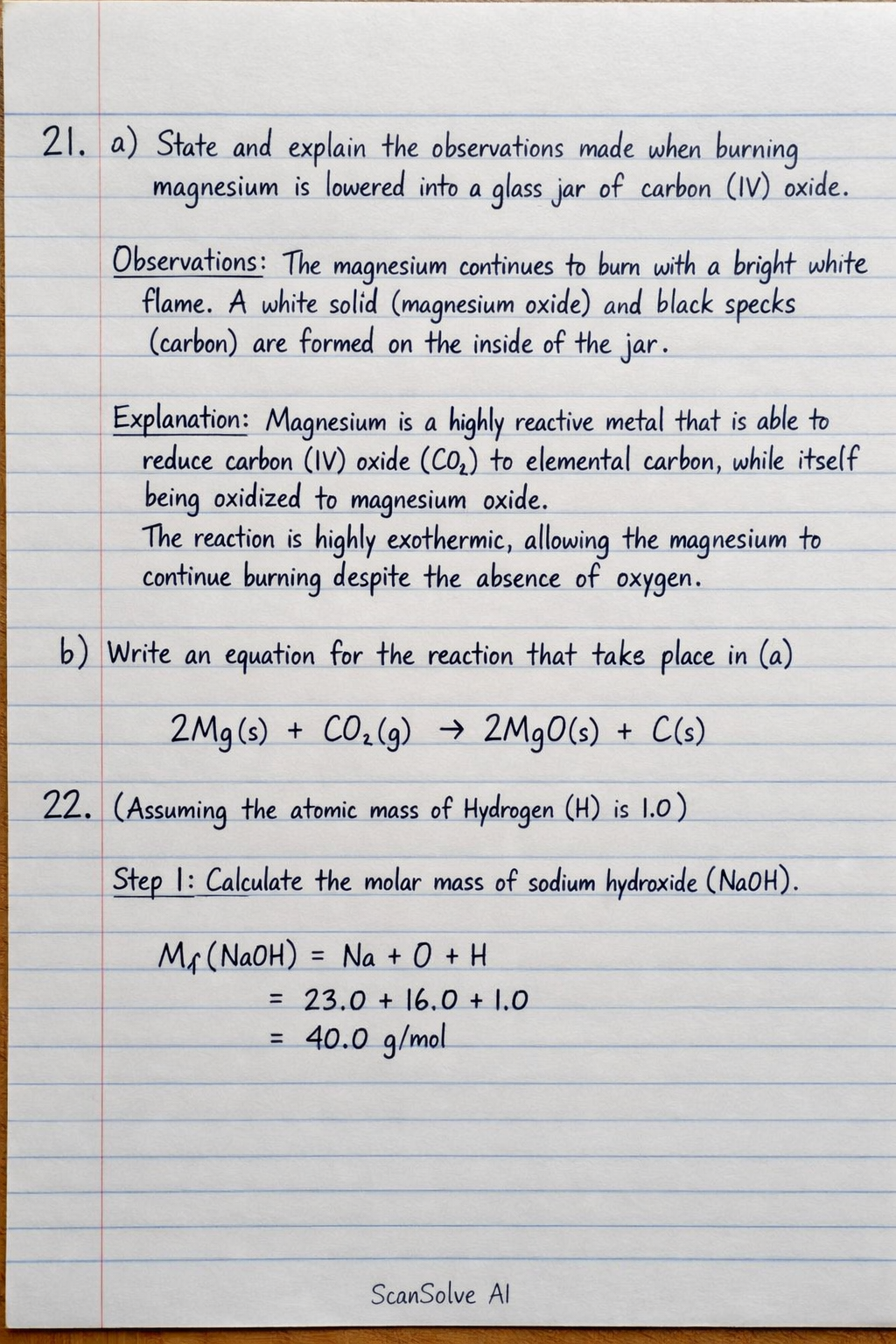
Part a
State and explain the observations made when burning magnesium is lowered into a glass jar of carbon (IV) oxide.
- Observations: The magnesium continues to burn with a bright white flame. A white solid (magnesium oxide) and black specks (carbon) are formed on the inside of the jar.
- Explanation: Magnesium is a highly reactive metal that is able to reduce carbon (IV) oxide () to elemental carbon, while itself being oxidized to magnesium oxide. The reaction is highly exothermic, allowing the magnesium to continue burning despite the absence of oxygen.
Part b90.1
Write an equation for the reaction that takes place in (a)
22.
(Assuming the atomic mass of Hydrogen (H) is 1.0, as H=10. is a likely typo.)
Calculate the molar mass of sodium hydroxide (NaOH).
Calculate the molarity of the sodium hydroxide solution.
The concentration is .
Calculate the moles of sodium hydroxide used.
Volume of NaOH solution .
Determine the moles of the dibasic acid.
A dibasic acid () reacts with sodium hydroxide in a 1:2 mole ratio:
Calculate the relative formula mass of the dibasic acid.
Mass of dibasic acid .
Rounding to three significant figures:
Was this helpful?
Try one yourself
A new problem that tests the same skill.
Still stuck on this one?
Ask a follow-up, and the answer starts from this question.
Got a different question?Ask your own question
More Chemistry Questions
QState and explain two observations made when magnesium ribbon is lowered into a gas jar full of…QExplain why a burning magnesium continues to burn in a gas jar full of carbon (IV) oxide while a…QWhen Magnesium metal is burnt in air, it reacts with both oxygen and nitrogen gases giving a white…QWhen a burning candle is put into a gas jar of sulphur (IV) oxide gas, it goes off but a burning…QCompare the reactivity of calcium and magnesium, provide balanced chemical equations for their…
Handwritten Step-by-Step Solution
Get this as a handwritten image on WhatsApp — like a tutor wrote it for you.
Try on WhatsApp